Options Trading for Beginners: Complete Guide 2026
The financial landscape is ever-evolving, and as we look towards 2026, technological advancements and increased access to sophisticated trading platforms make options more accessible than ever. However, accessibility does not equate to simplicity. The leverage options provide can amplify both gains and losses, making education and disciplined risk management non-negotiable. This article will serve as your definitive roadmap, providing practical insights, data-driven explanations, and references to authoritative sources like the SEC and FINRA, ensuring you build your options trading journey on a robust and informed base. Prepare to delve into the mechanics of options contracts, learn how to interpret options chains, and discover strategies that align with your financial goals and risk tolerance.
The Building Blocks of Options Trading: Calls, Puts, and Core Terminology
At its core, options trading revolves around two fundamental contract types: call options and put options. Understanding these, along with their associated terminology, is the absolute first step for any beginner. An option is a financial contract that gives the buyer the right, but not the obligation, to buy or sell an underlying asset (like a stock, ETF, or index) at a specified price on or before a specific date. Unlike buying or selling shares outright, options contracts derive their value from the underlying asset, offering leverage and flexibility.
Call Options: Betting on Upside Potential
A call option grants the holder the right to buy 100 shares of the underlying asset at a predetermined price, known as the strike price, on or before the expiration date. Investors typically buy call options when they are bullish on an asset, expecting its price to rise significantly above the strike price. For example, if you buy a call option on XYZ stock with a strike price of $50 and the stock rises to $60, you have the right to buy 100 shares at $50, then immediately sell them in the open market for $60, pocketing a profit (minus the premium paid). The appeal of calls lies in their ability to offer substantial upside exposure with a relatively smaller capital outlay compared to buying the actual shares. However, if the stock price does not rise above the strike price before expiration, the call option may expire worthless, and the entire premium paid would be lost.
Put Options: Hedging Against Downside Risk or Speculating on Declines
Conversely, a put option grants the holder the right to sell 100 shares of the underlying asset at a specified strike price on or before the expiration date. Investors typically buy put options when they are bearish on an asset, expecting its price to fall below the strike price, or when they want to protect an existing stock holding from a potential decline. For instance, if you own 100 shares of ABC stock currently trading at $100 and you buy a put option with a $95 strike price, you’ve essentially set a floor for your potential losses. If ABC drops to $80, you can exercise your put option to sell your shares at $95, mitigating a significant portion of the loss. Puts are invaluable tools for risk management, often referred to as “portfolio insurance.”
Strike Price, Expiration Date, and Options Premium
- Strike Price: This is the fixed price at which the underlying asset can be bought (for a call) or sold (for a put) if the option is exercised. It’s a key determinant of whether an option is “in-the-money” or “out-of-the-money.”
- Expiration Date: This is the last day the option contract is valid. After this date, the option becomes worthless if it’s not exercised or closed. Options can have various expiration cycles, from weekly to monthly, quarterly, or even LEAPS (Long-term Equity Anticipation Securities) extending out several years.
- Options Premium: This is the price paid by the buyer to the seller for the option contract. It’s the cost of acquiring the right to buy or sell. The premium is quoted per share, so if an option’s premium is $2.00, a standard contract (representing 100 shares) would cost $200 ($2.00 x 100). This premium is influenced by several factors, which we will explore in the next section. According to FINRA, understanding how premium is calculated is essential for assessing the true cost and potential profitability of an option trade.
Mastering these basic terms is the bedrock upon which all further options knowledge is built. Without a clear grasp of calls, puts, strike prices, expiration dates, and premiums, navigating the options market effectively is impossible.
Decoding Options Pricing: Intrinsic Value, Extrinsic Value, and Implied Volatility
The price you pay for an options contract, known as the options premium, is not a random figure. It is a sophisticated calculation based on several factors, primarily broken down into two components: intrinsic value and extrinsic value. Understanding these components is crucial for determining whether an option is fairly priced and for developing effective trading strategies. The interplay of these values, especially extrinsic value, is where the true dynamics of options pricing come to light.
Intrinsic Value: The “In-the-Money” Component
Intrinsic value is the immediate profit you would make if you exercised the option right now. An option only has intrinsic value if it is “in-the-money” (ITM). If an option is out-of-the-money (OTM) or at-the-money (ATM), its intrinsic value is zero.
- For a Call Option: Intrinsic value = (Underlying Stock Price – Strike Price). This value only exists if the stock price is above the strike price. For example, a $50 strike call on a stock trading at $55 has $5.00 of intrinsic value ($55 – $50).
- For a Put Option: Intrinsic value = (Strike Price – Underlying Stock Price). This value only exists if the stock price is below the strike price. For example, a $50 strike put on a stock trading at $45 has $5.00 of intrinsic value ($50 – $45).
Intrinsic value is straightforward and represents the minimum value an option should trade for.
Extrinsic Value (Time Value): The “Uncertainty” Component
Extrinsic value, also known as time value, is the portion of the option’s premium that exceeds its intrinsic value. It represents the market’s expectation of how likely the option is to become profitable before expiration. Extrinsic value is influenced by several factors, making it the more dynamic part of the options premium:
- Time to Expiration (Theta): The longer an option has until expiration, the greater its extrinsic value. More time means more opportunity for the underlying stock price to move favorably. As an option approaches expiration, its extrinsic value erodes, a phenomenon known as theta decay.
- Implied Volatility (Vega): This is arguably the most significant driver of extrinsic value. Implied volatility (IV) is the market’s forecast of how much the underlying asset’s price is expected to fluctuate in the future. Higher IV means higher uncertainty and thus higher extrinsic value (and higher premiums), as there’s a greater chance for the option to move into the money. Conversely, lower IV leads to lower premiums. Events like earnings announcements or FDA drug approvals often cause a spike in IV.
- Interest Rates (Rho): While less impactful for short-term options, higher interest rates can slightly increase call premiums and decrease put premiums, as the cost of carrying the underlying asset changes. The Federal Reserve’s monetary policy decisions can have a subtle, broad impact here.
- Dividends: Expected dividends can decrease call premiums and increase put premiums, as a dividend payout reduces the stock price by the dividend amount.
The formula for an option’s premium is simple: Premium = Intrinsic Value + Extrinsic Value. If an option has no intrinsic value, its premium is entirely composed of extrinsic value. For instance, a $50 strike call on a stock trading at $48 that costs $3.00 has $0 intrinsic value and $3.00 of extrinsic value. Understanding this breakdown allows traders to assess whether they are paying a fair price for the potential future movement and risk associated with the option.
Key Concepts for Smart Options Trading: ITM, OTM, ATM, and the Greeks
Beyond the basic definitions, successful options trading requires a deeper understanding of how an option’s relationship to the underlying asset’s price impacts its value, and how various market factors influence that value over time. Concepts like In-the-Money (ITM), Out-of-the-Money (OTM), and At-the-Money (ATM) categorize options based on their intrinsic value, while the “Greeks” provide a quantitative measure of an option’s sensitivity to different market variables. Mastering these concepts moves you from merely understanding what an option is to comprehending how it behaves.
In-the-Money (ITM), At-the-Money (ATM), Out-of-the-Money (OTM)
These terms describe the relationship between an option’s strike price and the underlying asset’s current market price:
- In-the-Money (ITM): An option is ITM if it has intrinsic value.
- Call Option: Strike Price < Underlying Stock Price (e.g., $50 strike call, stock at $52).
- Put Option: Strike Price > Underlying Stock Price (e.g., $50 strike put, stock at $48).
ITM options are more expensive because they already have inherent value, and they move more closely in sync with the underlying stock.
- At-the-Money (ATM): An option is ATM if its strike price is equal to or very close to the underlying stock price.
- Call Option: Strike Price ≈ Underlying Stock Price (e.g., $50 strike call, stock at $50).
- Put Option: Strike Price ≈ Underlying Stock Price (e.g., $50 strike put, stock at $50).
ATM options have the highest extrinsic value (time value) because they have the highest probability of moving ITM and benefiting from future price movements.
- Out-of-the-Money (OTM): An option is OTM if it has no intrinsic value.
- Call Option: Strike Price > Underlying Stock Price (e.g., $50 strike call, stock at $48).
- Put Option: Strike Price < Underlying Stock Price (e.g., $50 strike put, stock at $52).
OTM options are generally cheaper as they rely entirely on the underlying stock moving significantly in the desired direction before expiration to become profitable. They carry the highest risk of expiring worthless.
Implied Volatility (IV): The Market’s Expectation of Price Swings
As discussed in the previous section, Implied Volatility (IV) is a forward-looking metric that reflects the market’s expectation of future price fluctuations for the underlying asset. It is not historical volatility, but rather a derived value from the option’s current market price. High IV implies that the market expects large price swings, leading to higher options premiums, while low IV suggests the market expects relatively stable prices, resulting in lower premiums.
For options buyers, high IV is generally a disadvantage because they pay more for the option. If IV drops (a phenomenon called “volatility crush”) after you’ve bought an option, the option’s value can decrease even if the underlying stock price moves favorably. Conversely, options sellers often benefit from high IV, as they receive larger premiums, which then decay as IV normalizes or time passes. Understanding IV is crucial for selecting appropriate strategies; for instance, selling options when IV is high and buying options when IV is low is a common approach for experienced traders.
Theta Decay: The Relentless March of Time
Theta (θ) measures an option’s sensitivity to the passage of time. Specifically, it quantifies how much an option’s premium is expected to decrease each day as it approaches its expiration date, assuming all other factors remain constant. This phenomenon is known as theta decay. Theta is always a negative number for options buyers (meaning the option loses value over time) and a positive number for options sellers (meaning they profit from the option losing value over time).
Theta decay is non-linear; it accelerates significantly as an option gets closer to its expiration date. Options with more time until expiration experience slower theta decay, while options in their final weeks or days lose extrinsic value very rapidly. This makes short-dated options riskier for buyers but potentially more lucrative for sellers. For example, an option might lose $0.05 per day with 60 days to expiration, but $0.20 per day with only 10 days left. This exponential decay is a critical factor for options traders, influencing strategy selection and holding periods. Vanguard’s educational materials often highlight time decay as a key consideration for investors, particularly when comparing options to long-term equity investments.
Brief Mention of Other Greeks: Delta, Gamma, and Vega
While Theta and Vega (related to IV) are often the most impactful for beginners, a brief understanding of Delta and Gamma is also beneficial:
- Delta (Δ): Measures an option’s sensitivity to a $1 change in the underlying stock price. A call option with a delta of 0.50 means its price will increase by $0.50 for every $1 increase in the stock price. For puts, delta is negative.
- Gamma (Γ): Measures the rate of change of an option’s delta with respect to a $1 change in the underlying stock price. It’s often referred to as “delta’s delta.” Higher gamma means delta will change more dramatically with small stock price movements.
These “Greeks” provide a quantitative framework for assessing and managing the various risks associated with options positions, allowing traders to fine-tune their strategies and understand how their positions will react to market movements.
Essential Tools: Decoding Options Chains and Brokerage Platforms
To effectively participate in options trading, you need to understand how to read an options chain and leverage the tools provided by modern brokerage platforms. The options chain is your primary window into the options market, displaying a wealth of information about available contracts. Your brokerage platform, on the other hand, is your command center for analysis, order entry, and portfolio management. Familiarity with both is non-negotiable for navigating the market efficiently.
Understanding the Options Chain: Your Market Map
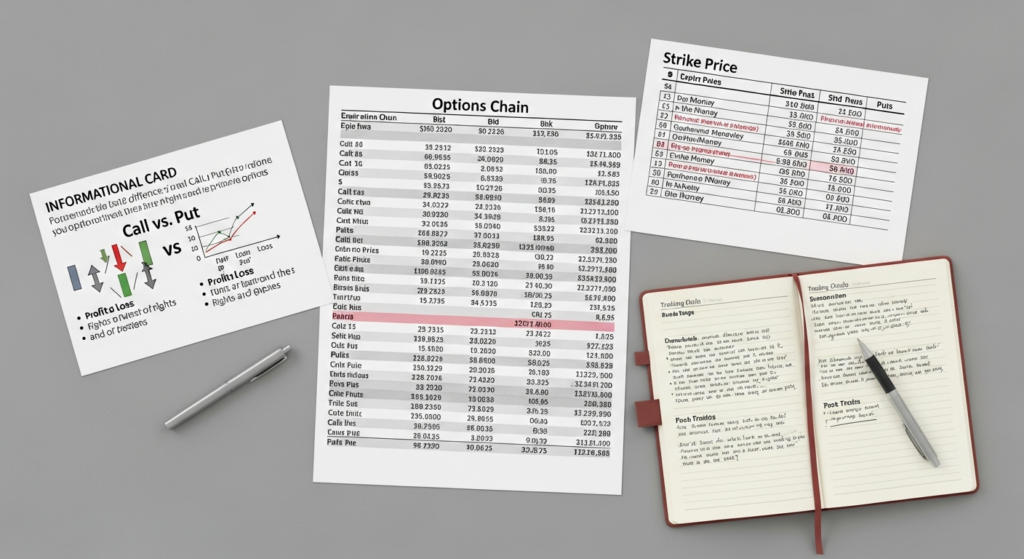
An options chain (also known as an options matrix or options table) is a listing of all available options contracts for a given underlying asset. It typically organizes contracts by expiration date and then by strike price, displaying crucial data for each contract. While the exact layout may vary slightly between brokers, the core information remains consistent:
- Expiration Dates: Usually listed horizontally or in a dropdown menu, showing the various dates when contracts expire (e.g., Jan 26, Feb 23, Mar 22).
- Strike Prices: Listed vertically, typically centered, showing the different prices at which the underlying asset can be bought or sold.
- Call Options Data: Usually on the left side of the strike prices, displaying information for call contracts.
- Put Options Data: Usually on the right side of the strike prices, displaying information for put contracts.
- Key Data Points for Each Contract:
- Last Price: The price at which the option last traded.
- Bid: The highest price a buyer is currently willing to pay for the option.
- Ask (Offer): The lowest price a seller is currently willing to accept for the option.
- Volume: The number of contracts traded during the current trading day. High volume indicates high liquidity.
- Open Interest: The total number of options contracts that are currently open (not yet closed or expired). High open interest suggests significant institutional and retail participation.
- Implied Volatility (IV): The market’s expectation of future price volatility for that specific option. Often shown as a percentage.
- Greeks: Delta, Gamma, Theta, and Vega values for each contract.
When you’re looking to place a trade, you’ll consult the options chain to identify the desired strike price and expiration date. The bid-ask spread is particularly important for beginners; a wide spread indicates lower liquidity and potentially higher trading costs, as you might buy at a higher “ask” and sell at a lower “bid.” For example, if a call option has a bid of $1.50 and an ask of $1.70, the spread is $0.20 per share, or $20 per contract. Trading options with tight bid-ask spreads (e.g., $0.01-$0.05) is generally more cost-effective.
Leveraging Modern Brokerage Platforms
Today’s online brokerage platforms offer a suite of tools designed to facilitate options trading, from basic order entry to advanced analytical features. Reputable platforms like Fidelity, Charles Schwab, Interactive Brokers, and TD Ameritrade (now Schwab) provide:
- Real-time Data: Access to live stock prices, options premiums, and Greek values.
- Options Screeners: Tools to filter options contracts based on criteria like strike price, expiration, IV, and volume.
- Strategy Builders: Interfaces that help you construct multi-leg options strategies and visualize their potential profit/loss profiles.
- Paper Trading Accounts: Virtual trading environments where you can practice options trading with simulated money without risking real capital. This is an invaluable tool for beginners to gain experience and test strategies. FINRA strongly recommends paper trading before live trading.
- Educational Resources: Many brokers offer extensive libraries of articles, videos, and webinars on options trading.
- Advanced Charting Tools: For technical analysis of the underlying asset.
When choosing a platform, consider factors like commission fees (e.g., some brokers charge $0.50-$0.75 per contract, plus a base commission), the quality of their options analysis tools, and the availability of educational resources. For example, Fidelity’s Active Trader Pro and Schwab’s thinkorswim platform are renowned for their comprehensive options analytics and trading capabilities. Utilizing these platforms effectively, combined with a clear understanding of the options chain, empowers you to make informed trading decisions and manage your positions with precision.
Beginner-Friendly Strategies: Income Generation and Portfolio Protection
Once you grasp the fundamentals of options contracts and how to read the market, you can begin exploring basic strategies. For beginners, it’s crucial to start with strategies that have defined risks and clear objectives, focusing on either generating income or protecting existing investments. Two excellent entry-level strategies are the Covered Call and the Protective Put, both of which are foundational for more advanced options trading.
Covered Calls: Generating Income from Owned Shares
The covered call strategy is one of the most popular and relatively conservative options strategies, making it ideal for beginners. It involves selling (or “writing”) a call option against shares of a stock you already own. The “covered” aspect means you own the underlying shares, so if the buyer of the call option decides to exercise their right to buy, you can simply deliver your existing shares, limiting your risk. This strategy is best employed when you have a neutral to moderately bullish outlook on a stock you own, or if you are willing to sell your shares at a slightly higher price.
How it Works:
- Own 100 Shares: You must own at least 100 shares of the underlying stock for each call option contract you sell.
- Sell a Call Option: You sell an out-of-the-money (OTM) call option with an expiration date you choose (e.g., 30-60 days out). The strike price you select should be above the current stock price, representing a price at which you would be comfortable selling your shares.
- Collect Premium: You immediately receive the option premium, which is yours to keep regardless of what happens next. This is your income.
Potential Outcomes:
- Stock Stays Below Strike Price: The option expires worthless. You keep the premium, and you still own your shares. You can then sell another covered call to generate more income.
- Stock Rises Above Strike Price: The option is exercised. You are obligated to sell your 100 shares at the strike price. Your profit is the difference between your purchase price and the strike price, plus the premium collected. Your upside is capped at the strike price plus the premium.
- Stock Falls: You still keep the premium, which helps to offset some of the loss in your stock’s value. However, the premium might not fully cover a significant decline in the stock price.
Example: You own 100 shares of XYZ stock at $50. You sell a $55 strike call option expiring in one month for a premium of $1.50 per share ($150 per contract). If XYZ stays below $55, you keep the $150. If XYZ rises to $58, you sell your shares at $55, making $5 per share from the stock appreciation ($55-$50) plus the $1.50 premium, for a total of $6.50 per share ($650 profit). Your maximum gain is capped at $55 + $1.50 = $56.50 per share.
Protective Puts: Insuring Your Portfolio Against Downturns
A protective put strategy is essentially buying insurance for your stock portfolio. It involves buying a put option on a stock you already own. This strategy is used when you are bullish on a stock long-term but want to protect against potential short-term downturns, similar to how you would buy car insurance. It sets a floor on your potential losses.
How it Works:
- Own 100 Shares: You own at least 100 shares of the underlying stock for each put option contract you buy.
- Buy a Put Option: You buy an out-of-the-money (OTM) or at-the-money (ATM) put option with an expiration date that covers your desired protection period. The strike price you select acts as your “insurance deductible” or the price at which you can sell your shares.
- Pay Premium: You pay the option premium, which is the cost of your insurance.
Potential Outcomes:
- Stock Stays Above Strike Price: The option expires worthless. You lose the premium paid, but your stock has held its value or increased. You’ve paid for protection you didn’t need, similar to car insurance if you don’t have an accident.
- Stock Falls Below Strike Price: The option gains value. You can either sell the put option for a profit (offsetting your stock’s loss) or exercise it to sell your shares at the strike price, protecting your capital from further decline. Your maximum loss is limited to the difference between your purchase price and the put’s strike price, plus the premium paid.
Example: You own 100 shares of ABC stock at $100. You buy a $95 strike put option expiring in three months for a premium of $2.00 per share ($200 per contract). If ABC drops to $80, your put option is now worth at least $15 per share ($95 – $80). You can sell the put for a gain of $15 – $2 = $13 per share ($1300 profit), which helps offset the $20 per share loss on your stock. Your maximum loss on the stock is effectively limited to $5 per share ($100 – $95) plus the $2 premium, totaling $7 per share ($700). Without the put, your loss would be $20 per share ($2000). Protective puts are an excellent risk management tool, especially in volatile markets or before significant news events.
Both covered calls and protective puts are relatively straightforward strategies that allow beginners to gain practical experience with options while managing risk. They represent the income-generating and risk-mitigation aspects of options trading, respectively, providing a solid foundation before exploring more complex multi-leg strategies.
Mitigating Risk and Understanding Regulations in Options Trading
While options trading offers significant opportunities, it also carries substantial risks, largely due to the inherent leverage in these contracts. For beginners, a thorough understanding of risk management principles and the regulatory landscape is just as important as learning the mechanics of calls and puts. Neglecting these aspects can lead to significant financial losses. The SEC and FINRA provide extensive guidance on the risks involved, emphasizing that options are not suitable for all investors.
The Inherent Risks of Options Trading
- Leverage Amplifies Gains and Losses: A single options contract typically controls 100 shares of the underlying stock. This means a small change in the option’s price can lead to a large percentage gain or loss on your invested capital. For example, a $1.00 option premium controlling $100 of stock means a 1% move in the stock can result in a 100% move in the option’s value (if the option is deep OTM and the stock moves enough to make it ITM), or a total loss if the stock moves against you.
- Time Decay (Theta): As