Mastering Trading Psychology for Consistent Profits: The 2026 Strategic Guide
The landscape of retail trading has undergone a massive transformation. As we look toward 2026, the barriers to entry have never been lower. High-speed execution, zero-commission structures, and institutional-grade data are now available to anyone with a smartphone and a modest bankroll. Yet, despite these technological advantages, the vast majority of retail investors continue to struggle. The reason is rarely a lack of technical knowledge or an “inferior” algorithm; it is the human element.
Trading psychology remains the final frontier for the retail investor. While you can automate your entries and minimize your transaction costs, you cannot automate your emotions. Consistency in the markets is not born from a “holy grail” indicator, but from the ability to manage fear, greed, and the biological impulses that lead to account-killing mistakes. This guide explores how to master your mindset to achieve professional-grade results while maintaining a lean, low-cost approach to the markets.
—
The Invisible Barrier: Why Most Retail Traders Fail to Scale
The statistics are often cited but rarely understood: nearly 90% of retail traders lose money over the long term. Many blame the “market makers” or “HFT algorithms,” but the reality is more internal. The biological hardware of the human brain is fundamentally mismatched for the environment of financial speculation.
Our brains are evolved for survival, not for probabilistic assessment. In a survival scenario, a “loss” (like losing food or shelter) can be fatal. Consequently, we are hardwired with **loss aversion**, a psychological phenomenon where the pain of losing is twice as potent as the joy of winning. In trading, this manifests as holding onto losing positions too long in the hope they will break even, while cutting winning trades too early to secure a small “win.”
To scale your trading in 2026, you must recognize that your primary opponent is not the market, but your own reflexive reactions. Retail investors who succeed are those who treat trading as a business of probability rather than a series of emotional events. By minimizing the “cost” of emotional errors—which are far more expensive than any brokerage fee—you pave the way for sustainable equity growth.
Mastering the Emotional Rollercoaster: FOMO, Greed, and Revenge Trading
For the retail trader looking to minimize costs, the most expensive mistakes are often driven by three specific emotional states: FOMO, Greed, and Revenge.
#
Fear of Missing Out (FOMO)
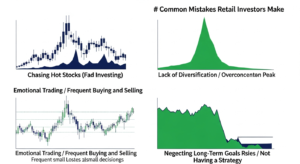
In an era of 24/7 financial news and social media influencers, FOMO is at an all-time high. Seeing a “meme stock” or a cryptocurrency rally 50% in a day triggers a frantic urge to participate. This usually leads to buying at the top—the point of maximum financial risk. A disciplined trader realizes that the market offers thousands of opportunities every year. Missing one is a non-event; chasing one is a potential catastrophe.
#
Greed and Over-Leveraging
Greed often disguises itself as “ambition.” For retail investors with smaller accounts, the temptation to use high leverage to “get rich quick” is overwhelming. However, leverage is a double-edged sword that amplifies emotional volatility just as much as financial volatility. Consistent profits come from steady, incremental gains, not the “one big trade.”
#
Revenge Trading
After a loss, the ego feels bruised. The immediate impulse is to “win it back” by entering a new position with larger size and less due diligence. This is revenge trading. It is the fastest way to blow an account. In 2026, successful traders utilize “cooling-off” periods, stepping away from the screen after a loss to ensure their next decision is based on logic, not a desire for emotional retribution.
Building a Cost-Effective Psychological Framework for 2026
You do not need an expensive therapist or a high-priced “trading coach” to master your mindset. You can build a robust psychological framework using low-cost or free tools.
1. **The Trading Business Plan:** Treat your trading like a lean startup. Document your entry criteria, exit strategy, and maximum risk per trade. Having a written “contract” with yourself reduces the cognitive load during market hours, as you are simply executing a pre-determined plan.
2. **The “Zero-Cost” Meditation:** Mindfulness is frequently cited by elite hedge fund managers as their secret weapon. Spending 10 minutes a day in quiet reflection helps develop “meta-cognition”—the ability to observe your thoughts without acting on them. When you feel the urge to overtrade, mindfulness allows you to see the urge, acknowledge it, and let it pass.
3. **Mechanical Execution:** To remove emotion, many retail investors are moving toward semi-automated systems. By using “if-then” logic and setting OCO (One-Cancels-the-Other) orders, you remove the need to make “gut” decisions in the heat of the moment. This minimizes the psychological friction and ensures you stick to your low-cost strategy.
The Zen of Risk Management: Decoupling Ego from Capital
The secret to psychological stability in trading is realizing that your self-worth is not tied to your P&L (Profit and Loss). Most traders suffer because they view a losing trade as a personal failure or a sign of being “wrong.”
In 2026, professional-grade retail traders view losses as **operating expenses**. Just as a coffee shop owner views the cost of beans as a necessary expense to generate revenue, a trader must view stop-losses as the cost of finding a winning trade.
To achieve this “Zen” state of risk management, you must trade at a size where a loss does not trigger a physical stress response. If your heart races or you feel nauseous when a trade goes against you, your position size is too large. By scaling down to a level that allows for objective decision-making, you preserve your mental capital—which is far more valuable than your financial capital. Remember, the goal of a retail trader is to survive long enough to become proficient.
Cognitive Biases: Rewiring the Brain for Market Realities
To achieve consistent profits, you must actively “debug” your brain’s software. Several cognitive biases specifically target retail investors:
* **Confirmation Bias:** We tend to seek out news and analysis that supports our existing positions while ignoring “red flags.” To counter this, always seek out the “bear case” for your “bullish” trades.
* **Recency Bias:** The tendency to believe that what happened recently will continue to happen. If you’ve had three winning trades in a row, you may feel invincible and increase your risk—right before a market shift.
* **Sunk Cost Fallacy:** This is the tendency to continue investing in a losing position because you have already put so much time or money into it. In the markets, the price does not care where you bought it. Every moment is a new decision: “If I didn’t own this stock right now, would I buy it at this price?” If the answer is no, sell it.
By identifying these biases, you can create “mental circuit breakers” that prevent them from draining your account.
Practical Tools for Maintaining Mental Edge without Expensive Software
You don’t need a Bloomberg Terminal to be a disciplined trader. In fact, many high-cost tools only add to the “noise” that complicates psychological management. Here are the essential low-cost tools for 2026:
* **A Detailed Trading Journal:** This is non-negotiable. Use a simple spreadsheet or a free digital notebook to record not just your entries and exits, but your *emotional state* during the trade. Were you anxious? Distracted? Overconfident? Over time, you will see patterns. You might realize you lose 80% of your trades on Friday afternoons when you are tired. That insight alone can save you thousands.
* **Standardized Checklists:** Create a physical or digital checklist of your rules. Physically checking off boxes before clicking “buy” forces the brain to shift from the emotional limbic system to the logical prefrontal cortex.
* **Routine and Sleep:** The cheapest way to improve your trading performance is a consistent sleep schedule. A sleep-deprived brain is more impulsive and less capable of complex risk assessment.
—
FAQ: Trading Psychology for Consistent Profits
#
1. What is the most important psychological trait for a trader in 2026?
The most important trait is **discipline**—specifically, the ability to stick to a strategy even during a losing streak. In an age of instant gratification, the ability to think long-term and follow a process without immediate rewards is a massive competitive advantage.
#
2. How do I stop “revenge trading” after a big loss?
The best way to stop revenge trading is to implement a “Max Daily Loss” rule. If you lose a certain percentage of your account or hit a certain number of losing trades in one day, your platform should be closed, or you must commit to walking away for 24 hours. This allows your nervous system to return to a baseline state.
#
3. Can trading psychology be learned, or do you have to be born with it?
It is absolutely a learned skill. While some people are naturally more risk-averse or stoic, the “trading brain” is built through repetitive, disciplined practice. It is similar to a muscle; it gets stronger the more you exercise the choice to follow your rules instead of your emotions.
#
4. How does overtrading impact my long-term profitability?
Overtrading is usually a psychological symptom of boredom or a need for “action.” Financially, it is devastating because it increases your transaction costs and exposure to market noise. By waiting for high-probability setups, you minimize costs and maximize the mental energy you can give to each trade.
#
5. Why do I perform well in a demo account but lose money in a live account?
In a demo account, there is no “fear of loss” because the money isn’t real. When real capital is at stake, your survival instincts kick in, leading to the biases mentioned earlier. The solution is to start with very small “live” positions—amounts so small they feel like “play money”—and slowly increase size as your psychological comfort grows.
—
Conclusion: The Path to Mastery in 2026
As we navigate the markets of 2026, the retail investor’s greatest asset is not their computer’s processing power, but their mental fortitude. Technology has leveled the playing field in terms of execution and cost, leaving psychology as the primary differentiator between those who churn through their savings and those who build lasting wealth.
Consistent profits are the byproduct of a consistent process. By understanding your biological biases, managing your emotional state through low-cost mindfulness and journaling, and decoupling your ego from the outcome of any single trade, you transform trading from a stressful gamble into a disciplined profession.
The journey to psychological mastery is not a destination but a continuous practice. It requires the humility to admit when you are wrong and the courage to stay the course when your system is in a temporary drawdown. In the high-stakes world of 2026 trading, the most profitable tool you will ever own is a calm, disciplined mind. Invest in it more than any software, and the markets will eventually reward you with the consistency you seek.