

Building Your Financial Fortress: Budgeting, Saving, and Emergency Funds
The cornerstone of any successful financial plan, regardless of age, is a meticulously crafted budget and a disciplined approach to saving. For young adults, this initial step is particularly critical as it establishes habits that will define your financial trajectory. Without a clear understanding of where your money comes from and, more importantly, where it goes, achieving financial goals becomes akin to navigating a ship without a compass.
Understanding Your Cash Flow: The Budgeting Imperative
Budgeting isn’t about deprivation; it’s about empowerment. It’s a tool that grants you visibility into your financial life, allowing you to make conscious choices about spending and saving. Start by tracking every dollar. This can be done manually with a spreadsheet, through budgeting apps, or even via your bank’s online tools. Categorize your expenses into fixed (rent, loan payments, subscriptions) and variable (groceries, entertainment, dining out). Once you have a clear picture, you can begin to allocate your income strategically. A popular method is the 50/30/20 rule: 50% of your income for needs, 30% for wants, and 20% for savings and debt repayment. Experiment to find a system that works for you, but the key is consistency.
For young adults, income streams might fluctuate, especially for freelancers or those in early career stages. In such cases, creating a “zero-based budget” where every dollar is assigned a job can be incredibly effective. This means if you earn $2,000, you allocate all $2,000 to expenses, savings, and debt, ensuring no money is left unaccounted for. This proactive approach prevents impulsive spending and reinforces financial discipline.
The Non-Negotiable Emergency Fund
Once your budget is in place, the very next priority should be building an emergency fund. Life is unpredictable, and unexpected expenses – a sudden job loss, a medical emergency, car repairs – can derail even the best-laid financial plans. An emergency fund acts as your financial safety net, preventing you from resorting to high-interest debt (like credit cards) when crises strike. Aim to save at least three to six months’ worth of essential living expenses in a readily accessible, high-yield savings account. For young adults just starting out, even saving $500 to $1,000 as a mini-emergency fund is an excellent first step, providing a buffer against smaller, more frequent financial bumps.
Automating your savings is perhaps the most powerful strategy for building both your emergency fund and other savings goals. Set up automatic transfers from your checking account to your savings account immediately after each paycheck. Treat these transfers like a non-negotiable bill. Out of sight, out of mind – and into your future financial security.
Furthermore, consider leveraging any unexpected windfalls – a tax refund, a bonus, or a monetary gift – by directing a significant portion, if not all, of it towards your emergency fund. This accelerates your progress and strengthens your financial resilience.
Conquering Debt: Strategies for Financial Freedom, Especially from Credit Cards
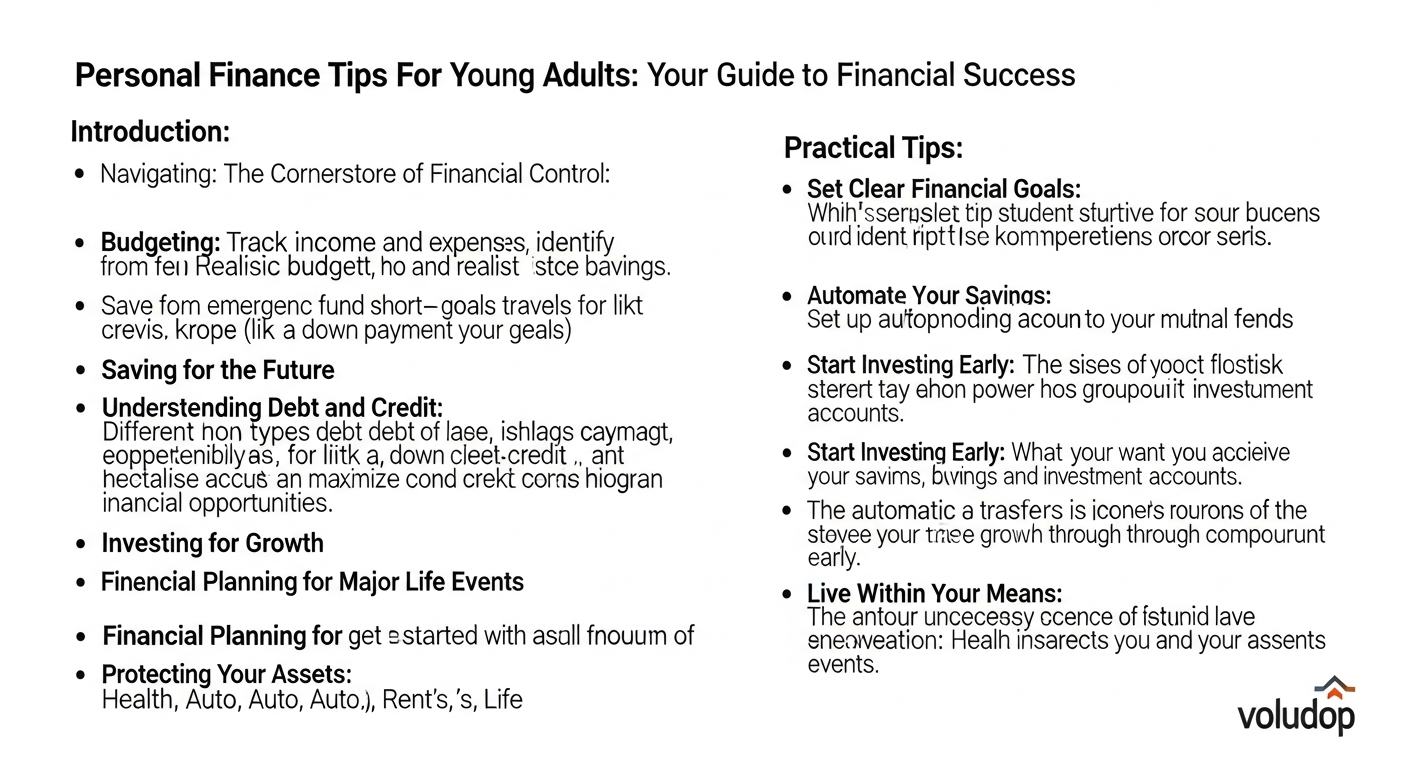
Debt, particularly high-interest consumer debt, can be a formidable obstacle to financial independence for young adults. While some debt, like student loans or a mortgage, can be a necessary investment in your future, revolving credit card debt often carries crippling interest rates that can trap individuals in a cycle of minimum payments and mounting balances. Understanding different types of debt and developing a clear strategy to manage and eliminate it is paramount.
Distinguishing Good Debt from Bad Debt
Not all debt is created equal. Good debt is typically an investment that has the potential to increase your net worth or future income. Examples include student loans (investing in education), a mortgage (building equity in a home), or a small business loan (generating income). These often have lower interest rates and provide a tangible return.
Bad debt, on the other hand, is typically incurred for depreciating assets or consumption, offering no future return. Credit card debt, personal loans taken for discretionary spending, and payday loans fall into this category. These debts often carry exorbitant interest rates, making them incredibly difficult to pay off.
The Insidious Trap of Credit Card Debt
For young adults, credit cards can be a double-edged sword. Used responsibly, they build credit history, offer rewards, and provide convenience. Used irresponsibly, they can quickly lead to overwhelming debt. The allure of instant gratification combined with a lack of understanding of compounding interest can lead to balances that spiral out of control. Minimum payments often barely cover the interest, meaning your principal balance hardly decreases, and you end up paying significantly more than the original purchase price over time.
If you find yourself burdened by credit card debt, taking immediate and decisive action is crucial. As highlighted in resources like “How To Get Out Credit Card Debt,” there are proven strategies to tackle this challenge head-on:
- Stop accruing new debt: Cut up or freeze your credit cards if necessary. Focus entirely on paying down existing balances.
- Debt Snowball Method: List your debts from smallest balance to largest. Pay the minimum on all debts except the smallest, which you attack with all extra available funds. Once the smallest is paid off, roll that payment amount into the next smallest debt, creating a “snowball” effect. This method provides psychological wins and builds momentum.
- Debt Avalanche Method: List your debts from highest interest rate to lowest. Pay the minimum on all debts except the one with the highest interest rate, which you aggressively pay down. Once that’s cleared, move to the next highest. This method saves you the most money in interest over the long run.
- Consolidation or Balance Transfers: If you have good credit, consider consolidating multiple credit card debts into a single personal loan with a lower interest rate, or transferring balances to a new card offering a 0% introductory APR. Be extremely cautious with balance transfers; ensure you can pay off the full amount before the promotional period ends, otherwise, you could face deferred interest or higher rates.
- Negotiate with Creditors: Sometimes, credit card companies are willing to work with you, especially if you’re struggling. They might offer a lower interest rate or a payment plan. It never hurts to ask.
The goal is to eliminate high-interest debt as quickly as possible, freeing up your income to build wealth rather than service debt.
Building and Maintaining Good Credit
Beyond debt repayment, understanding how to build and maintain good credit is vital for young adults. Your credit score impacts everything from apartment rentals and car loans to insurance premiums and even employment opportunities. Key factors influencing your credit score include:
- Payment History: Pay all your bills on time, every time. This is the most significant factor.
- Credit Utilization: Keep your credit card balances low relative to your credit limits (ideally below 30%).
- Length of Credit History: The longer your accounts have been open and in good standing, the better.
- New Credit: Avoid opening too many new credit accounts in a short period.
- Credit Mix: A healthy mix of different credit types (e.g., credit cards, student loans, auto loans) can be beneficial, but don’t take out loans you don’t need just to diversify.
Start by getting one credit card and using it responsibly for small, manageable purchases that you pay off in full every month. This demonstrates your ability to handle credit wisely, paving the way for larger financial opportunities in the future.
The Power of Early Investing: Starting Small, Thinking Big (Even in 2026)
Understanding Compound Interest: Your Wealth-Building Ally
Compound interest is often referred to as the “eighth wonder of the world.” It’s the process where your investment earnings themselves earn returns. Imagine earning interest not just on your initial principal but also on the accumulated interest from previous periods. This exponential growth is why starting early is so crucial. A dollar invested today has significantly more time to compound than a dollar invested a decade from now.
Accessible Investment Options for Young Adults (How To Start Investing Little Money 2026)
The good news is that in 2026, investing is more accessible than ever, even if you’re looking for “How To Start Investing Little Money 2026.” You don’t need a financial advisor or a hefty sum to begin. Here are excellent entry points:
- Employer-Sponsored Retirement Plans (401(k), 403(b)): If your employer offers a retirement plan, especially one with a matching contribution, contributing is a no-brainer. An employer match is essentially free money – a 100% return on your investment from day one. At a minimum, contribute enough to get the full match. These contributions are often pre-tax, reducing your taxable income now.
- Roth IRA: A Roth IRA is a fantastic option for young adults. You contribute after-tax money, and your investments grow tax-free, meaning qualified withdrawals in retirement are completely tax-free. Given that many young adults are in lower tax brackets now than they might be in the future, paying taxes on contributions today can be highly advantageous. You can open a Roth IRA with most brokerage firms and start with very small amounts, often with no minimum.
- Robo-Advisors: Services like Betterment, Wealthfront, and Fidelity Go are perfect for beginner investors. They manage your investments based on your risk tolerance and financial goals, using low-cost diversified portfolios of exchange-traded funds (ETFs). They offer automated investing, rebalancing, and tax-loss harvesting, all for a low annual fee. This is an excellent way to get started with professional management without needing a large initial sum.
- Exchange-Traded Funds (ETFs) and Index Funds: These are ideal for diversification and low cost. Instead of buying individual stocks, an ETF or index fund allows you to invest in a basket of many stocks (or bonds) at once, often tracking a specific market index like the S&P 500. This provides broad market exposure and reduces the risk associated with individual stock picking. Many brokerages allow you to buy fractional shares of ETFs, meaning you can invest with just a few dollars.
- Fractional Shares of Stocks: Many investment platforms now allow you to buy fractions of individual shares. Instead of needing $1,000 to buy a full share of a high-priced stock, you can invest $100 and own a tenth of that share. This lowers the barrier to entry for investing in companies you believe in.
Risk Tolerance and Diversification
As a young investor, you typically have a longer time horizon, which allows you to take on a bit more risk. Historically, equities (stocks) have outperformed bonds and cash over the long term. A diversified portfolio, spread across different asset classes, industries, and geographies, is crucial to mitigate risk. While past performance is no guarantee of future results, a well-diversified portfolio helps cushion the impact if one particular investment performs poorly.
Regularly review your investment portfolio, but avoid making emotional decisions based on short-term market fluctuations. Investing is a marathon, not a sprint. Stick to your long-term plan and continue to contribute consistently.
Beyond the Basics: Exploring Advanced Investment Avenues (with Caution)

Once you’ve established a solid financial foundation – a robust budget, a healthy emergency fund, and consistent contributions to diversified, long-term investment vehicles – you might find yourself curious about more sophisticated investment strategies. While the core tenets of personal finance for young adults revolve around steady growth and risk management, understanding the broader investment landscape can broaden your horizons. However, it’s crucial to approach these advanced avenues with significant caution, recognizing their inherent complexities and higher risk profiles.
Individual Stocks and Sector-Specific Investments
Many young investors are drawn to the idea of picking individual stocks, hoping to find the next big winner. While individual stock picking can offer higher potential returns, it also carries substantially higher risk compared to diversified index funds or ETFs. Researching individual companies requires significant time, effort, and a deep understanding of financial statements, market trends, and industry dynamics. For those interested, starting with a small portion of your portfolio (e.g., 5-10% after your core investments are solid) and focusing on companies you understand well can be a cautious approach.
Similarly, sector-specific ETFs or thematic investments (e.g., clean energy, artificial intelligence) can offer targeted exposure to high-growth areas. While these can provide excellent returns, they are also more volatile than broad market indices. Diversification within these sectors and understanding the underlying economic drivers are key.
Real Estate and Alternative Investments
Beyond traditional stocks and bonds, real estate often comes to mind as a wealth-building asset. For young adults, direct property ownership might be out of reach initially, but real estate investment trusts (REITs) offer a way to invest in real estate without buying physical property. REITs are companies that own, operate, or finance income-producing real estate and are traded like stocks on major exchanges. They offer diversification and often provide strong dividend yields.
Other alternative investments, such as peer-to-peer lending, crowdfunding, or even commodities, exist, but they generally require even more specialized knowledge and often come with illiquidity and higher risk. These should only be considered by experienced investors with a well-funded, diversified core portfolio.
Understanding Options Trading: A Word of Caution for Beginners
As your financial literacy grows, you might encounter discussions about options trading. Options are financial derivatives that give the buyer the right, but not the obligation, to buy or sell an underlying asset (like a stock) at a specified price on or before a certain date. They can be used for speculation, income generation, or hedging existing positions.
However, it is imperative to understand that options trading is a highly complex and speculative strategy, generally unsuitable for most young adults and beginner investors. The potential for rapid and substantial losses is significant, and it requires a deep understanding of market dynamics, volatility, time decay, and various intricate strategies. Many experienced traders lose money in options. For this reason, resources like an “Options Trading Beginners Guide” should be approached with extreme caution and only after you have a robust understanding of fundamental investing principles, a fully funded emergency fund, and a long-term investment portfolio firmly in place. It is not a get-rich-quick scheme, and it can quickly deplete your capital if not executed with expert knowledge and careful risk management.
Our recommendation for young adults is to master the fundamentals of long-term, diversified investing before even considering venturing into the highly speculative world of options. Focus on building wealth steadily through proven methods rather than risking your hard-earned capital on complex, high-stakes strategies.
Protecting Your Future: Insurance and Estate Planning Basics
While often overlooked by young adults, safeguarding your financial future extends beyond just saving and investing. Comprehensive financial planning also involves protecting yourself and your assets against unforeseen circumstances through appropriate insurance coverage and ensuring your wishes are honored through basic estate planning. These protective measures are not just for the elderly or the wealthy; they are fundamental components of a responsible personal finance strategy for everyone, including young adults.
Essential Insurance Coverage
Insurance acts as a financial safety net, mitigating the impact of unexpected events that could otherwise devastate your financial stability. For young adults, several types of insurance are particularly crucial:
- Health Insurance: This is arguably the most critical insurance for anyone. A single major medical event can lead to astronomical bills that can wipe out savings and create significant debt. Whether through an employer, a parent’s plan (until age 26), or the Health Insurance Marketplace, securing adequate health insurance is non-negotiable. Understand your deductible, out-of-pocket maximum, and network to make the most of your coverage.
- Auto Insurance: If you own or drive a car, auto insurance is legally required in most places. Beyond legal compliance, it protects you financially in case of an accident, covering damages to your vehicle, other vehicles, and medical expenses for injuries. Shop around for competitive rates and understand the different types of coverage (liability, collision, comprehensive, uninsured motorist).
- Renter’s Insurance: If you rent an apartment or house, renter’s insurance is an affordable way to protect your personal belongings from theft, fire, or other covered perils. Your landlord’s insurance covers the building structure, but not your personal items. It also often includes liability coverage if someone is injured in your rented space.
- Disability Insurance: Your ability to earn an income is your most valuable asset. If you become sick or injured and cannot work, disability insurance replaces a portion of your income. Many employers offer short-term and long-term disability benefits, but if not, consider purchasing an individual policy, especially if you have dependents or significant financial obligations.
- Life Insurance (Conditional): For most young adults without dependents or significant shared debt (like a mortgage with a spouse), term life insurance might not be an immediate necessity. However, if you have a spouse, children, or co-signed loans with parents (e.g., private student loans), life insurance becomes vital to protect those who rely on your income. Term life is generally recommended as it’s affordable and covers you for a specific period.
When selecting insurance, always compare quotes from multiple providers, understand the policy’s terms and conditions, and ensure the coverage aligns with your specific needs and risk profile. Don’t simply opt for the cheapest option; prioritize adequate protection.
Basic Estate Planning: It’s Not Just for the Elderly
The term “estate planning” often conjures images of complex trusts and wills for the wealthy, but basic estate planning is essential for everyone, including young adults. It’s about ensuring your wishes are respected and your loved ones are protected, even if you don’t have extensive assets.
- Will: A simple will dictates how your assets (even if modest) will be distributed upon your death and, crucially, names a guardian for any minor children you might have. Without a will, state laws will determine how your assets are divided, which might not align with your wishes.
- Power of Attorney (POA): This document grants someone you trust the authority to make financial and/or medical decisions on your behalf if you become incapacitated and unable to do so yourself. A Durable Power of Attorney for Finances allows someone to manage your money and property, while a Healthcare Power of Attorney (or Advance Directive) lets them make medical decisions. These are invaluable in preventing legal complications and ensuring your care preferences are followed.
- Beneficiary Designations: For accounts like retirement plans (401(k), IRA) and life insurance policies, beneficiary designations supersede your will. Ensure these are up-to-date and accurately reflect who you wish to receive these assets. Regularly review them, especially after major life events like marriage, divorce, or the birth of a child.
While the prospect of planning for incapacity or death can be uncomfortable, taking these basic steps provides peace of mind and significantly eases the burden on your loved ones during difficult times. Many online services offer affordable ways to create these documents, or you can consult with an attorney for more personalized advice.
Continuous Learning, Adaptability, and Professional Guidance
The financial world is dynamic, constantly evolving with new products, regulations, and economic shifts. For young adults, the journey of personal finance is not a one-time task but an ongoing commitment to learning, adapting, and refining strategies. Cultivating financial literacy is an investment in yourself that pays dividends throughout your lifetime, allowing you to navigate change with confidence and capitalize on opportunities.
Embrace Lifelong Financial Learning
The information presented in this guide is a strong starting point, but it’s by no means exhaustive. Make a habit of seeking out reliable financial information from reputable sources. Read books, follow trusted financial blogs (like Trading Costs!), listen to podcasts, and take advantage of educational resources offered by financial institutions. Understanding concepts like inflation, macroeconomic trends, tax implications, and different investment vehicles will empower you to make increasingly sophisticated decisions.
Stay informed about changes in tax laws, retirement account limits, and investment product innovations. The more you understand, the better equipped you’ll be to optimize your financial plan and avoid common pitfalls.
Adaptability: Your Financial Superpower
Life is full of unexpected twists and turns – career changes, marriage, starting a family, buying a home, or even economic downturns. Your financial plan should not be a rigid blueprint but a flexible framework that can adapt to these significant life events. What was appropriate for you financially at age 22 might not be at age 30 or 40. Regularly review your budget, savings goals, investment allocations, and insurance coverage. We recommend a comprehensive financial check-up at least once a year, or whenever a major life event occurs.
For instance, if you get a significant raise, update your budget to reflect your new income, ensuring a portion of it goes directly to increased savings and investments rather than lifestyle creep. If you get married, integrate your financial plans with your partner’s, discussing goals, debts, and investment strategies. If you face a job loss, having an emergency fund and a well-thought-out budget will allow you to weather the storm more effectively.
When to Seek Professional Guidance
While self-education is powerful, there will be times when professional guidance can be invaluable. A certified financial planner (CFP) can help you create a comprehensive financial plan tailored to your specific goals, risk tolerance, and life situation. They can assist with complex investment strategies, retirement planning, tax planning, and estate planning, offering an objective perspective and expert advice. Look for fee-only fiduciaries who are legally obligated to act in your best interest.
You might also consider consulting with:
- Tax Professionals: For complex tax situations, deductions, or business income.
- Estate Attorneys: For drafting wills, trusts, and powers of attorney, especially as your assets or family situation become more complex.
- Debt Counselors: If you find yourself overwhelmed by debt and need structured guidance beyond what you can manage alone.
Remember, seeking professional help is a sign of strength and smart financial management, not a weakness. It ensures you have expert support when navigating critical financial decisions.
In conclusion, personal finance for young adults is a journey of continuous learning, disciplined action, and strategic planning. By prioritizing budgeting and saving, aggressively tackling debt, embracing early and consistent investing, protecting yourself with appropriate insurance, and staying adaptable, you are not just managing money – you are actively shaping a future of financial security, independence, and opportunity. The time to start building that future is now.
Frequently Asked Questions
Recommended Resources
Explore Open Banking Explained for additional insights.
Learn more about this topic in How To Choose The Right Business Software at Kacerr.