The Ultimate Guide to Automated Trading Bots for Retail Investors in 2026
The landscape of global finance has undergone a seismic shift. Gone are the days when high-frequency trading and sophisticated algorithmic strategies were the exclusive playground of Wall Street hedge funds and institutional giants. As we move through 2026, the democratization of financial technology has placed immense power directly into the hands of the retail investor. Automated trading bots—software programs that execute trades based on pre-defined criteria—have become the cornerstone of the modern individual’s investment portfolio. For the retail trader, these tools are no longer a luxury; they are a necessity for staying competitive in a 24/7 market.
The primary appeal of automated trading lies in its ability to eliminate the two biggest hurdles to retail success: human emotion and time constraints. By leveraging automation, investors can execute high-precision strategies without staring at screens for twelve hours a day. More importantly, in an era where inflation and market volatility remain persistent, the focus has shifted toward minimizing costs and maximizing efficiency. This guide explores how retail investors can utilize automated trading bots to build wealth, manage risk, and drastically reduce the overhead associated with active trading.
—
What Are Automated Trading Bots and Why Do Retail Investors Need Them?
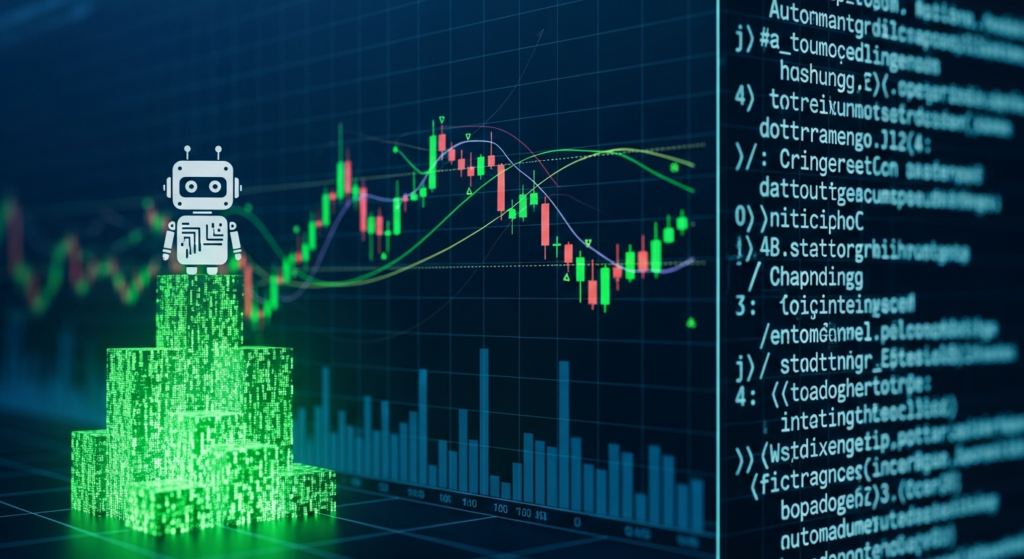
At its core, an automated trading bot is a set of code—an algorithm—that monitors market price action and executes buy or sell orders when specific conditions are met. These conditions can be as simple as “buy when the price hits a certain level” or as complex as “buy when the 50-day moving average crosses the 200-day moving average while the Relative Strength Index (RSI) is below 30.”
For the retail investor, the “why” is simple: efficiency. Human beings are fundamentally ill-equipped for the stresses of rapid market fluctuations. We suffer from “FOMO” (fear of missing out), we panic-sell during minor corrections, and we often hesitate when a perfect entry point presents itself. A bot has no such weaknesses. It executes the plan with surgical precision, 24 hours a day, across multiple asset classes including stocks, forex, and cryptocurrency.
Furthermore, the 2026 market environment is faster than ever. With the integration of AI-driven news feeds and global economic shifts happening in seconds, manual trading is becoming increasingly obsolete for those looking to capture short-to-medium-term gains. Retail investors need bots to bridge the gap between their daily lives and the non-stop heartbeat of the global economy.
—
The Financial Advantage: Minimizing Costs with Algorithmic Trading
For the cost-conscious retail investor, the “hidden” expenses of trading are often the biggest drain on a portfolio. Automated trading bots are specifically designed to tackle these costs, which include slippage, emotional errors, and the “opportunity cost” of lost time.
#
1. Eliminating the “Emotional Tax”
The most expensive mistake a trader can make is an emotional one. Revenge trading—trying to “win back” money after a loss—can lead to account liquidation. By delegating execution to a bot, you remove the psychological burden. The bot follows the math, not the mood. This consistency preserves capital over the long term.
#
2. Reducing Slippage
Slippage occurs when there is a delay between a trader deciding to buy and the actual execution of the order, resulting in a less favorable price. Bots operate at millisecond speeds. In 2026, where liquidity can shift in the blink of an eye, the ability of a bot to hit a “limit order” or execute a “market order” instantly saves the retail investor significant percentages over hundreds of trades.
#
3. Lowering Management Fees
Traditional wealth management often comes with 1% to 2% annual fees, plus performance incentives. By using a low-cost or open-source trading bot platform, retail investors can run sophisticated strategies for a fraction of the cost—often just a small monthly subscription or a tiny percentage of successful trades. This “fee compression” allows more of the compound interest to stay in the investor’s pocket.
—
Types of Automated Trading Strategies for Modern Investors
Not all bots are created equal. Depending on your risk tolerance and market outlook, you might choose one of several prevailing strategies that have dominated the 2026 retail landscape.
#
Trend Following (Momentum)
This is the most common strategy. The bot identifies a clear upward or downward trend using indicators like Moving Averages or the MACD. It buys when the trend is confirmed and sells when the trend shows signs of reversal. This is highly effective in trending markets and requires minimal intervention.
#
Grid Trading
Grid trading is a favorite for the crypto and forex markets, which often move sideways. The bot places a “grid” of buy and sell orders at regular intervals above and below a set price. As the price fluctuates, the bot “harvests” small profits repeatedly. This strategy thrives on volatility and turns “boring” market movements into a steady stream of income.
#
Arbitrage
Arbitrage bots look for price discrepancies for the same asset across different exchanges. For example, if Bitcoin is trading for $500 less on Exchange A than on Exchange B, the bot buys on A and sells on B simultaneously. While the margins are thin, for retail investors with the right software, this represents a low-risk way to grow a balance.
#
Mean Reversion
Based on the theory that prices eventually return to their historical average, these bots “short” assets that are overextended and “long” assets that have dropped too far too fast. In 2026, AI-enhanced mean reversion bots are particularly adept at identifying when a market has “overreacted” to news.
—
How to Choose the Right Trading Bot Platform in 2026
With the explosion of the “FinTech” sector, there are now hundreds of bot providers. Choosing the wrong one can be a costly mistake. For a retail investor focused on cost-minimization and security, the following criteria are non-negotiable:
**1. Security and API Integration:**
Never give a bot platform direct access to your funds. Modern bots use API keys. Ensure the platform allows you to “restrict withdrawal permissions.” This means the bot can trade your funds on an exchange like Binance or E*TRADE, but it cannot move those funds to an outside wallet.
**2. Backtesting Capabilities:**
Before risking a single dollar, you must know how your strategy would have performed in the past. A high-quality platform provides “backtesting” tools that simulate your bot’s performance against historical data. If a platform doesn’t offer robust backtesting, walk away.
**3. Transparency in Pricing:**
Avoid platforms with hidden “per-trade” commissions that eat into your margins. Look for flat-fee monthly subscriptions or “freemium” models that allow you to test one or two bots for free before scaling up.
**4. User Interface (UI) vs. Customization:**
If you are not a coder, look for “No-Code” platforms that offer “drag-and-drop” strategy builders. If you have programming skills, look for platforms that support Python or Pine Script for deeper customization.
—
Risk Management: Protecting Your Capital in an Automated World
Automation is not a “magic money printer.” It is a tool, and like any tool, it can be dangerous if used improperly. Retail investors must implement strict risk management protocols to ensure a market flash crash doesn’t wipe them out.
* **The 1% Rule:** Never allow a single trade to risk more than 1% of your total account balance. Most advanced bots allow you to set this as a hard limit.
* **Stop-Loss Orders:** This is the most critical component of automated trading. A stop-loss automatically closes a position if the price drops below a certain point, preventing a small loss from becoming a catastrophic one.
* **Diversification:** Do not put all your capital into one bot or one strategy. Run a trend-following bot on stocks and a grid-trading bot on stablecoins. If one market underperforms, the other can provide a hedge.
* **Regular Monitoring:** “Set and forget” is a myth. Markets change. A strategy that worked in a bull market will fail in a bear market. Investors should review their bot’s performance weekly to ensure the underlying logic still holds true in the current economic climate.
—
The Future: AI and Machine Learning in Retail Trading Bots
As we look toward the remainder of 2026 and beyond, the integration of Artificial Intelligence (AI) is the next frontier. Traditional bots follow “if-then” logic. However, the new generation of AI-driven bots utilizes Machine Learning (ML) to adapt to changing market conditions.
These bots can perform “Sentiment Analysis,” scanning social media, news headlines, and earnings reports in real-time to gauge market mood. If an unexpected geopolitical event occurs, an AI bot can recognize the shift in sentiment and pause its trading or pivot its strategy faster than any human could.
For the retail investor, this means access to “predictive analytics” that were once reserved for the elite. The cost of these AI tools is dropping rapidly, making it possible for an individual with a $5,000 account to utilize the same analytical power as a multi-billion dollar fund. This leveling of the playing field is the true legacy of the 2026 automated trading revolution.
—
Frequently Asked Questions (FAQ)
#
1. Are automated trading bots legal for retail investors?
Yes, trading bots are perfectly legal in most global jurisdictions, including the US, UK, and EU. They are simply tools used to execute trades on regulated exchanges. However, always ensure you are using a reputable platform that complies with local financial regulations.
#
2. How much money do I need to start using a trading bot?
One of the best things about the 2026 trading environment is the low barrier to entry. Many platforms allow you to start with as little as $100 to $500. The key is to start small, test your strategy, and only increase your capital once you see consistent, automated results.
#
3. Do I need to know how to code to use a trading bot?
Not at all. While coding knowledge (like Python) can help for custom strategies, most modern “Bot-as-a-Service” (BaaS) platforms offer user-friendly interfaces, pre-built templates, and “copy trading” features where you can mirror the bots of successful professional traders.
#
4. Can a trading bot lose all my money?
Like any investment, there is risk. A poorly configured bot or a strategy without a stop-loss can lead to significant losses. This is why backtesting and risk management are vital. A bot will only do exactly what you tell it to do—if you give it a bad strategy, it will execute that bad strategy perfectly.
#
5. What are the best assets for automated trading?
Bots work best in markets with high liquidity and volatility. This makes cryptocurrencies (Bitcoin, Ethereum), Major Forex pairs (EUR/USD), and highly traded ETFs or tech stocks (like those in the Nasdaq-100) ideal candidates for automated strategies.
—
Conclusion: Embracing the Algorithmic Future
The rise of automated trading bots represents the ultimate democratization of finance. For the retail investor, the ability to minimize costs, eliminate emotional bias, and trade 24/7 is a game-changer. As we navigate the complexities of the 2026 financial markets, those who embrace these technological tools will find themselves at a distinct advantage over those relying on manual, intuition-based trading.
Success in this new era requires a blend of the right technology and disciplined oversight. By choosing the right platform, implementing rigorous risk management, and staying informed about the evolution of AI, retail investors can finally compete on a level playing field with institutional giants. The future of trading isn’t just automated—it’s accessible, cost-effective, and powered by the individual.