
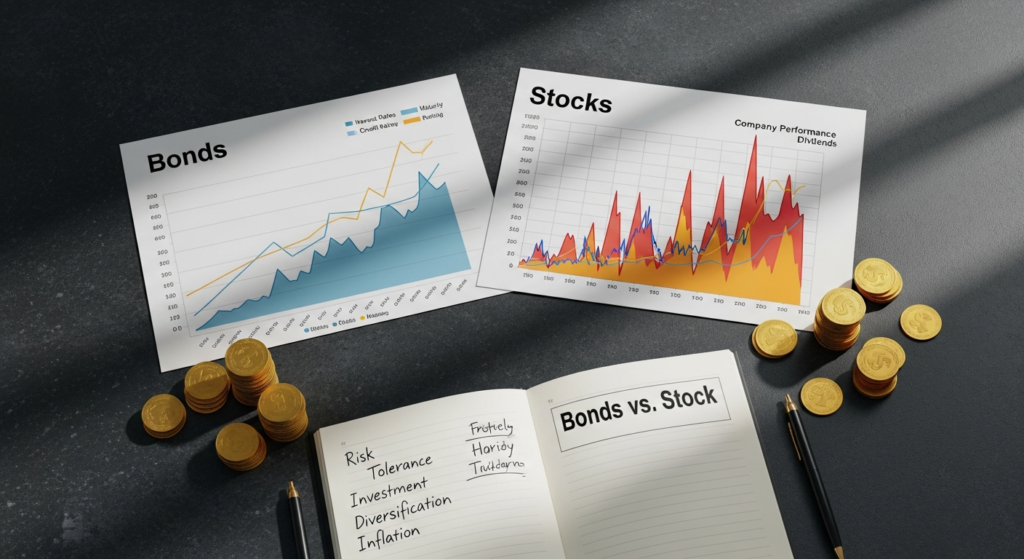
Bonds vs. Stocks: Navigating Your Investment Choice for Optimal Portfolio Performance

Bonds vs. Stocks: Navigating Your Investment Choice for Optimal Portfolio Performance The journey to
bonds vs stocks what to choose

Bonds vs. Stocks: Navigating Your Investment Choice for Optimal Portfolio Performance

The journey to financial independence and wealth accumulation is paved with critical decisions, none more fundamental than how to allocate your capital between stocks and bonds. This choice isn’t merely a theoretical exercise; it dictates the trajectory of your investment portfolio, influencing its growth potential, income generation, and susceptibility to market volatility. For investors and personal finance enthusiasts alike, understanding the nuanced roles of these two primary asset classes is paramount. There is no one-size-fits-all answer, as the optimal blend is deeply personal, contingent on individual financial goals, risk tolerance, and investment horizon. At TradingCosts, we believe in empowering our readers with data-driven insights to make informed decisions. This comprehensive guide will delve into the characteristics, historical performance, and strategic implications of investing in stocks versus bonds, offering an expert perspective to help you craft a robust and resilient portfolio.

Understanding Stocks: The Engine of Growth

Stocks, also known as equities, represent ownership stakes in a company. When you buy a stock, you become a part-owner, entitled to a share of the company’s assets and earnings. This ownership comes with the potential for two primary forms of return: capital appreciation and dividends.

Capital Appreciation: This occurs when the market price of your stock increases, allowing you to sell it for more than you paid. Stock prices are influenced by a myriad of factors, including company performance, industry trends, economic conditions, and investor sentiment. Successful companies that innovate, expand, and increase profitability tend to see their stock prices rise over time.

Dividends: Many companies distribute a portion of their profits to shareholders in the form of dividends. These are typically paid quarterly and can provide a steady stream of income, especially for investors focused on generating cash flow from their portfolios.

Key Characteristics of Stocks:

  • Higher Potential Returns: Historically, stocks have delivered superior returns compared to bonds over the long run. For instance, the S&P 500, a benchmark for large-cap U.S. equities, has generated an average annual return of approximately 10-12% since its inception in 1928, including dividends. Even looking at more recent periods, such as the last 50 years (1973-2023), the annualized return remains robust, often exceeding 10%. This long-term growth potential makes stocks indispensable for investors with distant financial goals, such as retirement.
  • Higher Volatility/Risk: The flip side of higher returns is increased volatility. Stock prices can fluctuate significantly in the short term due to market downturns, economic recessions, industry-specific challenges, or company-specific failures. While a diversified portfolio can mitigate some of this risk, the potential for substantial capital loss is inherent. For example, during the 2008 financial crisis, the S&P 500 plummeted by over 37% in a single year, highlighting the short-term risks.
  • Liquidity: Generally, large-cap stocks traded on major exchanges (like the NYSE or NASDAQ) offer high liquidity, meaning they can be bought or sold quickly without significantly impacting their price.
  • Inflation Hedge (Long-Term): Over the long term, stocks can act as a hedge against inflation. Companies can often pass increased costs onto consumers through higher prices, thereby maintaining or even growing their revenues and profits in an inflationary environment, which can translate to higher stock prices.

Types of Stocks and How to Invest:

Stocks aren’t monolithic. They can be categorized by growth potential (growth vs. value), dividend policy (income stocks), company size (large-cap, mid-cap, small-cap), and industry sector. Diversification across these types is crucial.

💰 Investing Tip

You can invest in stocks directly by purchasing shares of individual companies through brokerage platforms like Fidelity, Charles Schwab, or Vanguard. For broader market exposure and instant diversification, investors often opt for Exchange Traded Funds (ETFs) or Mutual Funds. Popular ETFs tracking the S&P 500 include SPDR S&P 500 ETF Trust (SPY) and Vanguard S&P 500 ETF (VOO), providing exposure to hundreds of companies in a single investment.

Understanding Bonds: The Bedrock of Stability

Bonds represent a loan made by an investor to a borrower, which can be a corporation, a government, or a municipality. In essence, when you buy a bond, you are lending money to the issuer. In return, the issuer promises to pay you regular interest payments (coupon payments) over a specified period and to repay the original principal amount (face value) at maturity.

Key Characteristics of Bonds:

  • Lower Potential Returns: Historically, bonds have offered lower returns compared to stocks. The U.S. Aggregate Bond Index, a common benchmark for the investment-grade bond market, has yielded average annual returns in the range of 4-6% over long periods (e.g., 1973-2023). While these returns are modest compared to equities, they come with a distinct advantage in terms of stability.
  • Lower Volatility/Risk: Bonds are generally considered less volatile than stocks. Their fixed income payments provide a predictable cash flow, and the obligation to repay principal at maturity offers a degree of capital preservation. This makes bonds attractive during periods of market uncertainty or for investors nearing retirement who prioritize capital protection. For instance, during the 2008 financial crisis when stocks plummeted, high-quality bonds often performed relatively well, acting as a ballast for diversified portfolios.
  • Interest Rate Risk: This is a primary risk for bondholders. When interest rates rise, newly issued bonds offer higher yields, making existing bonds with lower coupon rates less attractive. This can cause the market value of existing bonds to fall. Conversely, when interest rates fall, existing bonds with higher coupon rates become more appealing, and their market value tends to rise.
  • Inflation Risk: Bonds with fixed interest payments are susceptible to inflation risk. If inflation outpaces the bond’s coupon rate, the purchasing power of those fixed payments erodes over time, diminishing the real return on investment.
  • Credit Risk (Default Risk): This is the risk that the bond issuer may fail to make its promised interest payments or repay the principal. U.S. Treasury bonds are considered virtually risk-free in terms of credit risk due to the full faith and credit of the U.S. government. Corporate bonds, however, carry varying degrees of credit risk depending on the issuer’s financial health, rated by agencies like Moody’s and S&P Global.
  • Diversification: Bonds often exhibit a low or even negative correlation with stocks, especially during equity market downturns. This means that when stocks perform poorly, bonds may hold their value or even appreciate, thereby reducing overall portfolio volatility and acting as a crucial diversifier.

Types of Bonds and How to Invest:

The bond market is diverse:

  • Government Bonds: Issued by national governments. U.S. Treasuries (T-bills, T-notes, T-bonds, TIPS) are considered among the safest investments globally. TIPS (Treasury Inflation-Protected Securities) offer protection against inflation, as their principal value adjusts with the Consumer Price Index (CPI).
  • Corporate Bonds: Issued by companies to raise capital. They are categorized by credit quality: investment-grade bonds (issued by financially strong companies) and high-yield or “junk” bonds (issued by companies with lower credit ratings, offering higher yields to compensate for increased risk).
  • Municipal Bonds (“Munis”): Issued by state and local governments. A key attraction is that the interest earned on many municipal bonds is exempt from federal income tax, and sometimes state and local taxes for residents of the issuing state.

Like stocks, bonds can be purchased directly through brokerage platforms, though the direct purchase of individual bonds can be complex for retail investors. More commonly, investors gain bond exposure through bond ETFs or mutual funds, such as the Vanguard Total Bond Market ETF (BND) or the iShares Core U.S. Aggregate Bond ETF (AGG). These funds offer instant diversification across hundreds or thousands of bonds, managed by professionals.

Historical Performance and Risk-Return Trade-offs

The historical data unequivocally demonstrates a clear risk-return trade-off between stocks and bonds. Over the long term, stocks have delivered superior returns, but at the cost of higher volatility. Bonds, conversely, have provided more modest returns with greater stability.

Quantifying the Differences:

  • Stocks (S&P 500): As mentioned, the average annual return of the S&P 500 has been around 10-12% over extended periods. However, this comes with a standard deviation (a measure of volatility) typically in the range of 15-20% annually. This means that while the average is high, individual year returns can swing wildly. For instance, from 1928 to 2022, the S&P 500’s annualized return was approximately 10.1%, with a standard deviation of 19.8%.
  • Bonds (U.S. Aggregate Bond Index/Long-Term Government Bonds): The average annual return for a broad bond market index has been closer to 4-6% over similar long periods. The standard deviation for bonds is significantly lower, often in the 3-6% range. For example, long-term government bonds from 1928 to 2022 had an annualized return of about 5.6% with a standard deviation of 10.1% (still higher than aggregate due to duration risk), while the U.S. Aggregate Bond Index (more diversified) typically shows lower volatility.

This data illustrates a fundamental principle of investing: to achieve higher returns, you generally must accept higher risk. The long-term outperformance of stocks is often referred to as the “equity risk premium.”

The Power of Diversification:

While stocks offer growth and bonds offer stability, combining them strategically in a portfolio can create an “efficient frontier” – a portfolio that offers the highest expected return for a given level of risk, or the lowest risk for a given expected return. This is the essence of Modern Portfolio Theory, pioneered by Harry Markowitz.

The key to this synergy lies in their correlation. Historically, stocks and bonds have often had a low or negative correlation, meaning they tend to move in opposite directions, or at least not in tandem. During periods of economic stress, when stock markets are falling, investors often flock to safer assets like government bonds, driving up their prices. This inverse relationship helps cushion the blow to a diversified portfolio. For example, in the bear market of 2000-2002, while the S&P 500 lost about 45%, the Lehman Brothers Aggregate Bond Index gained approximately 20%.

A classic example is the 60/40 portfolio (60% stocks, 40% bonds). Over many decades, this allocation has delivered respectable returns with significantly less volatility than an all-stock portfolio. For instance, from 1926 to 2022, a 60/40 portfolio generated an average annual return of approximately 8.8%, with a standard deviation of around 10.5%, demonstrating superior risk-adjusted returns compared to 100% stocks or 100% bonds.

Factors Influencing Your Choice: A Personalized Approach

Deciding on the right mix of stocks and bonds is a highly personal endeavor. Several key factors should guide your asset allocation strategy:

  • Investment Horizon: This refers to the length of time you plan to hold your investments.
    • Longer Horizon (10+ years): Investors with a long time horizon (e.g., young professionals saving for retirement) can typically afford to take on more risk. They have ample time to recover from market downturns, allowing them to capitalize on the long-term growth potential of stocks. A higher allocation to equities (e.g., 70-90%) is often appropriate.
    • Shorter Horizon (under 5 years): For goals with a shorter time frame (e.g., saving for a down payment on a house in 3 years), capital preservation becomes paramount. Market volatility poses a greater threat, as there’s less time for recovery. A higher allocation to bonds, cash equivalents, or short-term fixed income products (e.g., 60-80% bonds) is generally advisable.
  • Risk Tolerance: This is your psychological comfort level with potential fluctuations in your portfolio’s value.
    • Aggressive Investors: Comfortable with significant market swings for the potential of higher returns. They might tolerate a higher stock allocation (e.g., 80-100%).
    • Moderate Investors: Seek a balance between growth and stability. A balanced approach like the 60/40 portfolio often suits them.
    • Conservative Investors: Prioritize capital preservation and are averse to large losses, even if it means lower returns. They would lean heavily towards bonds and cash (e.g., 20-40% stocks).
  • Financial Goals: The specific purpose of your investment will influence your allocation.
    • Growth: Goals like retirement planning decades away typically favor a growth-oriented, stock-heavy portfolio.
    • Income: If you need regular income from your portfolio (e.g., retirees drawing down assets), a higher bond allocation or dividend-paying stocks might be appropriate.
    • Specific Purchases: Saving for a child’s college education or a home down payment requires careful consideration of the timeframe and liquidity needs.
  • Current Market Conditions: While long-term investing discourages market timing, the prevailing economic environment can influence tactical adjustments.
    • Interest Rate Environment: Rising interest rates can negatively impact existing bond prices but offer higher yields on new bond issues. Conversely, falling rates benefit existing bondholders.
    • Economic Outlook: A strong economic outlook might favor stocks, while a recessionary environment could increase the appeal of safe-haven bonds.
  • Age and Life Stage: A common heuristic is the “Rule of 100” or “Rule of 110” or even “Rule of 120,” which suggests subtracting your age from 100 (or 110/120) to determine the percentage of your portfolio that should be allocated to stocks. For example, a 30-year-old might have 70% in stocks (100-30), while a 60-year-old might have 40%. While simplified, this rule captures the general principle that as you age and your investment horizon shortens, your portfolio should gradually shift towards more conservative assets.

Crafting Your Portfolio: Blending Stocks and Bonds

Once you understand your personal factors, the next step is to implement an asset allocation strategy. This involves not just choosing between stocks and bonds, but also diversifying within each asset class and regularly reviewing your choices.

Asset Allocation Strategies:

  • The Balanced Portfolio (e.g., 60/40): The 60% stocks, 40% bonds portfolio is a classic benchmark, often recommended for moderate investors. It aims to capture significant equity growth while mitigating risk with a substantial bond allocation. Its historical resilience across various market cycles makes it a robust starting point for many.
  • Target-Date Funds: These are mutual funds or ETFs that automatically adjust their asset allocation over time. They start with a higher allocation to stocks when you are young and gradually shift towards bonds as you approach the target retirement date. Providers like Vanguard and Fidelity offer popular target-date funds, making diversification and rebalancing effortless for investors.
  • Risk Parity: This strategy allocates assets based on their risk contribution, rather than just capital allocation. The goal is to equalize the risk contribution of each asset class to the overall portfolio. This often results in a higher allocation to bonds (which are less volatile) to achieve the same risk contribution as a smaller allocation to stocks.
  • Dynamic Asset Allocation: This approach involves actively adjusting the portfolio’s asset mix based on changing market conditions and economic forecasts. While potentially offering higher returns, it requires more expertise, active management, and carries the risk of incorrect market timing. For most individual investors, a strategic, long-term allocation with periodic rebalancing is more suitable.

The Importance of Rebalancing:

Over time, market movements will cause your portfolio’s asset allocation to drift from its original targets. For example, a strong bull market might cause your stock allocation to grow to 70% from an initial 60%, increasing your portfolio’s overall risk. Rebalancing is the process of periodically adjusting your portfolio back to your target asset allocation by selling assets that have performed well and buying those that have lagged. This disciplined approach helps:

  • Manage Risk: It prevents your portfolio from becoming overly concentrated in one asset class due to market movements.
  • Buy Low, Sell High: By selling assets that have outperformed and buying those that have underperformed, you are inherently engaging in a “buy low, sell high” strategy.

Many financial advisors recommend rebalancing annually or semi-annually, or when an asset class deviates by a certain percentage (e.g., 5-10%) from its target allocation.

Diversification within Asset Classes:

Beyond the stock-bond split, it’s crucial to diversify within each asset class. For stocks, this means investing across different industries, market capitalizations (large, mid, small), geographies (domestic, international), and styles (growth, value). For bonds, diversify across different issuers (government, corporate, municipal), credit qualities, and maturities (short, intermediate, long-term).

Beyond the Basics: Advanced Considerations

For sophisticated investors, there are additional factors to consider that can further optimize portfolio performance and risk management.

  • Inflation-Protected Securities (TIPS): As discussed, inflation can erode the purchasing power of fixed bond payments. TIPS are a specific type of U.S. Treasury bond designed to protect investors from inflation. Their principal value adjusts semi-annually based on changes in the Consumer Price Index (CPI), ensuring that your investment keeps pace with inflation. They are a valuable component for investors particularly concerned about rising prices.
  • Alternative Investments: While stocks and bonds form the core of most portfolios, alternative investments can offer further diversification and potentially enhanced returns. These can include:
    • Real Estate: Through REITs (Real Estate Investment Trusts) or direct property ownership.
    • Commodities: Such as gold, oil, or agricultural products, often accessed via ETFs.
    • Private Equity: Investing in non-publicly traded companies, typically for accredited investors.
    • Hedge Funds: Employing complex strategies to generate returns, also typically for accredited investors.

    These alternatives often have low correlations with traditional stocks and bonds, but they also come with their own unique risks, liquidity constraints, and complexities.

  • Tax Implications: The tax efficiency of your investments can significantly impact your net returns.
    • Bonds: Interest from corporate bonds is generally taxable at the federal, state, and local levels. Interest from U.S. Treasury bonds is exempt from state and local taxes but subject to federal tax. Interest from municipal bonds is often exempt from federal tax, and sometimes state and local taxes if you reside in the issuing state.
    • Stocks: Capital gains from selling stocks are taxed, as are qualified dividends (often at lower rates than ordinary income).

    Utilizing tax-advantaged accounts like 401(k)s, IRAs (Traditional or Roth), and 529 plans can shelter investments from annual taxation, allowing for greater compounding.

  • Behavioral Finance: One of the biggest threats to investor returns is often self-inflicted through emotional decision-making. Panicking during market downturns and selling low, or getting overly exuberant during bull markets and chasing speculative assets, can derail even the best-laid plans. Staying disciplined, adhering to your long-term asset allocation, and avoiding impulsive reactions are crucial for successful investing.

Frequently Asked Questions

Is a 60/40 portfolio still relevant today, especially with low bond yields?
While low-interest-rate environments can challenge the traditional 60/40 portfolio’s bond component to generate significant income, its relevance as a diversified, risk-mitigating strategy remains strong. Historically, bonds have served as a crucial ballast during equity downturns, and this diversification benefit persists. Investors might consider diversifying their bond holdings into global bonds, inflation-protected securities (TIPS), or exploring other income-generating assets, but the core principle of balancing growth and stability is enduring. Even with lower yields, high-quality bonds still offer capital preservation and downside protection that equities do not.
How often should I rebalance my portfolio?
Most experts recommend rebalancing your portfolio annually or semi-annually. Alternatively, you can use a “threshold-based” approach, rebalancing only when an asset class deviates by a certain percentage (e.g., 5% or 10%) from its target allocation. For instance, if your target is 60% stocks and they grow to 66%, you would rebalance. Regular rebalancing helps maintain your desired risk level and ensures you’re not unknowingly taking on too much or too little risk.
Are bonds truly “safe” investments?
Bonds are generally considered “safer” than stocks, but they are not entirely risk-free. The safety depends on the issuer’s creditworthiness (e.g., U.S. Treasuries are considered very safe in terms of default risk). However, all bonds are subject to interest rate risk (their price can fall if interest rates rise) and inflation risk (fixed payments lose purchasing power over time). High-yield corporate bonds also carry significant credit risk, similar to equities in some respects. So, while they offer more stability than stocks, understanding and mitigating these risks is essential.
Can I just invest in a single fund that holds both stocks and bonds?
Yes, absolutely. This is a very common and convenient approach for many investors. Balanced mutual funds, asset allocation funds, and target-date funds are specifically designed to hold a diversified mix of both stocks and bonds, often adjusting the allocation automatically over time. Many robo-advisors (e.g., Betterment, Wealthfront) also construct and manage diversified portfolios of ETFs containing both asset classes based on your risk profile. These options simplify portfolio management significantly.
What if I have a very short investment horizon (e.g., 1-3 years)?
For very short investment horizons, capital preservation should be your absolute priority. The volatility of stocks makes them unsuitable for money you’ll need in the near future. Instead, focus on highly liquid, low-risk options such as high-yield savings accounts, money market funds, certificates of deposit (CDs), or short-term government bonds (e.g., Treasury bills). While these offer minimal returns, they provide stability and ensure your principal is available when you need it.

Conclusion

The choice between stocks and bonds is not an “either/or” proposition but rather a strategic decision on “how much of each” to integrate into your portfolio. Stocks offer the potential for substantial long-term growth, vital for achieving ambitious financial goals, but come with inherent volatility. Bonds, on the other hand, provide stability, income, and crucial diversification, acting as a buffer against market downturns, albeit with lower return expectations. The optimal allocation is a dynamic process, shaped by your individual investment horizon, risk tolerance, and specific financial objectives.

By understanding the unique characteristics, historical performance, and risk-return trade-offs of both asset classes, investors can construct a robust portfolio tailored to their needs. Embrace diversification, commit to a disciplined rebalancing strategy, and always prioritize informed decision-making over emotional reactions. Your financial success hinges on this thoughtful approach to blending the growth engine of stocks with the stabilizing force of bonds, ensuring your portfolio is well-positioned to navigate the complexities of the market and achieve your long-term aspirations.

Disclaimer: This article is intended for informational purposes only and does not constitute financial advice. Investment involves risks, including the possible loss of principal. Always consult with a qualified financial advisor before making any investment decisions.

“`json
[
{
“@context”: “https://schema.org”,
“@type”: “Article”,
“mainEntityOfPage”: {
“@type”: “WebPage”,
“@id”: “https://www.tradingcosts.com/bonds-vs-stocks-what-to-choose”
},
“headline”: “Bonds vs. Stocks: Navigating Your Investment Choice for Optimal Portfolio Performance”,
“description”: “An expert guide for investors on choosing between stocks and bonds, covering historical performance, risk-return trade-offs, asset allocation strategies, and personalized factors for portfolio construction.”,
“image”: [
“https://www.tradingcosts.com/images/bonds-vs-stocks-hero.jpg”,
“https://www.tradingcosts.com/images/bonds-vs-stocks-thumbnail.jpg”
],
“author”: {
“@type”: “Organization”,
“name”: “TradingCosts”
},
“publisher”: {
“@type”: “Organization”,
“name”: “TradingCosts”,
“logo”: {
“@type”: “ImageObject”,
“url”: “https://www.tradingcosts.com/images/tradingcosts-logo.png”
}
},
“datePublished”: “2023