How to Find Undervalued Stocks in 2026: A Retail Investor’s Guide to Maximum Returns
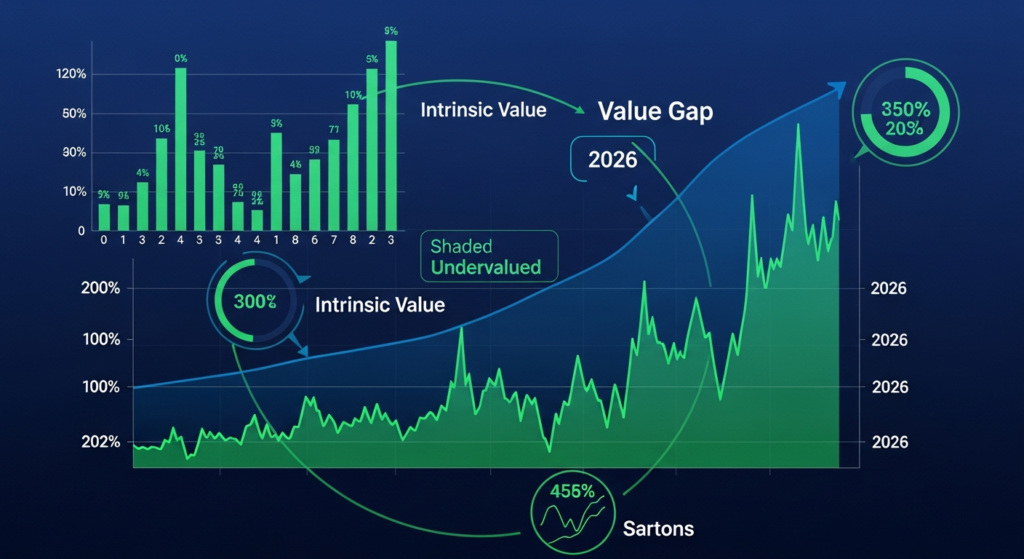
The financial landscape of 2026 is one defined by the integration of artificial intelligence, a shift toward sustainable energy, and a more cautious approach to high-growth valuation. For the retail investor, the “easy money” era of speculative bubbles has largely faded, replaced by a market that rewards discipline, data-driven analysis, and a return to fundamental value. Finding undervalued stocks in 2026 isn’t about chasing the latest trend; it’s about identifying companies whose intrinsic value far exceeds their current market price.
As a retail trader, your primary advantage is agility and the ability to operate without the constraints of large institutional mandates. However, your challenge is minimizing costs while maximizing the quality of your research. In 2026, the democratization of financial data means you no longer need an expensive Bloomberg terminal to find “diamonds in the rough.” This guide will walk you through the strategic frameworks and low-cost tools necessary to build a portfolio of undervalued assets that are positioned for long-term growth.
—
1. The Fundamentals of Value Investing in the 2026 Market
Value investing has evolved significantly. In 2026, simply looking for a low Price-to-Earnings (P/E) ratio is no longer enough. The market has become highly efficient at pricing in obvious metrics, which means the real value often lies in more nuanced financial indicators. To find undervalued stocks today, you must look at a combination of traditional and modern metrics.
#
The PEG Ratio (Price/Earnings to Growth)
While the P/E ratio tells you what you’re paying for today’s earnings, the PEG ratio factors in expected growth. In 2026’s tech-heavy environment, a company with a P/E of 25 might seem expensive, but if its earnings are growing at 30% per year, its PEG ratio is under 1.0, suggesting it may actually be undervalued relative to its potential.
#
Price-to-Book (P/B) and Tangible Assets
For industrial or manufacturing sectors, the P/B ratio remains a gold standard. However, in 2026, you must also consider “intangible book value”—the value of patents, proprietary AI algorithms, and brand equity. If a company’s market cap is close to its liquidation value, you’ve found a significant margin of safety.
#
Free Cash Flow Yield
Earnings can be manipulated by accounting tricks, but cash is reality. The Free Cash Flow (FCF) yield helps you identify companies that are generating more cash than they need to run their business. In a 2026 economy where capital costs remain a factor, companies with high FCF yields are often undervalued because they have the “dry powder” to buy back shares, pay dividends, or acquire competitors.
—
2. Leveraging Free and Low-Cost AI-Powered Tools
One of the greatest shifts in 2026 is the accessibility of high-level analytical tools for the average retail trader. You no longer need to pay thousands in subscription fees to screen the market effectively. Minimizing costs is essential for long-term compounding, so utilizing free resources is a cornerstone of a smart strategy.
#
Advanced Stock Screeners
Platforms like **Finviz** and **TradingView** have integrated basic AI functionalities that allow you to filter thousands of stocks in seconds. To find undervalued gems, set your screener to look for:
* P/E Ratio < 15
* Debt-to-Equity < 0.5
* Positive Earnings Growth over the last 5 years
* Relative Strength Index (RSI) < 40 (indicating the stock may be oversold)
#
Open-Source Data and Community Insights
In 2026, decentralized finance platforms and community-driven research hubs provide institutional-grade insights for free. Websites that aggregate SEC filings and visualize insider buying patterns are invaluable. When executives are buying their own company’s stock with their personal money, it is one of the strongest signals that the stock is currently undervalued.
#
Utilizing LLMs for Sentiment Analysis
Retail investors can now use free versions of Large Language Models (LLMs) to summarize quarterly earnings calls. Instead of reading a 50-page transcript, you can ask the AI to “Identify three areas where management expressed concern and three areas of unexpected growth.” This allows you to spot discrepancies between the company’s actual performance and the market’s pessimistic reaction.
—
3. Analyzing Cash Flow and Debt: The “Safety First” Approach
In the 2026 economic environment, interest rates have stabilized, but the “zero-interest-rate policy” (ZIRP) era is a distant memory. This makes debt analysis a critical component of finding undervalued stocks. A “cheap” stock with a massive debt load is often a “value trap”—a company that is inexpensive because it is on the verge of insolvency.
#
The Debt-to-Equity Ratio
To minimize risk, focus on companies with a Debt-to-Equity ratio of less than 1.0. This ensures that the company owns more than it owes. In 2026, companies with clean balance sheets are undervalued by the market whenever there is a temporary macro-economic dip. When the market panics, these “boring” but financially sound companies often see their prices drop alongside the risky ones, creating a perfect entry point for the value investor.
#
Interest Coverage Ratio
This metric tells you how easily a company can pay interest on its outstanding debt. A ratio above 3.0 is generally considered healthy. If a stock’s price has plummeted but its interest coverage remains high, the market is likely overreacting to short-term news, ignoring the company’s structural durability.
#
The Importance of Dividend Sustainability
For retail investors looking for passive income, undervalued dividend stocks are the holy grail. Don’t just look at the yield; look at the **Payout Ratio**. If a company is paying out 90% of its earnings as dividends, that dividend is at risk. A company with a 3% yield and a 30% payout ratio is far more valuable because it has room to grow its dividend even during a downturn.
—
4. Identifying “Moats” in the 2026 Tech Landscape
The concept of an “Economic Moat”—a structural advantage that protects a company from competitors—is more important in 2026 than ever before. With AI accelerating the pace of disruption, a company without a moat can see its value evaporate overnight. Undervalued stocks are often found where the market has failed to recognize the strength of a company’s moat.
#
High Switching Costs
In the software and services sector, look for companies that are deeply integrated into their customers’ workflows. Even if a competitor offers a slightly cheaper product, the cost and headache of switching systems make the incumbent’s revenue “sticky.” If such a company is trading at a discount due to a broad market sell-off, it is likely undervalued.
#
Network Effects
In 2026, platform-based businesses dominate. A network effect occurs when a service becomes more valuable as more people use it. Retail investors should look for niche platforms that are currently in the “growth-to-value” transition phase. Often, the market hasn’t yet priced in the long-term profitability of a dominant network.
#
Brand Power and Intellectual Property
In a world of generic AI-generated content and products, brand trust is a massive asset. Companies with strong IP portfolios—whether in biotech, entertainment, or specialized manufacturing—often have undervalued stocks when their R&D pipeline is misunderstood by short-term traders. Finding a company with a “hidden” patent or a loyal customer base can lead to massive 2026 gains.
—
5. Sentiment Analysis and Contrarian Strategies
The psychological aspect of the 2026 market is a goldmine for the disciplined retail trader. Because news travels instantly and algorithmic trading dominates daily volume, stocks frequently become “oversold” due to panic or algorithmic cascades. Finding undervalued stocks requires you to be a contrarian: buying when others are fearful.
#
The Fear and Greed Index
Use sentiment indicators to gauge the broader market mood. When the market is in a state of “Extreme Fear,” even high-quality companies are sold off. This is the best time for retail investors to shop for undervalued assets. By staying calm while the headlines are screaming, you can pick up shares at a 20% or 30% discount.
#
Analyzing “Boring” Industries
In 2026, much of the retail hype is centered around space exploration, advanced robotics, and biotech. As a result, “boring” sectors like waste management, water utilities, and specialty chemicals are often overlooked. These companies provide essential services, have predictable cash flows, and frequently trade at valuations far below their tech counterparts.
#
Following the “Smart Money” (Carefully)
While institutional investors aren’t always right, significant moves by value-oriented hedge funds can point you in the right direction. Use free 13F filing aggregators to see what the legendary value investors are buying. If a respected fund manager is building a position in a stock that is currently at a 52-week low, it’s a strong signal to perform your own due diligence on that ticker.
—
6. Common Pitfalls: Avoiding Value Traps in 2026
Not every stock that looks cheap is undervalued. A “value trap” is a stock that appears to be a bargain based on low valuation metrics but continues to decline because the underlying business is failing. In 2026, avoiding these traps is the difference between a successful portfolio and a stagnant one.
#
Technological Obsolescence
The fastest way for a stock to become a value trap in 2026 is through obsolescence. A company might have a low P/E and high dividends, but if its core product is being replaced by an AI-driven alternative, those earnings will eventually disappear. Always ask: “Will this company’s product be relevant in 2030?”
#
Declining Profit Margins
If a stock is cheap but its profit margins have been shrinking for three consecutive years, it’s likely losing its competitive edge. This is a sign of a price war or rising operational costs that the company cannot pass on to consumers. Undervalued stocks should have stable or expanding margins, even if revenue growth is slow.
#
Poor Corporate Governance
A company can have the best products in the world, but if the management team is focused on self-enrichment rather than shareholder value, the stock will remain undervalued indefinitely. Look for excessive executive compensation or a history of diluting shareholders with constant new stock issuances. In 2026, retail investors have more power than ever to voice concerns, but it’s better to simply avoid companies with “toxic” management from the start.
—
FAQ: Finding Undervalued Stocks in 2026
**Q1: What is the single best metric for finding undervalued stocks in 2026?**
A: While no single metric is perfect, the **Free Cash Flow (FCF) Yield** is arguably the most reliable. It shows the actual cash a company generates relative to its market value, making it harder to manipulate than standard earnings reports.
**Q2: Are penny stocks a good way to find undervalued companies?**
A: Rarely. Most penny stocks are cheap for a reason—lack of liquidity, poor transparency, or failing business models. Retail investors are better off looking for undervalued mid-cap or large-cap stocks where there is more reliable data and lower risk of manipulation.
**Q3: How long should I hold an undervalued stock?**
A: Value investing is a long-term game. It often takes the market 12 to 24 months to recognize a company’s true intrinsic value. In 2026, patience is a competitive advantage; if your thesis remains correct, hold until the stock reaches your calculated fair value.
**Q4: Can I use AI to find undervalued stocks automatically?**
A: You can use AI to *screen* for candidates, but you should never let it make the final decision. AI can miss qualitative factors like a change in management or a pending lawsuit. Use AI to do the “heavy lifting” of data sorting, then apply your own human judgment.
**Q5: Is 2026 a good year to start value investing?**
A: Yes. As the market moves away from the high-volatility cycles of previous years, 2026 is seeing a “flight to quality.” Investors are increasingly looking for safety and fundamentals, making it an ideal time to identify and purchase undervalued assets before the broader market catches on.
—
Conclusion
Finding undervalued stocks in 2026 requires a blend of traditional financial wisdom and modern technological savvy. By focusing on fundamental metrics like PEG ratios and Free Cash Flow, leveraging free AI-driven screening tools, and maintaining a contrarian mindset, retail investors can achieve institutional-level results while minimizing costs.
The key to success in 2026 is not finding the “next big thing,” but finding the “current great thing” that the market has temporarily ignored. Remember that price is what you pay, but value is what you get. If you can master the art of identifying that gap, you are well on your way to building lasting wealth in the modern financial era. Stay disciplined, keep your costs low, and always perform your own due diligence before clicking the “buy” button.