
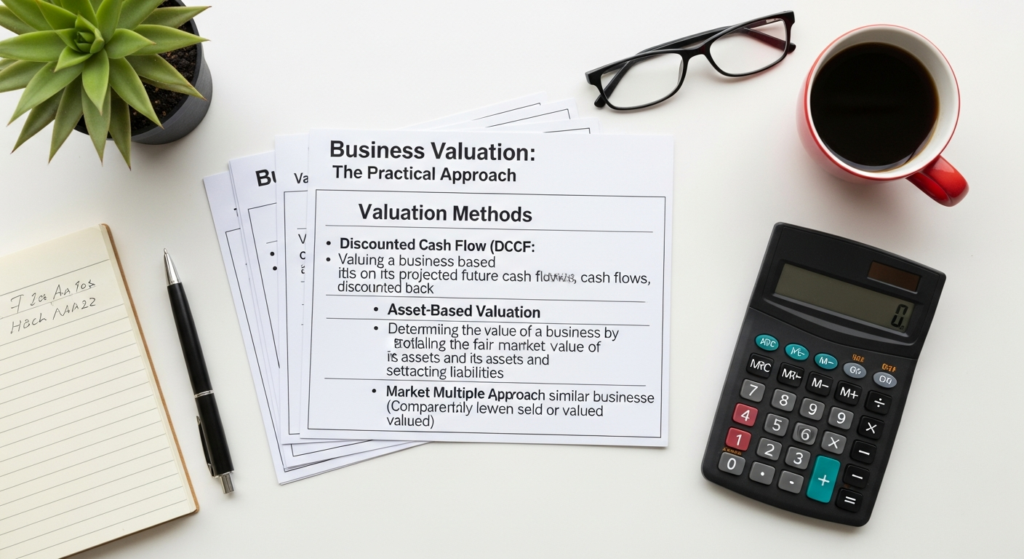
The Definitive Guide to Business Valuation in 2026: Unlocking True Investment Value
Business valuation is not merely an academic exercise; it’s a critical skill for anyone looking to build substantial wealth. Whether you’re considering buying individual stocks, evaluating a private equity opportunity, or even assessing a small business for acquisition, knowing how to determine intrinsic value is paramount. This article will demystify the core methodologies, offer step-by-step guidance, and highlight practical considerations to help you navigate the complexities of financial analysis like a seasoned professional.
Understanding the Core Principles of Business Valuation
Before diving into specific methodologies, it’s crucial to grasp the foundational concepts that underpin all valuation efforts. Valuation is fundamentally about determining what an asset is worth today, based on its future economic benefits.
Why Value a Business?
- Investment Decisions: The primary reason for most individual investors. Valuation helps you decide whether a stock is overvalued, undervalued, or fairly priced relative to its intrinsic worth.
- Mergers & Acquisitions (M&A): Buyers need to ensure they’re paying a fair price, while sellers want to maximize their proceeds.
- Capital Raising: Businesses seeking funding (equity or debt) need a credible valuation to attract investors.
- Financial Reporting & Compliance: For accounting purposes, tax planning, and regulatory requirements.
- Strategic Planning: Management uses valuation to assess the impact of strategic initiatives on shareholder value.
Intrinsic Value vs. Market Value
A key distinction often overlooked is the difference between intrinsic value and market value:
- Intrinsic Value: This is the “true” value of a business, based on a thorough analysis of its fundamentals, future cash flows, assets, and liabilities. It’s what an asset should be worth.
- Market Value: This is the price at which a business (or its shares) currently trades in the open market. It’s what an asset is worth according to the collective opinion of buyers and sellers at any given moment.
Savvy investors seek to exploit discrepancies between intrinsic value and market value, buying when market value is below intrinsic value and selling when it’s above.
The Time Value of Money and Risk
Two immutable principles govern all valuation:
- Time Value of Money (TVM): A dollar today is worth more than a dollar tomorrow due to its potential earning capacity. Future cash flows must be discounted back to their present value.
- Risk: The greater the uncertainty or risk associated with a business’s future cash flows, the higher the discount rate applied, and consequently, the lower its present value.
Ultimately, business value is driven by its ability to generate future cash flows, the expected growth rate of those cash flows, and the risk associated with their realization. Remember the “Garbage In, Garbage Out” (GIGO) principle: the quality of your valuation output is directly dependent on the quality and realism of your input assumptions.
Discounted Cash Flow (DCF) Analysis: The Gold Standard
Discounted Cash Flow (DCF) analysis is widely considered the most theoretically sound valuation method. It directly applies the time value of money principle, projecting a company’s future free cash flows and discounting them back to their present value using an appropriate discount rate.
Step-by-Step DCF Calculation
Step 1: Project Free Cash Flow (FCF)
Free Cash Flow (FCF) represents the cash a company generates after accounting for cash outflows to support its operations and maintain its capital assets. It’s the cash available to all capital providers (debt and equity holders).
- Forecast Revenue Growth: Based on industry trends, competitive landscape, management guidance, and historical performance. Be realistic; aggressive growth assumptions are a common pitfall. For a mature company, 3-7% annual growth might be reasonable, while a high-growth tech firm could see 15-25% initially, decelerating over time.
- Project Operating Expenses: Cost of Goods Sold (COGS), Selling, General & Administrative (SG&A), and Research & Development (R&D). Often projected as a percentage of revenue, adjusted for economies of scale or specific strategic initiatives.
- Calculate Earnings Before Interest & Taxes (EBIT): Revenue minus operating expenses.
- Estimate Taxes: Apply the company’s effective tax rate to EBIT.
- Calculate Net Operating Profit After Tax (NOPAT): EBIT * (1 – Tax Rate).
- Adjust for Non-Cash Expenses & Investments:
- Add back Depreciation & Amortization (D&A): These are non-cash expenses.
- Subtract Capital Expenditures (CapEx): Cash spent on acquiring or upgrading physical assets. Project based on historical trends, growth plans, or as a percentage of revenue.
- Adjust for Changes in Net Working Capital (NWC): NWC = Current Assets (excluding cash) – Current Liabilities (excluding debt). An increase in NWC is a cash outflow (e.g., building inventory), while a decrease is an inflow. Project NWC items (accounts receivable, inventory, accounts payable) as a percentage of revenue.
- Result: Free Cash Flow (FCF) for each projected year (typically 5-10 years).
Step 2: Calculate the Weighted Average Cost of Capital (WACC)
WACC is the average rate of return a company expects to pay to all its security holders (debt and equity) to finance its assets. It’s the discount rate used in a DCF.
WACC = (Cost of Equity % Equity) + (Cost of Debt % Debt * (1 – Tax Rate))
- Cost of Equity (Ke): Often calculated using the Capital Asset Pricing Model (CAPM):
Ke = Risk-Free Rate + Beta * Equity Risk Premium (ERP)- Risk-Free Rate: The return on a theoretically risk-free investment, typically the yield on a long-term (e.g., 10-year or 20-year) government bond. As of current market conditions, a range of 4.5% to 5.0% for the US 10-year Treasury is a reasonable benchmark.
- Beta: A measure of a stock’s volatility relative to the overall market. A beta of 1 means the stock moves with the market; >1 means more volatile, <1 means less volatile. Obtain from financial data providers (e.g., Bloomberg, Yahoo Finance).
- Equity Risk Premium (ERP): The extra return investors expect for investing in the stock market over a risk-free asset. Historical averages for the US range from 5.0% to 6.0%.
- Cost of Debt (Kd): The interest rate a company pays on its borrowings. Use the current market rate for new debt, or an average of existing debt.
- Market Value of Equity (E) and Debt (D): Determine the current market capitalization for equity and the market value of debt (or book value if market value is unavailable).
- Tax Rate (t): The company’s marginal tax rate.
A WACC for a stable, large-cap company might range from 7-9%, while a higher-risk, smaller company could see WACC in the 10-15%+ range.
Step 3: Determine Terminal Value (TV)
Since forecasting FCF for an infinite period is impractical, we estimate a Terminal Value (TV) at the end of the explicit forecast period (e.g., year 5 or 10), representing the value of all cash flows beyond that point.
- Perpetual Growth Model (Gordon Growth Model):
TV = [FCF (Year N+1)] / (WACC – g)
Where ‘g’ is the perpetual growth rate of FCF, typically 1-3% (should not exceed the long-term nominal GDP growth rate). This assumes the company will grow at a stable rate indefinitely. - Exit Multiple Method: Apply an industry-appropriate valuation multiple (e.g., EV/EBITDA) from comparable companies to the target company’s projected EBITDA in the terminal year.
TV = (Terminal Year EBITDA) * (EV/EBITDA Multiple)
The TV often accounts for 60-80% of the total intrinsic value, making its assumptions highly impactful.
Step 4: Sum the Present Values
Discount each year’s projected FCF and the Terminal Value back to the present using the WACC.
Intrinsic Value = PV(FCF1) + PV(FCF2) + … + PV(FCFn) + PV(Terminal Value)
Dividing the total intrinsic value by the number of outstanding shares yields the intrinsic value per share.
Sensitivity Analysis
Due to the sensitivity of DCF to its input assumptions (especially growth rates, WACC, and terminal growth), performing sensitivity analysis is critical. Create a data table showing how the intrinsic value changes if you vary key assumptions by +/- 1% or 0.5%. This provides a range of possible values rather than a single point estimate.
Limitations of DCF
- Highly Sensitive to Assumptions: Small changes in growth rates, WACC, or terminal value can lead to significant swings in valuation.
- Difficulty in Forecasting: Predicting cash flows accurately 5-10 years out is challenging, especially for volatile or rapidly changing industries.
- Not Suitable for All Businesses: Less effective for early-stage companies with erratic or negative cash flows.
Relative Valuation: Comparable Company Analysis (CCA) and Precedent Transactions
Relative valuation methods assess a company’s worth by comparing it to similar businesses or transactions. This approach assumes that similar assets should trade at similar prices.
Key Multiples and Their Application
The most common multiples are based on Enterprise Value (EV) or Equity Value (Market Capitalization).
Enterprise Value (EV) Multiples:
EV represents the total value of a company, including both equity and debt, less cash.
EV = Market Capitalization + Total Debt – Cash & Cash Equivalents
- EV/EBITDA:
- Definition: Enterprise Value divided by Earnings Before Interest, Taxes, Depreciation, and Amortization.
- Use Case: Excellent for comparing companies with different capital structures, depreciation policies, or tax rates, as EBITDA is pre-interest, pre-tax, and pre-non-cash expenses. Widely used in capital-intensive industries (e.g., manufacturing, telecom, real estate).
- Example: If comparable companies trade at an average EV/EBITDA of 10x, and your target company has $100 million in EBITDA, its implied EV is $1 billion.
- EV/Sales (or EV/Revenue):
- Definition: Enterprise Value divided by Sales (or Revenue).
- Use Case: Useful for valuing high-growth companies that may not yet be profitable (e.g., many SaaS startups or early-stage tech firms). Less susceptible to accounting distortions than earnings-based multiples.
- Limitation: Doesn’t account for profitability or cost structure efficiency.
Equity Value Multiples:
- P/E Ratio (Price-to-Earnings):
- Definition: Share Price divided by Earnings Per Share (or Market Cap divided by Net Income).
- Use Case: Most common multiple for mature, profitable companies. Easy to understand and widely quoted.
- Limitations: Highly sensitive to accounting policies, non-recurring items, and capital structure. Not useful for unprofitable companies.
- Example: If comps trade at a median P/E of 20x, and your target company has $5.00 in EPS, its implied share price is $100.00.
- P/B Ratio (Price-to-Book):
- Definition: Share Price divided by Book Value Per Share (or Market Cap divided by Shareholder Equity).
- Use Case: Most relevant for asset-heavy industries like financial institutions (banks, insurance companies) or real estate, where assets are a good proxy for value.
- Limitation: Book value often doesn’t reflect the true market value of assets, especially for companies with significant intangible assets.
Comparable Company Analysis (CCA)
This involves identifying a peer group of publicly traded companies that are similar to the target company in terms of:
- Industry: Operate in the same or closely related sectors.
- Size: Similar revenue, market capitalization, or employee count.
- Growth Profile: Comparable historical and projected revenue/EBITDA growth rates.
- Profitability: Similar margins (Gross, EBITDA, Net).
- Geographic Market: Operate in the same regions.
- Business Model: Similar customer acquisition, revenue generation, and cost structures.
Once the comps are selected, calculate their relevant multiples (e.g., EV/EBITDA, P/E) and derive a range (median, average, min/max). Apply this range to the target company’s corresponding financial metrics to arrive at an implied valuation range.
Precedent Transactions Analysis (PTA)
PTA involves analyzing the multiples paid in recent M&A transactions involving companies similar to the target. This provides insights into what strategic or financial buyers have historically been willing to pay.
- Process: Identify transactions with similar characteristics (industry, size, timing, deal rationale). Collect transaction multiples (e.g., EV/EBITDA, EV/Sales at the time of the deal). Apply the median/average of these multiples to the target company’s metrics.
- Key Difference from CCA: PTA multiples often include a “control premium” because buyers typically pay more to acquire an entire company.
Pros and Cons of Relative Valuation
- Pros: Market-based (reflects current market sentiment), relatively easy to understand and calculate, provides quick insights.
- Cons: Relies on the assumption that the market is “right,” finding truly comparable companies can be difficult, market sentiment can distort multiples, doesn’t capture unique strategic advantages or disadvantages.
Asset-Based Valuation (ABV) and Other Methods
While DCF and relative valuation are the most common, other methods are crucial for specific business types or situations.
Asset-Based Valuation (ABV)
ABV involves valuing a business by summing the fair market value of its individual assets and subtracting the fair value of its liabilities.
- When to Use:
- Asset-Heavy Businesses: Real estate holding companies, manufacturing firms with significant plant and equipment, or companies with substantial liquid assets.
- Companies in Distress or Liquidation: To determine the liquidation value.
- Valuing Intangibles: Sometimes used to value specific intangible assets like patents or trademarks (though often more complex).
- Process:
- Identify all tangible assets (cash, accounts receivable, inventory, property, plant & equipment).
- Estimate the fair market value (FMV) of each asset. This often requires appraisals for real estate and equipment.
- Identify all liabilities (accounts payable, debt, deferred revenue).
- Subtract total liabilities from total asset value to arrive at the net asset value.
- Limitations: ABV often fails to capture the value of a business as a going concern, especially its future earning potential or the value of intangible assets like brand equity, customer relationships, or intellectual property (unless explicitly valued separately).
Other Specialized Valuation Methods
- Dividend Discount Model (DDM): Values a stock based on the present value of its future dividend payments. Best suited for mature, stable, dividend-paying companies with a predictable dividend policy. Less relevant for growth companies that reinvest earnings.
- Economic Value Added (EVA): Measures a company’s true economic profit by deducting the cost of capital from its NOPAT. If a company generates positive EVA, it is creating value for shareholders.
- Option Pricing Models (e.g., Black-Scholes): Used to value complex securities with option-like characteristics, such as warrants, convertible debt, or employee stock options. Highly specialized.
Integrating Valuation Approaches and Practical Considerations
No single valuation method is perfect. Experienced analysts rarely rely on just one. The most robust valuations integrate multiple approaches to triangulate a credible value range.
The “Football Field” Analysis
A “football field” chart is a visual representation that combines the valuation ranges derived from different methodologies (DCF, CCA, PTA). This provides a comprehensive overview of the implied valuation range for the target company, often showing a low, mid, and high estimate from each method. The overlap or clustering of ranges helps build conviction around a particular valuation.
Qualitative Factors: Beyond the Numbers
While quantitative models are essential, they are only as good as the assumptions feeding them. Critical qualitative factors can significantly impact a business’s long-term value and must be considered:
- Management Quality and Team: Experienced, ethical, and visionary leadership is invaluable. Assess track record, strategic decisions, and succession planning.
- Competitive Landscape and Moat: Does the company have a sustainable competitive advantage (e.g., strong brand, proprietary technology, network effects, cost advantage, regulatory barriers)? Porter’s Five Forces can be a useful framework.
- Industry Trends and Growth Prospects: Is the industry growing or declining? What are the technological shifts or regulatory changes impacting it?
- Brand Strength and Customer Loyalty: Intangible assets that drive pricing power and repeat business.
- Regulatory and Political Environment: Favorable or unfavorable government policies, tariffs, or environmental regulations.
- ESG Factors: Environmental, Social, and Governance considerations are increasingly important. Strong ESG practices can reduce risk, attract capital, and enhance brand reputation, potentially impacting WACC or terminal growth assumptions.
These qualitative insights should inform your quantitative assumptions (e.g., a strong competitive moat might justify a higher perpetual growth rate or a lower discount rate).
Scenario Planning and Stress Testing
Always run multiple scenarios:
- Base Case: Your most probable assumptions.
- Best Case: Optimistic yet plausible assumptions.
- Worst Case: Pessimistic but realistic assumptions.
This provides a more complete picture of potential outcomes and helps assess the robustness of your valuation. Stress test key variables (e.g., what if revenue growth slows by 2% or WACC increases by 1%?).
Tools and Resources for Valuation
- Financial Statements: Annual Reports (10-K) and Quarterly Reports (10-Q) from the SEC EDGAR database are your primary source of raw data.
- Industry Reports: Research from firms like Gartner, Forrester, or S&P Global can provide industry growth rates, competitive analysis, and benchmarks.
- Financial Data Providers: Bloomberg Terminal and Capital IQ offer extensive company data, competitor analysis, and pre-built models (often expensive for individual investors). Publicly available sites like Yahoo Finance, Google Finance, and Finviz offer basic financial data and ratios.
- Spreadsheet Software: Microsoft Excel or Google Sheets are indispensable for building and manipulating your valuation models.
The “Margin of Safety”
Inspired by Benjamin Graham, the concept of a “margin of safety” is crucial. After determining a business’s intrinsic value, only purchase it if its market price is significantly below that intrinsic value. This buffer protects your investment against unforeseen events, errors in your analysis, or adverse market movements. A common margin of safety target is 20-30% below intrinsic value.