Options Trading Explained for Beginners 2026: Your Definitive Guide to Strategic Leverage and Risk Management
Options are not merely speculative instruments; they are versatile tools that, when understood and applied strategically, can significantly augment your investment arsenal. From generating consistent premiums on existing stock holdings to protecting against potential downturns, the utility of options extends far beyond simple directional bets. Yet, the path to proficiency demands rigorous education, a commitment to risk management, and a deep understanding of market mechanics. Forget the vague advice and unsubstantiated claims; here, we delve into the core concepts, practical applications, and essential considerations for anyone looking to intelligently incorporate options into their financial strategy today.
What Are Options? The Core Mechanics of Derivatives
At its heart, an option is a derivative contract, meaning its value is derived from an underlying asset—typically a stock, but it can also be an index, commodity, or currency. Unlike owning the stock itself, an option grants the buyer the “right, but not the obligation,” to buy or sell the underlying asset at a predetermined price (the “strike price”) on or before a specific date (the “expiration date”). For this right, the buyer pays a non-refundable fee, known as the “premium,” to the seller (or “writer”) of the option.
Understanding the two fundamental types of options is crucial:
- Call Options: A call option gives the holder the right to buy the underlying asset at the strike price. Buyers of call options typically anticipate the underlying asset’s price will rise above the strike price before expiration. Sellers of calls, conversely, believe the price will stay below the strike or are willing to sell their shares at the strike price.
- Put Options: A put option gives the holder the right to sell the underlying asset at the strike price. Buyers of put options generally expect the underlying asset’s price to fall below the strike price before expiration. Sellers of puts believe the price will remain above the strike or are willing to purchase shares at the strike price.
The premium paid for an option is influenced by several factors, including the underlying asset’s price, the strike price, the time remaining until expiration, and the volatility of the underlying asset. This premium has two components:
- Intrinsic Value: This is the in-the-money portion of the option. For a call, it’s the amount by which the underlying price exceeds the strike price. For a put, it’s the amount by which the strike price exceeds the underlying price. If an option has no intrinsic value, it’s considered “out-of-the-money” (OTM).
- Extrinsic Value (Time Value): This is the portion of the premium beyond the intrinsic value. It represents the market’s expectation that the option will gain intrinsic value before expiration. A significant component of extrinsic value is “time decay,” or Theta. As an option approaches its expiration date, its extrinsic value erodes, accelerating rapidly in the final weeks. This decay is a critical concept, as it means that even if the underlying stock moves in your favor, time can still work against you as an option buyer. Conversely, option sellers benefit directly from time decay.
The concept of leverage is inherent in options. For a fraction of the cost of buying 100 shares of a stock, you can control those 100 shares through an option contract. For example, if a stock trades at $100, buying 100 shares costs $10,000. A call option for the same 100 shares might cost $200-$500. While this leverage can amplify returns, it equally amplifies potential losses if the trade moves against you. This is why a disciplined approach to position sizing and understanding maximum potential loss is paramount from day one.
Why Trade Options? Unlocking Strategic Advantages (and Risks)
Options trading, when approached with a solid understanding of its mechanics and risks, offers distinct advantages that conventional stock investing often cannot. However, it’s crucial to balance these potential benefits with a clear-eyed view of the associated risks, especially for beginners.
Strategic Advantages:
- Income Generation: One of the most popular reasons individual investors turn to options is to generate additional income from their existing portfolios. Strategies like selling “covered calls” against shares you already own allow you to collect premiums, effectively lowering your cost basis or boosting your yield. Similarly, selling “cash-secured puts” can generate income while providing a mechanism to acquire shares of a company you wish to own at a potentially lower price. Data consistently shows that selling options, particularly covered calls, can enhance portfolio returns over time, with some studies indicating an average annualized return boost of 5-10% in stable or moderately rising markets for conservative strategies.
- Hedging and Risk Mitigation: Options are powerful tools for protecting your portfolio against adverse market movements. A “protective put,” for instance, acts like an insurance policy for your stock holdings. By buying a put option on a stock you own, you cap your potential downside risk while retaining unlimited upside potential, similar to how car insurance protects against accidents. This strategy is particularly valuable during periods of high market uncertainty or for protecting substantial gains in a single equity position.
- Speculation and Leverage: For those with a strong conviction about a stock’s future direction, options provide significant leverage. A small movement in the underlying stock can lead to a much larger percentage gain (or loss) in the option’s value. For example, if you believe a stock currently at $50 will rise, buying a call option might cost $200. If the stock moves to $55, the option’s value could jump to $400 or more, representing a 100%+ return on a relatively small capital outlay, whereas owning the stock outright would yield a 10% return. This capital efficiency allows investors to participate in market movements with less upfront capital.
- Diversification of Strategies: Options allow investors to profit in various market conditions—up, down, or even sideways. While buying stocks typically profits only when prices rise, options strategies can be constructed to benefit from falling prices (buying puts), sideways markets (selling straddles or strangles), or even simply from the passage of time (selling options). This versatility adds a new dimension to portfolio management.
Inherent Risks and Realities:
Despite these advantages, options trading is not without significant risks. Historically, studies often cite that 70-80% of options expire worthless, underscoring the statistical edge often held by option sellers and the challenge faced by buyers. This statistic is a stark reminder that time decay (Theta) is a relentless force against option buyers.
- Time Decay: As mentioned, extrinsic value erodes over time. If the underlying asset does not move sufficiently in the desired direction before expiration, an option buyer can lose their entire premium, even if their directional view was eventually correct but too late.
- Leverage Amplifies Losses: While leverage can magnify gains, it equally magnifies losses. For option buyers, the maximum loss is typically the premium paid. However, for option sellers, particularly those selling “naked” (uncovered) calls or puts, the potential for loss can be unlimited or very substantial, far exceeding the initial premium received. This is why beginners are strongly advised to avoid naked option selling.
- Complexity: Options strategies range from simple to highly complex multi-leg combinations. Misunderstanding the nuances of a strategy or the impact of market movements on various “Greeks” (Delta, Gamma, Theta, Vega) can lead to unexpected and costly outcomes.
- Liquidity Risk: Not all options contracts are actively traded. Options on less popular stocks or those with far-out strike prices or distant expiration dates may have wide bid-ask spreads, making it difficult to enter or exit positions at favorable prices.
A practical approach mandates that you never risk capital you cannot afford to lose. For beginners, it’s prudent to allocate no more than 5-10% of your total trading capital to any single options trade, and perhaps 1-2% for highly speculative plays. Start with strategies that have defined and limited risk, such as covered calls or cash-secured puts, before exploring more complex structures.
Essential Options Terminology and Concepts for the Beginner
To navigate the options market effectively, a solid grasp of fundamental terminology and concepts is non-negotiable. These terms form the language of options trading and understanding them is the first step towards informed decision-making.
- In-the-Money (ITM):
- For a Call Option: When the underlying asset’s price is above the strike price.
- For a Put Option: When the underlying asset’s price is below the strike price.
- ITM options have intrinsic value.
- At-the-Money (ATM):
- When the underlying asset’s price is equal or very close to the strike price.
- ATM options consist almost entirely of extrinsic (time) value.
- Out-of-the-Money (OTM):
- For a Call Option: When the underlying asset’s price is below the strike price.
- For a Put Option: When the underlying asset’s price is above the strike price.
- OTM options have no intrinsic value and consist solely of extrinsic value. They are generally cheaper but have a lower probability of expiring ITM.
- Bid/Ask Spread: The difference between the highest price a buyer is willing to pay (bid) and the lowest price a seller is willing to accept (ask). A wider spread indicates less liquidity and potentially higher trading costs. For example, if a call option has a bid of $1.50 and an ask of $1.60, the spread is $0.10.
- Liquidity: Refers to how easily an option contract can be bought or sold without significantly affecting its price. High volume and open interest typically indicate good liquidity.
- Open Interest: The total number of outstanding options contracts that have not yet been closed or exercised. High open interest suggests significant institutional and retail participation, generally correlating with better liquidity.
- Volume: The number of contracts traded during a specific period (e.g., a trading day). High volume indicates active trading.
- Expiration Cycles: Options expire on various schedules. Most equity options expire on the third Friday of each month (“monthly options”). Many popular stocks also have “weekly options” expiring every Friday. “LEAPs” (Long-term Equity AnticiPation Securities) are options with expiration dates extending out to two or three years, offering a longer time horizon.
- Assignment vs. Exercise:
- Exercise: When an option holder invokes their right to buy (call) or sell (put) the underlying asset at the strike price.
- Assignment: When an option writer (seller) is obligated to fulfill their side of the contract (sell shares for a call, buy shares for a put) because the option they wrote was exercised by the holder.
Most options are closed out by selling them back into the market rather than exercising/being assigned, especially for retail traders, to avoid transaction costs and capital commitment.
- The “Greeks”: These are statistical measures that quantify the sensitivity of an option’s price to various factors. For beginners, understanding their practical implications is more important than their complex mathematical derivations.
- Delta (Δ): Measures an option’s price sensitivity to a $1 change in the underlying asset’s price. A call option with a Delta of 0.50 means its price will theoretically increase by $0.50 for every $1 increase in the stock price. Put Deltas are negative, indicating an inverse relationship. Delta also approximates the probability an option will expire in-the-money.
- Theta (Θ): Measures an option’s price sensitivity to the passage of time. A negative Theta indicates the amount an option’s price will theoretically decrease each day due to time decay. For example, a Theta of -0.05 means the option loses $0.05 of value per day. This is critical for option sellers who benefit from time decay and a challenge for option buyers.
- Vega (ν): Measures an option’s price sensitivity to a 1% change in the underlying asset’s implied volatility. Higher volatility generally leads to higher option premiums, all else being equal.
- Gamma (Γ): Measures the rate of change of an option’s Delta for every $1 change in the underlying asset’s price. It indicates how quickly Delta will accelerate or decelerate as the stock moves.
While the Greeks can seem daunting, focus on Delta and Theta initially. Delta helps you gauge directional exposure, and Theta highlights the impact of time, a constant and critical factor in options trading.
Getting Started: Step-by-Step Options Trading for 2026
Embarking on your options trading journey in 2026 requires a structured approach, prioritizing education, risk management, and practical application. Avoid the temptation to jump into complex strategies before mastering the fundamentals.
Step 1: Foundational Education & Paper Trading
Before risking any capital, dedicate significant time to learning. This article is a starting point, but delve deeper into reputable books, online courses, and educational resources from established financial institutions. Understand the mechanics, terminology, and the various strategies. Once you have a theoretical grasp, move to paper trading (simulated trading). Most major brokerage platforms offer paper trading accounts where you can execute trades with virtual money in real-time market conditions. This allows you to test strategies, understand execution, and observe the impact of the Greeks without financial risk. Aim for at least 3-6 months of consistent paper trading profitability before considering live trading.
Step 2: Brokerage Account & Approval Levels
To trade options, you’ll need a brokerage account with options trading approval. Brokers typically have different “options approval levels,” which dictate the complexity of strategies you’re permitted to execute:
- Level 1: Covered Calls, Protective Puts (buying). Limited risk strategies.
- Level 2: Buying Calls/Puts, Selling Cash-Secured Puts, Spreads (defined risk).
- Level 3: Spreads with undefined risk, uncovered calls/puts (often requiring significant capital and experience).
- Level 4: Naked Options (unlimited risk for calls, substantial for puts). Reserved for highly experienced traders.
For beginners, start with Level 1 or Level 2 strategies. Be honest about your experience and financial situation when applying, as brokers assess your suitability based on these factors to protect both you and themselves.
Step 3: Capital Allocation and Risk Management
The most critical aspect of options trading is capital management. Only ever trade with “risk capital”—money you can afford to lose without impacting your financial well-being. A common guideline for prudent risk management is to allocate no more than 5-10% of your total trading capital to any single options trade, and perhaps 1-2% for highly speculative plays. For instance, if you have $10,000 designated for options trading, a single trade should ideally not expose more than $500-$1,000 to potential loss.
Define your maximum acceptable loss for each trade before entry. Use mental or actual stop-losses where appropriate. For option buyers, your maximum loss is the premium paid. For option sellers using covered strategies, understand your potential assignment obligations. Never let a single trade jeopardize your entire portfolio.
Step 4: Strategy Selection for Beginners
Start with strategies that have clearly defined, limited risk. Here are two excellent starting points:
Conservative Strategies:
- Covered Calls (Income Generation): If you own 100 shares of a stock (e.g., XYZ Corp. at $100/share), you can sell one call option contract (representing 100 shares) against it. For example, you sell a call with a strike price of $105 expiring in 30 days for a premium of $2.00 per share ($200 total).
- Scenario 1 (Stock stays below $105): The option expires worthless. You keep the $200 premium and your 100 shares. Your effective return on the $10,000 investment is 2% in 30 days.
- Scenario 2 (Stock goes above $105): The option is exercised. Your 100 shares are “called away” (sold) at $105. You keep the $200 premium plus the $5 profit per share ($500) from the stock appreciation. Your total profit is $700 ($200 premium + $500 stock appreciation) for a 7% return in 30 days, capped at the strike price.
This strategy generates income but caps your upside potential on the underlying stock.
- Cash-Secured Puts (Income/Acquisition): If you want to acquire 100 shares of a stock (e.g., ABC Corp. currently at $50/share) at a lower price, you can sell one put option contract with a strike price below the current market price (e.g., $48) expiring in 30 days for a premium of $1.50 per share ($150 total). You must have enough cash in your account to buy the shares if assigned ($4,800 in this case).
- Scenario 1 (Stock stays above $48): The option expires worthless. You keep the $150 premium. Your capital ($4,800) is released, and you don’t acquire the stock. Your effective return on the $4,800 reserved capital is 3.125% in 30 days.
- Scenario 2 (Stock goes below $48): The option is exercised, and you are “assigned.” You are obligated to buy 100 shares of ABC at $48 each. Your effective purchase price is $48 – $1.50 (premium collected) = $46.50 per share. This strategy allows you to get paid to potentially buy a stock you want at a discount.
Moderate Strategies (for after proficiency in Level 1 strategies):
- Long Calls/Puts: Simply buying a call if you expect the stock to rise, or buying a put if you expect it to fall. Your maximum loss is the premium paid. These offer high leverage but are challenged by time decay and the need for significant directional movement.
Avoid for Beginners: Selling naked (uncovered) calls or puts, complex multi-leg spreads, or options on highly volatile, illiquid assets. The potential for unlimited or substantial losses in these strategies makes them unsuitable for those still learning the ropes.
Step 5: Monitoring and Adjustment
Options positions require active monitoring. Time decay, changes in the underlying stock price, and shifts in implied volatility can all impact your position. Be prepared to adjust or close positions early if your thesis changes or if the market moves against you. Don’t simply hold until expiration and hope for the best.
Practical Examples and Tools for Informed Decisions
Beyond theoretical understanding, practical application is key. Let’s reinforce the concepts with a more detailed example and discuss essential tools.
Detailed Example: Covered Call on a Tech Stock
Consider a hypothetical scenario in 2026:
- You own 100 shares of “InnovateTech Inc.” (ticker: ITI) currently trading at $120 per share. Your total investment is $12,000.
- You believe ITI might consolidate or rise only modestly in the short term, but you don’t want to sell your shares.
- You decide to sell a covered call option. You look at the options chain and find:
- ITI Call Option, Strike Price $125, Expiration 30 days from now.
- Bid: $2.50, Ask: $2.60.
- You sell 1 contract (representing 100 shares) at the bid price of $2.50. You receive a premium of $2.50 * 100 = $250.
Potential Outcomes:
- ITI closes below $125 at expiration (e.g., $123):
- The call option expires worthless.
- You keep your 100 shares of ITI.
- You keep the $250 premium.
- Your return on the $12,000 stock investment for this 30-day period is $250/$12,000 = 2.08%. This is an annualized return of approximately 25% if consistently replicated.
- ITI closes above $125 at expiration (e.g., $128):
- The call option is “in-the-money” and will likely be exercised.
- Your 100 shares of ITI are “called away” (sold) at the strike price of $125.
- You keep the $250 premium.
- Your profit from the stock appreciation is ($125 – $120) * 100 = $500.
- Your total profit is $250 (premium) + $500 (stock profit) = $750.
- Your total return is $750/$12,000 = 6.25% in 30 days. This is a solid return, though you missed out on the stock’s move above $125.
This example clearly illustrates how covered calls generate income and define your upside potential while you still own the underlying shares.
Essential Tools for Informed Options Trading:
In 2026, technology provides an array of tools to assist options traders. Leveraging these can significantly enhance your decision-making process.
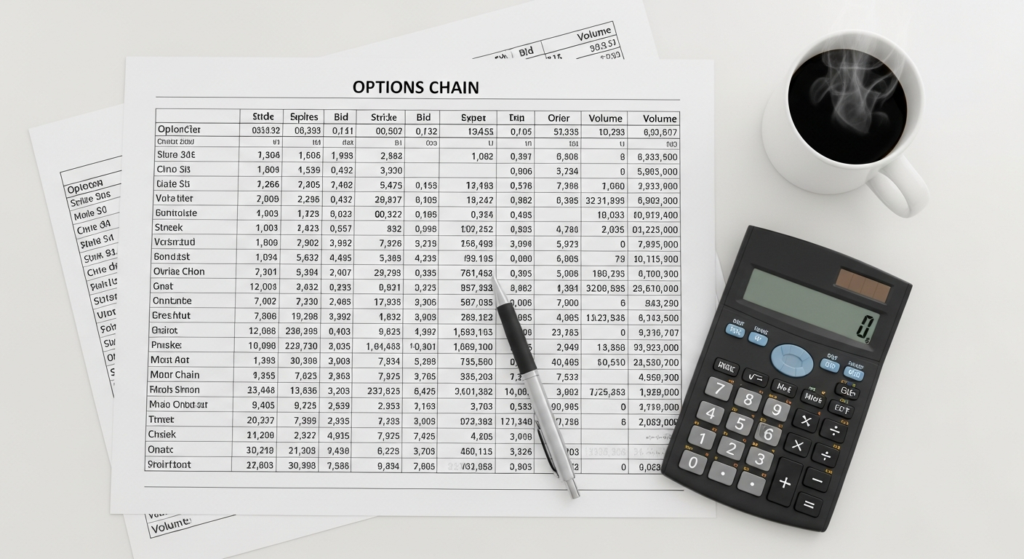
- Options Chain: This is the most fundamental tool, available on any brokerage platform. It displays all available call and put options for a given underlying asset, organized by strike price and expiration date. Key data points to analyze:
- Strike Prices: Range of available strike prices.
- Expiration Dates: Different expiration cycles (weekly, monthly, LEAPs).
- Bid/Ask Prices: Current prices for buying and selling the options. Look for tight spreads for better liquidity.
- Volume: Number of contracts traded today. High volume indicates active trading.
- Open Interest: Total number of outstanding contracts. High open interest suggests good liquidity and institutional participation.
- Implied Volatility (IV): A measure of the market’s expectation of future price swings. Higher IV generally means higher option premiums.
- The Greeks: Delta, Gamma, Theta, Vega values for each contract.
- Options Calculators & Strategy Builders: Many brokerage platforms and third-party websites offer options calculators. These tools allow you to input a strategy (e.g., buying a call, selling a covered call) and visualize the potential profit/loss at different stock prices and expiration dates. They often display the Greeks and analyze the probability of profit. Fidelity, Schwab, E*TRADE, and tastytrade all offer robust versions.
- Brokerage Platforms: Modern platforms like Interactive Brokers, Charles Schwab (thinkorswim), Fidelity, and E*TRADE offer sophisticated analysis tools, real-time data, and paper trading environments. Look for platforms that offer:
- Intuitive options chain display.
- Strategy builders and profit/loss analysis.
- Real-time data feeds.
- Customizable watchlists and alerts.
- Educational resources.
- Financial News and Analysis Websites: Stay informed about the underlying companies and broader market trends. Reputable sources like Bloomberg, The Wall Street Journal, Reuters, and specialized financial news outlets provide crucial context. Look for earnings reports, analyst ratings, and macroeconomic indicators that can influence stock prices and implied volatility.
Navigating the Options Landscape in 2026: Trends and Considerations
The options market in 2026 continues to evolve, shaped by technological advancements, market dynamics, and increasing retail investor participation. Understanding these trends is vital for staying ahead.
Increased Retail Participation and Accessibility:
Over the past few years, we’ve witnessed an unprecedented surge in retail investors entering the options market, driven by zero-commission trading, simplified platform interfaces, and the widespread dissemination of trading knowledge (and sometimes misinformation) online. This trend is expected to continue in 2026. While increased participation can lead to greater liquidity in popular options, it also means more competition and the potential for heightened volatility around popular, heavily traded stocks. The proliferation of accessible tools means the ‘smart non-expert’ has more resources than ever, but also necessitates a more rigorous approach to filtering out noise and focusing on proven strategies.
The Role of High-Frequency Trading (HFT) and Market Makers:
High-frequency trading firms and professional market makers play a significant role in providing liquidity to the options market. They profit from bid-ask spreads and by balancing their books. While they ensure efficient pricing, their advanced algorithms can react to market news and order flow far faster than individual traders. This underscores the importance of executing trades efficiently, using limit orders instead of market orders, and focusing on strategies with a statistical edge rather than trying to outpace HFT