
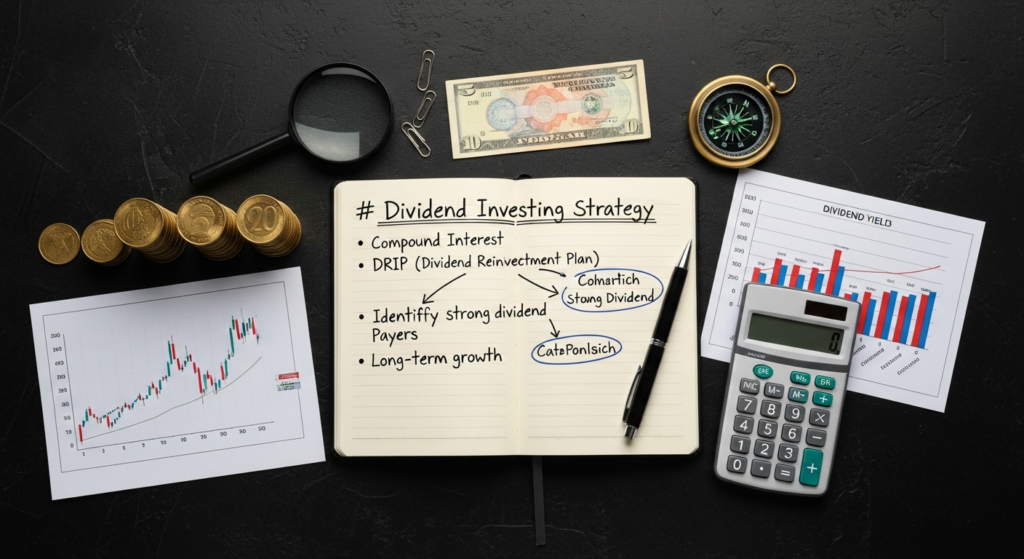
Mastering Dividend Investing: A Comprehensive Strategy Guide for Long-Term Wealth Generation

Mastering Dividend Investing: A Comprehensive Strategy Guide for Long-Term Wealth Generation Welcome to TradingCosts,
dividend investing strategy guide

Mastering Dividend Investing: A Comprehensive Strategy Guide for Long-Term Wealth Generation

Welcome to TradingCosts, where our mission is to empower investors with data-driven insights and actionable strategies. In the pursuit of long-term financial security and wealth accumulation, few investment approaches offer the tangible benefits and consistent income potential of dividend investing. Often championed by seasoned investors and financial advisors alike, a well-executed dividend strategy can serve as a cornerstone of a robust portfolio, providing both a steady stream of income and a powerful engine for compounding returns.

This comprehensive guide delves deep into the world of dividend investing, moving beyond superficial definitions to explore the nuances, benefits, risks, and practical steps involved in building a resilient dividend-focused portfolio. Whether you’re a novice investor seeking to understand the basics or an experienced one looking to refine your strategy, we’ll equip you with the expert knowledge needed to navigate this rewarding investment path. We’ll examine key metrics, discuss portfolio construction, analyze tax implications, and highlight common pitfalls, all while maintaining our commitment to objective analysis and actionable advice.

The Foundation of Dividend Investing: What, Why, and How it Works

At its core, a dividend is a distribution of a portion of a company’s earnings to its shareholders. When you own a share of a dividend-paying company, you essentially become a part-owner, and the company shares its profits with you, typically on a quarterly basis. These payments are usually made in cash, though some companies offer dividend reinvestment plans (DRIPs) where dividends are automatically used to purchase more shares of the company.

Understanding Key Dividend Metrics:

  • Dividend Yield: This is the annual dividend per share divided by the stock’s current share price, expressed as a percentage. For example, a stock trading at $100 paying $2 per year in dividends has a 2% dividend yield. It’s a quick way to gauge the income potential of a stock relative to its price.
  • Dividend Payout Ratio: This metric indicates the percentage of a company’s earnings that are paid out as dividends. It’s calculated as Dividends Per Share (DPS) divided by Earnings Per Share (EPS). A healthy payout ratio typically ranges from 30% to 70% for mature, stable companies. A ratio too high (e.g., above 80-90%) might signal unsustainability, while a very low ratio might suggest the company is reinvesting heavily or could afford to pay more.
  • Dividend Growth Rate: This measures how quickly a company’s dividend payments have increased over a specific period. Consistent dividend growth is often a strong indicator of a healthy, financially disciplined company with increasing earnings and free cash flow.

Why Companies Pay Dividends:

Companies pay dividends for several strategic reasons. Firstly, it signals financial strength and stability. A company that consistently pays and increases its dividends demonstrates confidence in its future earnings and cash flow generation. Secondly, it attracts a specific type of investor – those seeking income, stability, and long-term capital appreciation. Finally, for mature companies with fewer high-growth reinvestment opportunities, returning capital to shareholders via dividends can be a more efficient use of earnings than hoarding cash or making less productive investments.

The Power of Compounding and Reinvestment:

One of the most compelling aspects of dividend investing is the power of compounding. When you reinvest your dividends, you use the income generated to buy more shares, which in turn generate more dividends. This creates a snowball effect, accelerating your portfolio’s growth over time. Historically, a significant portion of total stock market returns has been attributed to dividends and their reinvestment. For instance, according to a study by Hartford Funds and Ned Davis Research, from 1970 to 2020, dividends contributed approximately 41% of the S&P 500’s total return. While past performance is not indicative of future results, this illustrates the substantial impact of reinvesting income.

Identifying High-Quality Dividend Stocks: Key Metrics and Criteria

💰 Investing Tip

Not all dividend stocks are created equal. A high dividend yield can sometimes be a red flag, indicating a struggling company whose stock price has fallen, artificially inflating its yield. Identifying truly high-quality dividend payers requires a methodical approach, focusing on financial health, sustainability, and growth potential.

Essential Metrics to Evaluate:

  • Sustainable Dividend Yield: While a higher yield is attractive, focus on sustainability. Compare the stock’s yield to its historical average and its industry peers. The average dividend yield of the S&P 500 typically hovers between 1.5% and 2.0%. A yield significantly above 5-6% (especially for large-cap, stable companies) warrants deeper investigation into the company’s financial health.
  • Consistent Dividend Growth: Companies that consistently increase their dividends over many years are often referred to as “Dividend Aristocrats” (S&P 500 companies with 25+ consecutive years of dividend increases) or “Dividend Kings” (50+ consecutive years). Examples include Procter & Gamble (PG) and Johnson & Johnson (JNJ), which have decades of uninterrupted dividend growth. Such a track record indicates robust business models and management committed to shareholder returns.
  • Healthy Payout Ratio: As discussed, a payout ratio between 30% and 70% is generally considered healthy. It suggests the company has enough earnings to cover its dividends while retaining sufficient capital for reinvestment, debt reduction, or future growth. A payout ratio consistently above 80% might indicate that the dividend is unsustainable, particularly if earnings decline.
  • Strong Free Cash Flow (FCF): Dividends are paid from cash, not just reported earnings. Free cash flow (operating cash flow minus capital expenditures) is a crucial indicator of a company’s ability to generate the cash needed to pay and grow its dividends. Look for companies with consistent and growing FCF.
  • Manageable Debt Levels: Companies with excessive debt may struggle to maintain dividend payments, especially during economic downturns or periods of rising interest rates. Assess the company’s debt-to-equity ratio and interest coverage ratio to ensure its debt load is manageable.
  • Robust Business Fundamentals: Beyond the dividend metrics, evaluate the underlying business. Does it operate in a stable industry? Does it have a strong competitive advantage (a “moat”)? Look for consistent revenue growth, strong profit margins, and a clear strategic vision. Companies in consumer staples, utilities, healthcare, and certain technology sectors often exhibit these characteristics.

Building a Resilient Dividend Portfolio: Diversification and Strategy

A successful dividend investment strategy isn’t just about picking individual stocks; it’s about constructing a diversified portfolio that can weather market fluctuations and consistently deliver income and growth. Diversification is paramount to mitigate risks inherent in individual stock selection.

Key Diversification Strategies:

  • Sector Diversification: Avoid concentrating too much of your portfolio in a single industry. For example, if you hold many utility stocks, a sudden change in energy policy could disproportionately impact your returns. Spread your investments across various sectors like consumer staples, industrials, healthcare, technology, and financials.
  • Geographic Diversification: While many strong dividend payers are U.S.-based, consider diversifying internationally through global dividend ETFs or individual foreign stocks. This can reduce reliance on a single economy and potentially tap into different growth drivers.
  • Market Capitalization Diversification: While large-cap companies often offer the most stable dividends, mid-cap and even some small-cap companies can provide higher growth potential, albeit with increased risk. A balanced approach can be beneficial.

Popular Dividend Investment Strategies:

Investors can tailor their dividend strategy to their specific goals and risk tolerance:

  • Dividend Growth Strategy: This strategy focuses on companies that consistently increase their dividend payments year after year, even if their initial yield isn’t the highest. The idea is that a growing dividend often signifies a growing, healthy business, and over time, the yield on your original investment can become very substantial. Examples include companies like Coca-Cola (KO) or 3M (MMM), renowned for their long dividend growth streaks. This approach often leads to capital appreciation alongside income growth.
  • High Dividend Yield Strategy: This strategy prioritizes current income, seeking out stocks with above-average dividend yields. While tempting, investors must exercise caution to avoid “value traps”—companies with high yields due to a falling stock price and a high likelihood of a dividend cut. Thorough due diligence on financial health is critical for this strategy.
  • Dividend Aristocrats/Kings Strategy: As mentioned, investing in companies that have consistently raised dividends for 25 (Aristocrats) or 50+ (Kings) years offers a focus on proven stability and financial discipline. ETFs like the ProShares S&P 500 Dividend Aristocrats ETF (NOBL) provide diversified exposure to this group.
  • Dividend Reinvestment Plans (DRIPs): Many companies and brokerages offer DRIPs, allowing you to automatically reinvest your cash dividends back into additional shares of the same stock, often commission-free. This strategy maximizes the power of compounding without requiring manual intervention, making it ideal for long-term wealth building.

Leveraging ETFs and Mutual Funds for Dividend Investing:

For investors seeking broad diversification and professional management without the need to research individual stocks, dividend-focused Exchange Traded Funds (ETFs) and mutual funds are excellent options. These funds hold a basket of dividend-paying stocks, automatically providing diversification across companies and sectors.

  • Vanguard High Dividend Yield ETF (VYM): Seeks to track the performance of the FTSE High Dividend Yield Index, which comprises common stocks of companies that generally pay above-average dividends.
  • Schwab U.S. Dividend Equity ETF (SCHD): Tracks the Dow Jones U.S. Dividend 100 Index, focusing on companies with a history of consistent dividend payments and strong financial fundamentals.
  • ProShares S&P 500 Dividend Aristocrats ETF (NOBL): Specifically invests in companies that are part of the S&P 500 and have increased their dividends for at least 25 consecutive years.

These funds offer immediate diversification, often with lower expense ratios compared to actively managed mutual funds, making them a popular choice for many dividend investors.

Tax Implications and Account Considerations

The tax treatment of dividends can significantly impact your net returns, making it crucial to understand the rules and utilize appropriate account types.

Qualified vs. Non-Qualified Dividends:

  • Qualified Dividends: These are typically paid by U.S. corporations or qualified foreign corporations and meet specific holding period requirements. They are taxed at lower long-term capital gains rates (0%, 15%, or 20% depending on your income bracket). Most dividends you receive from publicly traded U.S. companies will fall into this category.
  • Non-Qualified (Ordinary) Dividends: These include dividends from REITs (Real Estate Investment Trusts), money market accounts, employee stock options, and some foreign companies. They are taxed at your ordinary income tax rate, which can be significantly higher than qualified dividend rates.

Optimizing with Tax-Advantaged Accounts:

Investing in dividend stocks within tax-advantaged accounts can significantly boost your long-term returns by deferring or eliminating taxes on dividend income and capital gains.

  • Traditional IRA/401(k): Contributions are often tax-deductible, and investments grow tax-deferred. You pay taxes only upon withdrawal in retirement, typically at your ordinary income tax rate. This allows dividends to compound without annual tax drag.
  • Roth IRA/401(k): Contributions are made with after-tax dollars, but qualified withdrawals in retirement are entirely tax-free. This means all your dividend income and capital gains can grow and be withdrawn tax-free, making Roth accounts particularly powerful for dividend investors.
  • Health Savings Account (HSA): For those eligible, HSAs offer a triple tax advantage: tax-deductible contributions, tax-free growth, and tax-free withdrawals for qualified medical expenses. Investing dividends within an HSA can provide an extremely efficient way to save and grow wealth.

Taxable Brokerage Accounts:

Dividends received in a standard taxable brokerage account are subject to taxes in the year they are received. While qualified dividends receive favorable tax treatment, they still incur an annual tax liability, which can slightly dampen the compounding effect compared to tax-advantaged accounts. It’s often strategic to prioritize tax-inefficient dividend payers (like REITs or high-turnover funds generating ordinary dividends) within tax-advantaged accounts first.

Foreign Withholding Tax:

If you invest in international dividend stocks or ETFs, you might encounter foreign withholding taxes. Many countries withhold a portion of dividends paid to foreign investors. The U.S. has tax treaties with many countries to reduce or eliminate this withholding, and you may be able to claim a foreign tax credit on your U.S. tax return. However, this adds a layer of complexity.

Risks and Common Pitfalls in Dividend Investing

While dividend investing offers numerous advantages, it’s not without its risks. Acknowledging and understanding these potential pitfalls is crucial for building a robust and sustainable strategy.

  • Dividend Cuts or Suspensions: The most significant risk for dividend investors is a company reducing or eliminating its dividend. This often occurs when a company’s earnings decline, its financial health deteriorates, or it needs to conserve cash for other purposes (e.g., debt reduction, capital expenditures). A dividend cut typically leads to a sharp decline in the stock price, impacting both income and capital. Enron, General Electric, and many banks during the 2008 financial crisis serve as stark reminders of this risk.
  • Value Traps: A high dividend yield can be deceptive. Sometimes, a stock’s price falls significantly due to underlying business problems, artificially inflating its yield. Investors who chase these high yields without thoroughly analyzing the company’s fundamentals can fall into “value traps,” ending up with a struggling business and a likely dividend cut. Always scrutinize the payout ratio, free cash flow, and debt levels.
  • Interest Rate Sensitivity: Dividend stocks, particularly those with stable but lower growth prospects (like utilities or REITs), can be sensitive to changes in interest rates. When interest rates rise, the appeal of fixed-income investments (like bonds) increases, making dividend stocks, especially those with high yields but low growth, less attractive in comparison. This can put downward pressure on their stock prices.
  • Inflation Risk: While dividends provide income, inflation erodes the purchasing power of that income over time. If a company’s dividend growth rate doesn’t keep pace with inflation, your real (inflation-adjusted) return will decline. This underscores the importance of focusing on dividend growth, not just current yield.
  • Overconcentration: Focusing too heavily on a few high-yielding stocks or a single sector (e.g., energy or financials) can expose your portfolio to excessive risk. A downturn in that specific company or industry can severely impact your overall returns. Diversification across sectors, industries, and company sizes is essential.
  • Ignoring Total Return: Some dividend investors focus solely on the dividend yield, neglecting the total return, which includes both dividends and capital appreciation (or depreciation). A stock might have a high yield but experience significant capital losses, leading to a poor overall return. A balanced approach considers both income and potential for capital growth.
  • Tax Inefficiency: As discussed, neglecting the tax implications of dividends can reduce your net income. Failing to utilize tax-advantaged accounts or understand the difference between qualified and non-qualified dividends can result in higher tax liabilities.

Practical Steps to Get Started with Dividend Investing

Ready to build your dividend portfolio? Here’s a practical roadmap:

  1. Define Your Goals: Are you seeking current income for retirement, or long-term growth through dividend reinvestment? Your goals will shape your strategy.
  2. Choose a Brokerage Account: Select a reputable brokerage that offers low commissions, a wide range of investment options (stocks, ETFs), and user-friendly tools. Popular choices include Fidelity, Charles Schwab, Vanguard, Interactive Brokers, and M1 Finance (known for its automated portfolio features and fractional shares). Many offer commission-free trading for stocks and ETFs.
  3. Fund Your Account: Set up regular contributions, whether weekly, bi-weekly, or monthly, to leverage dollar-cost averaging.
  4. Research & Select Investments:
    • For individual stocks: Use screeners provided by your brokerage or financial websites (e.g., Finviz, Seeking Alpha, Yahoo Finance) to filter for criteria like dividend yield, payout ratio, dividend growth history, and market cap. Focus on companies with strong fundamentals and a history of reliable payments.
    • For ETFs/Mutual Funds: Consider funds like VYM, SCHD, or NOBL for diversified exposure. Research their underlying holdings, expense ratios, and historical performance.
  5. Implement a DRIP: If your goal is long-term growth, set up automatic dividend reinvestment with your brokerage. This ensures your dividends are put to work immediately.
  6. Monitor and Rebalance: Periodically review your portfolio (e.g., quarterly or annually) to ensure it aligns with your goals. Rebalance as needed to maintain your desired asset allocation and risk profile. This might involve selling some overperforming assets and buying more of underperforming ones to restore balance.

Conclusion: The Enduring Power of Dividend Investing

Dividend investing, when approached with discipline and a comprehensive understanding of its underlying principles, offers a robust pathway to long-term financial success. It’s not merely about receiving periodic payments; it’s about strategically aligning with financially sound companies that share their prosperity, providing both a tangible income stream and a powerful mechanism for compounding wealth.

📊 Market Insight

By focusing on quality metrics like sustainable payout ratios, strong free cash flow, and a consistent history of dividend growth, investors can construct a resilient portfolio designed to generate income and appreciate over time. Diversification across sectors and geographies, coupled with the strategic use of tax-advantaged accounts, further enhances the effectiveness of this approach. While risks such as dividend cuts and value traps exist, diligent research and a long-term perspective can help mitigate these challenges.

At TradingCosts, we believe that informed decisions are the cornerstone of successful investing. Embrace the principles outlined in this guide, and you’ll be well-equipped to harness the enduring power of dividend investing to build a secure and prosperous financial future.

Disclaimer: This article is for informational and educational purposes only and does not constitute financial advice. Investing in securities involves risks, including the potential loss of principal. Always consult with a qualified financial advisor before making any investment decisions.

“`json
{
“@context”: “https://schema.org”,
“@graph”: [
{
“@type”: “Article”,
“headline”: “Mastering Dividend Investing: A Comprehensive Strategy Guide for Long-Term Wealth Generation”,
“image”: {
“@type”: “ImageObject”,
“url”: “https://www.tradingcosts.com/images/dividend-investing-banner.jpg”,
“width”: 1200,
“height”: 675
},
“author”: {
“@type”: “Organization”,
“name”: “TradingCosts Editorial Team”
},
“publisher”: {
“@type”: “Organization”,
“name”: “TradingCosts”,
“logo”: {
“@type”: “ImageObject”,
“url”: “https://www.tradingcosts.com/images/tradingcosts-logo.png”,
“width”: 600,
“height”: 60
}
},
“datePublished”: “2023-10-27T08:00:00+00:00”,
“dateModified”: “2023-10-27T08:00:00+00:00”,
“mainEntityOfPage”: {
“@type”: “WebPage”,
“@id”: “https://www.tradingcosts.com/blog/dividend-investing-strategy-guide”
},
“articleSection”: [
“Investing & Trading”
],
“keywords”: “dividend investing, dividend stocks, passive income, investment strategy, long-term wealth, financial planning, portfolio diversification, dividend yield, dividend growth, tax-advantaged accounts, financial advice”,
“articleBody”: “Welcome to TradingCosts, where our mission is to empower investors with data-driven insights and actionable strategies. In the pursuit of long-term financial security and wealth accumulation, few investment approaches offer the tangible benefits and consistent income potential of dividend investing. Often championed by seasoned investors and financial advisors alike, a well-executed dividend strategy can serve as a cornerstone of a robust portfolio, providing both a steady stream of income and a powerful engine for compounding returns. This comprehensive guide delves deep into the world of dividend investing, moving beyond superficial definitions to explore the nuances, benefits, risks, and practical steps involved in building a resilient dividend-focused portfolio. Whether you’re a novice investor seeking to understand the basics or an experienced one looking to refine your strategy, we’ll equip you with the expert knowledge needed to navigate this rewarding investment path. We’ll examine key metrics, discuss portfolio construction, analyze tax implications, and highlight common pitfalls, all while maintaining our commitment to objective analysis and actionable advice. [Rest of the article content would go here, truncated for brevity in schema example]”
},
{
“@type”: “FAQPage”,
“mainEntity”: [
{
“@type”: “Question”,
“name”: “Q1: Is dividend investing suitable for everyone?”,
“acceptedAnswer”: {
“@type”: “Answer”,
“text”: “A1: Dividend investing can be suitable for a wide range of investors, particularly those seeking passive income, long-term wealth accumulation, and a degree of stability in their portfolio. It’s especially appealing to retirees or those nearing retirement who rely on investment income, as well as younger investors who can benefit from the compounding power of reinvested dividends over decades. However, it requires patience and a long-term perspective, and may not be ideal for those seeking aggressive short-term growth or high-risk, high-reward opportunities.”
}
},
{
“@type”: “Question”,
“name”: “Q2: What’s considered a \”good\” dividend yield?”,
“acceptedAnswer”: {
“@type”: “Answer”,
“text”: “A2: A \”good\” dividend yield is subjective and depends on your goals and the company’s industry. Generally, a yield significantly above the S&P 500 average (historically 1.5-2.0%) can be attractive. However, blindly chasing the highest yield is risky due to potential \”value traps.\” A yield between 2% and 5% from a financially stable company with a history of dividend growth is often considered a healthy balance. Always prioritize sustainability and the company’s ability to maintain or grow its dividend over a high current yield.”
}
},
{
“@type”: “Question”,
“name”: “Q3: Should I always reinvest my dividends?”,
“acceptedAnswer”: {
“@type”: “Answer”,
“text”: “A3: For most long-term investors, especially those in their accumulation phase, reinvesting dividends (DRIPs) is highly recommended. It harnesses the power of compounding, allowing you to buy more shares without additional cash contributions, thus accelerating portfolio growth. If you’re retired or need the income to cover living expenses, taking the dividends as cash is perfectly acceptable. Your decision should align with your financial goals and current life stage.”
}
},
{
“@type”: “Question”,
“name”: “Q4: How do I find good dividend stocks?”,
“acceptedAnswer”: {
“@type”: “Answer”,
“text”: “A4: You can find good dividend stocks by using stock screeners available on most brokerage platforms (e.g., Fidelity, Schwab)