Mastering Your Money: A Comprehensive Guide to Creating an Effective Household Budget
The Strategic Imperative: Why a Household Budget is Non-Negotiable
For many, the word “budget” conjures images of restriction and sacrifice. However, a truly effective budget is not about deprivation; it’s about empowerment, intentionality, and strategic allocation of resources. It transforms abstract financial goals into concrete, actionable plans. Without a clear understanding of where your money originates and, more importantly, where it goes, you are essentially navigating a financial landscape blindfolded.
Consider the average American household. According to the Bureau of Labor Statistics (BLS), consumer units spent an average of $72,967 in 2022. This figure, while insightful, masks the vast variations in individual spending patterns. A budget provides the personalized lens to scrutinize your unique financial blueprint. It helps you:
* Identify Financial Leaks: Uncover recurring, often unnoticed, expenditures that drain your resources. These “silent killers” can range from subscription services you no longer use to excessive dining out.
* Achieve Financial Goals: Whether it’s saving for a down payment, funding a child’s education, paying down high-interest debt, or building a robust retirement portfolio, a budget provides the roadmap. Without it, goals remain aspirational rather than attainable.
* Reduce Financial Stress: Uncertainty breeds anxiety. A clear budget replaces ambiguity with clarity, allowing you to make informed decisions and providing peace of mind, even amidst economic volatility.
* Optimize Investment Capital: Every dollar saved through smart budgeting is a dollar that can be invested. Historically, the S&P 500 has delivered an average annual return of approximately 10-12% over the long term, demonstrating the profound impact of compounding. Even small, consistent contributions, freed up by effective budgeting, can grow substantially over decades. For example, consistently investing an extra $200 per month could accumulate to over $220,000 in 30 years, assuming a conservative 7% annual return.
In essence, a budget is your personal financial operating statement, offering the insights needed to make data-driven decisions that align with your broader financial objectives.
Deconstructing Your Financial Landscape: Income and Expenditure Analysis
Step 1: Calculate Your Net Income
Your net income (or take-home pay) is the total amount of money you receive after taxes, 401(k) contributions, health insurance premiums, and other deductions. For most salaried employees, this is straightforward. For freelancers, small business owners, or those with variable income, this may require averaging income over several months or even a year to get a realistic figure. Include all sources: salaries, side hustles, rental income, dividends, interest, and any other regular cash inflows.
Step 2: Track and Categorize Your Spending
Categorize your expenses into two primary groups:
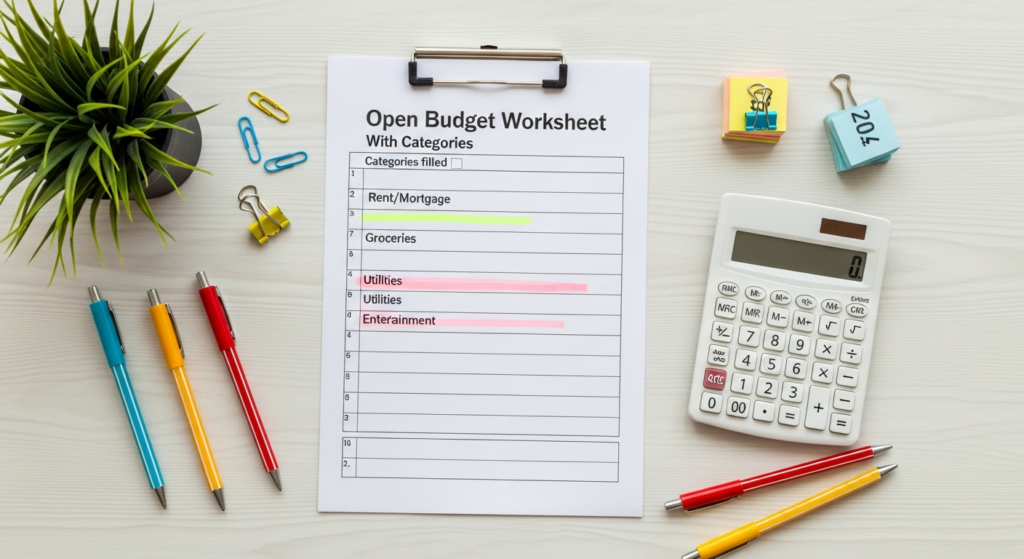
* Fixed Expenses: These are costs that typically remain constant each month and are often contractual. Examples include:
* Rent/Mortgage payments
* Loan payments (car, student, personal)
* Insurance premiums (health, auto, home)
* Subscription services (Netflix, gym memberships)
* Property taxes (if paid monthly)
* Variable Expenses: These fluctuate from month to month and offer the most flexibility for adjustments. Examples include:
* Groceries
* Utilities (electricity, gas, water – these can have seasonal variations)
* Dining out/Entertainment
* Transportation (gas, public transit, ride-shares)
* Clothing
* Personal care
* Medical co-pays
Pro Tip for Tracking: Use your bank statements and credit card statements as primary data sources. Many financial institutions offer categorization tools within their online platforms. Alternatively, dedicated budgeting apps can automate much of this process by linking to your accounts.
Once you have a clear picture of your total net income and your categorized expenses, you can begin to see where your money truly goes. You might be surprised to find that seemingly small, frequent purchases accumulate into significant amounts. For instance, a daily $5 coffee habit translates to $150 per month, or $1,800 annually – a sum that could contribute meaningfully to an IRA or emergency fund.
Architecting Your Financial Framework: Choosing a Budgeting Method
With your financial data in hand, it’s time to select a budgeting method that aligns with your personality, financial complexity, and goals. There is no one-size-fits-all approach; the best budget is the one you will consistently use.
1. The 50/30/20 Rule
Concept: This popular rule, popularized by Senator Elizabeth Warren, advocates allocating your after-tax income into three broad categories:
* 50% for Needs: Essential expenses like housing, utilities, groceries, transportation, insurance, and minimum loan payments.
* 30% for Wants: Discretionary spending such as dining out, entertainment, hobbies, vacations, and non-essential shopping.
* 20% for Savings & Debt Repayment: Contributions to an emergency fund, retirement accounts (401(k), IRA), investment accounts, and extra payments on high-interest debt.
Pros: Simplicity and ease of implementation. Provides a high-level framework without getting bogged down in minute details. Good starting point for beginners.
Cons: Can be too broad for those needing more granular control. May not be suitable for individuals with very high or very low incomes, where 50% for needs might be too restrictive or too generous.
Data Point: The 20% savings target aligns with expert recommendations for building substantial wealth over time, particularly when considering the power of compound interest.
2. Zero-Based Budgeting
Concept: Every dollar of your income is assigned a specific job. Income minus expenses (including savings and debt payments) should equal zero. This means you actively decide where every dollar goes before the month begins.
Pros: Maximizes financial control and intentionality. Ensures no money is left unaccounted for, preventing “mystery spending.” Highly effective for debt reduction and rapid savings accumulation.
Cons: Requires significant time and discipline, especially initially. Can feel restrictive for some. Less flexible for unexpected expenses unless a “miscellaneous” category is included.
Practical Application: Ideal for individuals committed to aggressive financial goals. Platforms like You Need A Budget (YNAB) are built around this methodology.
3. The Envelope System
Concept: A physical, cash-based system where you allocate specific amounts of cash into labeled envelopes for various variable spending categories (e.g., “Groceries,” “Entertainment,” “Gas”). Once an envelope is empty, you stop spending in that category until the next budgeting cycle.
Pros: Highly effective for curbing overspending in specific categories. Tangible and visual, which can be beneficial for those who struggle with digital tracking.
Cons: Inconvenient in a largely cashless society. Not suitable for fixed expenses or online payments. Security concerns with carrying large amounts of cash.
Relevance: While less common today, the underlying principle of pre-allocating funds can be adapted digitally using separate bank accounts or virtual envelopes within budgeting apps.
4. Paycheck-to-Paycheck (PTP) Budgeting
Concept: While “paycheck-to-paycheck” often implies financial struggle, this method (when intentionally applied) involves creating a mini-budget for each paycheck received, ensuring all expenses due before the next paycheck are covered.
Pros: Excellent for individuals with variable income or those just starting to build a financial buffer. Provides frequent check-ins and adjustments.
Cons: Can feel constant and demanding. Requires careful synchronization of income and expense due dates.
Strategic Use: Can be a stepping stone to building a one-month buffer, where your current month’s expenses are covered by last month’s income. This is a key principle advocated by many financial advisors for reducing stress and increasing financial resilience.
5. Hybrid Approaches
Many individuals find success by blending elements of different methods. For instance, you might use the 50/30/20 rule as an overarching guide but implement zero-based budgeting for your “wants” category to gain more control over discretionary spending. The key is to experiment and find what resonates with your financial habits and goals.
Operationalizing Your Budget: Implementation, Tracking, and Tools
Once you’ve chosen a method, the next phase is putting it into action and maintaining consistency. This involves selecting the right tools and establishing a regular review cadence.
Budgeting Tools and Platforms
The market offers a robust suite of tools, ranging from basic spreadsheets to sophisticated financial management software.
* Spreadsheets (e.g., Google Sheets, Microsoft Excel):
* Pros: Free, highly customizable, offers complete control over categories and formulas. Excellent for those who enjoy data manipulation and deep dives.
* Cons: Requires manual data entry (unless integrated with bank feeds via third-party add-ons), time-consuming to set up and maintain.
* Dedicated Budgeting Software/Apps:
* Mint (Intuit):
* Pros: Free, links to bank accounts and credit cards, automates transaction categorization, tracks net worth, offers bill reminders. Good for a holistic financial overview.
* Cons: Categorization can sometimes be inaccurate, ads can be distracting, less emphasis on proactive budgeting (more reactive tracking).
* You Need A Budget (YNAB):
* Pros: Built on the zero-based budgeting philosophy, highly effective for changing financial habits, excellent customer support and educational resources.
* Cons: Subscription fee ($14.99/month or $99/year), steep learning curve initially for some users.
* Personal Capital (now Empower Personal Wealth):
* Pros: Free, links all financial accounts, strong emphasis on investment tracking and net worth analysis, offers retirement planning tools.
* Cons: Budgeting features are secondary to investment tracking, less granular control over daily spending compared to dedicated budgeting apps. Offers paid financial advisory services, which may be promoted.
* Fidelity Full View / Vanguard My Total Assets:
* Pros: If you already have accounts with these brokerages, their integrated tools offer a convenient way to aggregate accounts and get a high-level view of your finances. Can be particularly useful for investors.
* Cons: Budgeting features are typically less robust than dedicated apps; primarily focused on investment performance.
* Manual Ledger/Notebook:
* Pros: No cost, forces active engagement with every transaction, suitable for those who prefer physical tracking.
* Cons: Time-consuming, prone to human error, no automated insights or data analysis.
Establishing a Review Cadence
A budget is a living document, not a static spreadsheet. Regular review is crucial for its effectiveness.
* Weekly Check-ins (15-30 minutes): Review recent transactions, categorize any uncategorized spending, adjust for minor over/under spending in variable categories. This keeps you connected to your money.
* Monthly Review (1-2 hours): Reconcile all accounts, assess overall progress towards goals, adjust category limits for the upcoming month based on actual spending and anticipated changes (e.g., seasonal utility bills, upcoming travel). This is also a good time to check your emergency fund balance and investment contributions.
* Quarterly/Annual Review (2-4 hours): A more comprehensive review. Evaluate your long-term financial goals, adjust for significant life changes (e.g., new job, marriage, children, home purchase), reassess investment allocations, and ensure your budget still aligns with your overarching financial strategy. This is an opportune time to revisit your asset allocation within your Fidelity, Vanguard, or Schwab accounts, considering market performance and your risk tolerance.
Strategic Refinement and Future-Proofing: Adapting and Optimizing Your Budget
An effective budget is dynamic, evolving with your life and financial circumstances. Optimization is an ongoing process that integrates your budget with your broader financial goals, including investing and wealth accumulation.
1. Building a Robust Emergency Fund
Before aggressively investing beyond employer-matched 401(k) contributions, prioritize an emergency fund. Financial experts recommend saving 3-6 months’ worth of essential living expenses in a high-yield savings account (HYSA). This acts as a crucial buffer against unexpected job loss, medical emergencies, or significant home/auto repairs, preventing you from derailing your budget or tapping into investments prematurely.
2. Tackling High-Interest Debt
Budgeting helps identify funds that can be redirected towards debt repayment. High-interest debt, such as credit card balances (often with APRs exceeding 20%), can severely impede wealth creation. Strategically allocating extra funds from your budget to pay down these debts (e.g., using the debt snowball or debt avalanche method) offers a guaranteed “return” equivalent to the interest rate, often far surpassing typical market returns.
3. Integrating with Investment Goals
Your budget is the engine that fuels your investment portfolio.
* Automate Savings and Investments: Once your budget is established, automate transfers from your checking account to your savings, emergency fund, and investment accounts (e.g., brokerage accounts with Fidelity, Vanguard, Schwab, or your employer-sponsored 401(k)). This “pay yourself first” strategy ensures consistency.
* Align with Long-Term Objectives: If your goal is early retirement, your budget might be more aggressive in allocating towards retirement accounts. If saving for a child’s college, 529 plan contributions would be a budgeted line item.
* Leverage Windfalls: Budget any bonuses, tax refunds, or unexpected income strategically. Resist lifestyle creep. Consider allocating a significant portion to debt reduction, emergency fund bolstering, or increased investment contributions.
4. Dealing with Lifestyle Creep
As income increases, there’s a natural tendency for spending to rise proportionally. This “lifestyle creep” can negate the benefits of increased earnings. Your budget is your defense mechanism. When you get a raise, consciously decide how to allocate that extra income—perhaps 50% to savings/investments and 50% to an improved lifestyle, rather than letting it all dissipate into increased discretionary spending.
5. Inflation and Market Risk Considerations
While budgeting provides control over your personal finances, it’s crucial to acknowledge external economic factors.
* Inflation: The purchasing power of your money erodes over time due to inflation. Historically, inflation averages around 2-3% annually. This means your future expenses will likely be higher. Your budget should account for potential increases in costs for groceries, utilities, and services. Investing your savings, rather than letting it sit idle, is a key strategy to outpace inflation.
* Market Risk: When budgeting for investment contributions, remember that all investments carry risk. While historical returns are illustrative, past performance does not guarantee future results. Diversification across different asset classes (equities, bonds, real estate) and regular portfolio rebalancing are crucial risk management strategies employed by platforms like Fidelity and Vanguard.
By continuously refining your budget and integrating it with these broader financial strategies, you transform it from a mere tracking tool into a powerful instrument for wealth creation and financial freedom.
Conclusion: The Path to Financial Mastery
Creating and maintaining a household budget is far more than a mundane financial chore; it is an indispensable tool for financial mastery. It provides the clarity to understand your current financial standing, the framework to make intentional spending and saving decisions, and the strategic leverage to propel you towards your long-term investment goals. By meticulously tracking income and expenditure, choosing a suitable budgeting method, leveraging appropriate tools, and consistently reviewing and adapting your plan, you transform your financial narrative from one of reaction to one of proactive control. Embrace the process, commit to the discipline, and unlock the profound power of a well-managed budget to build enduring wealth and achieve true financial freedom.
*
Disclaimer: This article is for informational purposes only and does not constitute financial advice. The information provided is general in nature and does not consider your specific financial situation, investment objectives, or risk tolerance. Always consult with a qualified financial advisor before making any investment decisions. Investment involves risk, including the possible loss of principal. Past performance is not indicative of future results.