Simple Technical Analysis for Beginners: A Cost-Effective Guide to Smarter Trading
The world of retail investing has undergone a massive transformation heading into 2026. No longer is high-level market analysis reserved for institutional traders with million-dollar Bloomberg terminals and proprietary algorithms. Today, the individual investor has access to the same real-time data and sophisticated charting tools that were once gatekept by Wall Street. However, with this abundance of information comes a new challenge: complexity. Many beginners fall into the trap of “analysis paralysis,” cluttering their screens with dozens of indicators that provide conflicting signals.
Technical analysis (TA) doesn’t have to be expensive or overly complicated. At its core, TA is the study of historical price action and volume to identify patterns that suggest future price movements. For the retail trader looking to minimize costs, the goal is to develop a “minimalist” toolkit—using free resources to make high-probability decisions. This guide will walk you through the essentials of simple technical analysis, proving that you can navigate the markets effectively without spending a fortune on premium subscriptions or “guru” courses.
—
1. The Core Philosophy: Why Technical Analysis Works for Retail Investors
To succeed in technical analysis, you must first understand its foundational premise: **Price discounts everything.** This means that all known information—earnings reports, economic data, and geopolitical events—is already reflected in the current market price. As a retail investor, you are likely not the first to hear a piece of news. By the time you read a headline, the “smart money” has already reacted. Technical analysis allows you to stop chasing news and start following the money.
Another key pillar is that **prices move in trends.** Markets are not entirely random; they are driven by human psychology, which tends to repeat itself. Fear and greed create patterns that we can see on a chart. By learning to identify these patterns, you are essentially learning to read the collective sentiment of millions of other participants.
For the cost-conscious trader, the beauty of TA is its accessibility. While fundamental analysis often requires expensive access to private equity research or complex financial modeling software, the basic “language” of price action is free. Whether you are trading stocks, crypto, or forex, the charts look the same. By mastering a few simple concepts, you create a portable skill set that applies to any liquid market.
2. Essential Charting Tools Without the Price Tag
In 2026, there is absolutely no reason for a beginner to pay for charting software. The “freemium” models offered by industry leaders are more than sufficient for retail needs. Platforms like TradingView or the native charting tools within low-cost brokerages (like Robinhood, Charles Schwab, or various international equivalents) provide institutional-grade visuals for free.
#
Candlestick Charts: Your Primary Lens
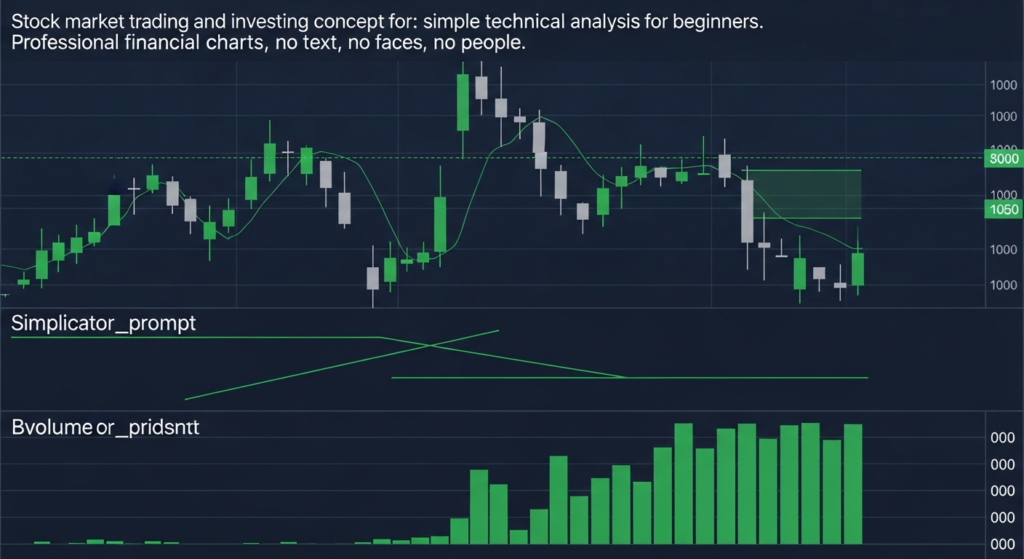
The first step in your technical journey is switching your view from a simple line chart to a **Candlestick Chart**. Candlesticks provide four data points for a specific period (whether it’s five minutes or one month): the Open, High, Low, and Close (OHLC).
* **The Body:** The filled part of the candle represents the range between the open and the close.
* **The Wicks (Shadows):** The thin lines above and below the body show the price extremes during that period.
A green (or hollow) candle means the price closed higher than it opened (bullish), while a red (or filled) candle means it closed lower (bearish). Understanding candlesticks is the most cost-effective way to gauge market “exhaustion.” For example, a long wick on the bottom of a candle suggests that sellers tried to push the price down, but buyers stepped in aggressively—a potential sign of a reversal.
3. Identifying Trends: The Retail Trader’s Best Friend
The oldest adage in trading remains the most important: “The trend is your friend.” For a beginner, the easiest way to lose money is to try and “pick the bottom” of a crashing stock or “short the top” of a mooning one. Simple technical analysis focuses on joining an existing move rather than predicting a new one.
#
The Three Market Phases
1. **Uptrend:** Characterized by a series of **Higher Highs (HH)** and **Higher Lows (HL)**. If the peaks and valleys are moving up, you should only be looking for buying opportunities.
2. **Downtrend:** Characterized by **Lower Highs (LH)** and **Lower Lows (LL)**. In this environment, the path of least resistance is down.
3. **Sideways/Ranging:** The price is trapped between a horizontal ceiling and floor. For beginners, these are often “no-trade zones” where capital gets chewed up by indecision.
#
Drawing Trendlines
You don’t need a PhD to draw a trendline. Simply connect at least two (ideally three) significant lows in an uptrend or two/three significant highs in a downtrend. As long as the price stays above an ascending trendline, the bullish thesis remains intact. When the price breaks a trendline with high volume, it serves as a free “warning light” that the market structure is changing.
4. Support and Resistance: Mapping the Market Floor and Ceiling
Support and resistance (S&R) are perhaps the most vital concepts in all of technical analysis. They represent “psychological barriers” where the price has historically struggled to move past.
* **Support (The Floor):** A price level where a downtrend tends to pause due to a concentration of buying demand. Think of it as a trampoline; when the price hits it, it tends to bounce back up.
* **Resistance (The Ceiling):** A price level where an uptrend pauses because sellers are stepping in to take profits.
#
The Principle of Role Reversal
One of the most “profitable” simple concepts to learn is that **broken resistance often becomes new support.** When a stock finally breaks through a “ceiling” that has held it back for months, that level often becomes the new “floor” when the price eventually pulls back.
To keep costs low, you don’t need automated “S&R Heatmaps.” You simply look at your chart, zoom out to the daily or weekly timeframe, and look for levels where the price touched and bounced multiple times. These “value zones” are where you should look to enter or exit trades, rather than buying at random prices.
5. Low-Lag Indicators for a Minimalist Strategy
While price action is king, a few select indicators can provide “confirmation.” The key for the retail investor is to avoid “indicator soup.” Stick to these two free, widely available tools:
#
Moving Averages (The Smoother)
A Moving Average (MA) takes the average price over a set number of days and plots it as a line.
* **The 50-Day MA:** Great for medium-term trend direction.
* **The 200-Day MA:** Often called the “line in the sand” for long-term investors.
If the price is above the 200-day MA, the market is generally considered healthy. A simple, cost-free strategy used by many is the “Golden Cross”—when a shorter-term MA crosses above a longer-term MA, signaling a major shift in momentum.
#
Relative Strength Index (RSI)
The RSI is a “momentum oscillator” that measures the speed and change of price movements on a scale of 0 to 100.
* **Overbought (>70):** The price may have risen too fast and is due for a pullback.
* **Oversold (<30):** The price may have fallen too hard and is due for a bounce.
**Warning:** In a strong trend, the RSI can stay overbought or oversold for a long time. Never sell just because the RSI is at 75; use it as a signal to tighten your stop-loss or look for other signs of exhaustion.
6. Risk Management: How to Protect Your Capital for Free
The biggest difference between a retail trader who survives 2026 and one who goes bust is risk management. You can have the best technical analysis in the world, but if you don’t manage risk, one “black swan” event will wipe you out.
#
The 1% Rule
Never risk more than 1% of your total account balance on a single trade. If you have $5,000, you shouldn’t lose more than $50 if the trade goes against you. This is calculated by the distance between your entry price and your **Stop-Loss**.
#
Using Stop-Loss Orders
A stop-loss is a free tool provided by every modern broker. It is an automated order that sells your position if the price hits a certain level. By placing your stop-loss just below a major support level, you are using technical analysis to define your “exit door.” This removes emotion from the equation, which is the most expensive mistake a beginner can make.
#
Position Sizing
Retail investors often make the mistake of “going all in.” Instead, use your technical levels to determine your size. If the support level is far away, your position size should be smaller. If the support is very close, you can afford a slightly larger position while still only risking 1% of your total capital.
—
FAQ: Simple Technical Analysis for Beginners
**Q1: Is technical analysis better than fundamental analysis?**
Neither is “better.” Fundamental analysis tells you *what* to buy (a company with great earnings), while technical analysis tells you *when* to buy it (at a support level or trend breakout). Many successful retail traders use a “fusion” approach.
**Q2: How much time do I need to spend on charts every day?**
As a beginner, less is often more. Spending 15–30 minutes an evening looking at daily charts is usually more effective than staring at 1-minute charts all day, which often leads to over-trading and high commission costs.
**Q3: Can I use technical analysis for long-term investing?**
Absolutely. Long-term investors use weekly and monthly charts to ensure they aren’t buying a stock at a historical peak (resistance). TA helps you find “deals” on great companies during market pullbacks.
**Q4: Do I need to learn complex patterns like “Head and Shoulders” or “Gartley Harmonics”?**
Not initially. While these patterns can be useful, they are often subjective. Beginners should focus on trends, support/resistance, and volume. Master the basics before moving to “exotic” patterns.
**Q5: Why do some people say technical analysis doesn’t work?**
TA is about probabilities, not certainties. It “fails” when traders treat it like a crystal ball. TA works best when it is used to manage risk and identify zones where the odds are slightly in your favor.
—
Conclusion: The Path Forward in 2026
Simple technical analysis is a superpower for the retail investor. It provides a structured way to look at the chaos of the financial markets without needing a degree in finance or an expensive suite of software. By focusing on the “Minimalist Trio”—Trend, Support/Resistance, and Risk Management—you can cut through the noise and make decisions based on what the market is actually doing, rather than what you *hope* it will do.
As you begin your journey, remember that consistency is more valuable than brilliance. Start on a “paper trading” (simulated) account to practice drawing your lines and identifying trends without risking real capital. In the trading world of 2026, the winners aren’t those with the most expensive tools, but those with the most discipline and the simplest plans. Keep your charts clean, your risks low, and your mind focused on the price action. The markets are always communicating; your job is simply to learn how to listen.