

Social Security Planning: Maximizing Your Retirement Benefits
The Foundations of Social Security Benefits: Understanding the Basics
Before diving into maximization strategies, it’s essential to grasp the fundamental mechanics of how Social Security benefits are determined. This understanding forms the bedrock of effective social security planning.
Eligibility and Work Credits
To qualify for Social Security retirement benefits, you need to accumulate “work credits.” You can earn up to four credits each year. In 2024, one credit is earned for every $1,730 in earnings, up to the maximum of four credits for earnings of $6,920. Most people need 40 credits (10 years of work) to be eligible for retirement benefits. These credits do not need to be continuous; they simply need to be accumulated over your working lifetime.
Calculating Your Primary Insurance Amount (PIA)
Your monthly Social Security benefit is based on your Primary Insurance Amount (PIA), which is the benefit you would receive if you start collecting benefits at your Full Retirement Age (FRA). The calculation of your PIA is complex, based on your average indexed monthly earnings (AIME) over your 35 highest-earning years. If you have fewer than 35 years of earnings, zero-earning years will be averaged in, potentially reducing your AIME and thus your PIA. The AIME is then run through a progressive formula using “bend points” that are updated annually. This progressive formula means that lower-income earners receive a higher percentage of their average indexed earnings back as benefits compared to higher-income earners.
- Average Indexed Monthly Earnings (AIME): Your past earnings are adjusted (indexed) to account for changes in average wages in the economy since the year the earnings were paid. This ensures that your past earnings reflect their relative value at the time you became eligible for Social Security.
- Bend Points: These are dollar amounts that determine the segments of your AIME subject to different percentage factors. For example, for those becoming eligible for benefits in 2024, the PIA formula is: 90% of the first $1,174 of AIME, plus 32% of AIME over $1,174 up to $7,078, plus 15% of AIME over $7,078.
Defining Your Full Retirement Age (FRA)
Your Full Retirement Age (FRA) is the age at which you are entitled to receive 100% of your PIA. This age depends on your birth year. For those born in 1943 through 1954, FRA is 66. It gradually increases for those born between 1955 and 1959, reaching 67 for anyone born in 1960 or later. Knowing your specific FRA is crucial, as it serves as the benchmark for determining how much your benefits will be increased or decreased based on when you choose to claim.
Actionable Tip: Regularly check your Social Security Statement online at ssa.gov/myaccount. This statement provides a personalized estimate of your benefits at different claiming ages, your earnings history, and eligibility for disability and survivor benefits. Reviewing it annually helps you identify potential errors and keeps you informed for effective social security planning.
The Critical Decision: When to Claim Your Social Security Benefits
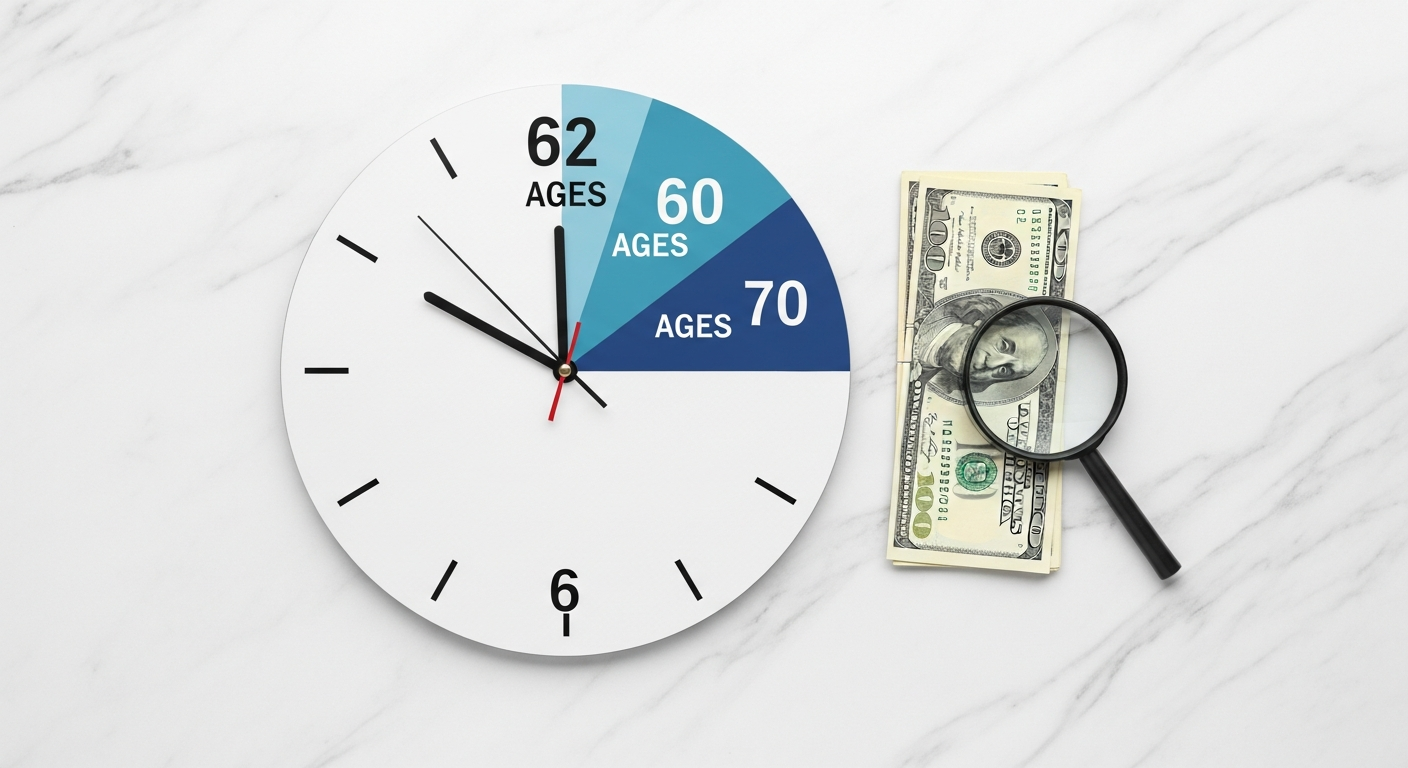
One of the most impactful decisions in your social security planning journey is choosing when to start receiving benefits. This choice can lead to vastly different monthly payouts and significantly affect your financial stability in retirement.
Claiming Early (Age 62)
The earliest age you can begin receiving Social Security retirement benefits is 62. However, claiming at this age results in a permanent reduction of your monthly benefit. The reduction percentage depends on your Full Retirement Age (FRA). For someone with an FRA of 67, claiming at age 62 means accepting a benefit that is approximately 30% less than their PIA. While this provides income sooner, it locks in a lower monthly amount for life. This option might be suitable for individuals with shorter life expectancies, immediate financial needs, or those who simply wish to enjoy retirement earlier and have other sufficient income sources.
Pros:
- Access to income earlier.
- Potentially useful for those facing health issues or job loss.
Cons:
- Permanently reduced monthly benefit.
- Lower lifetime earnings for beneficiaries if you live a long life.
Claiming at Full Retirement Age (FRA)
Claiming benefits at your FRA means you receive 100% of your Primary Insurance Amount (PIA). This is the baseline from which early and delayed claiming are measured. For many, claiming at FRA strikes a balance between receiving benefits at a reasonable age and getting your full earned amount. At FRA, you can also work without your benefits being subject to the Social Security earnings test (which we’ll cover later).
Pros:
- Receive 100% of your earned benefit without reductions.
- No earnings test restrictions on your income.
Cons:
- May still leave potential “money on the table” compared to delayed claiming.
Delaying Benefits (Up to Age 70)
Perhaps the most powerful strategy for maximizing your benefits is delaying your claim beyond your FRA, up to age 70. For each year you delay past your FRA, your benefit amount increases by a certain percentage, known as Delayed Retirement Credits (DRCs). These credits amount to 8% per year for those born in 1943 or later. This means that if your FRA is 67 and you delay claiming until age 70, your monthly benefit will be 124% of your PIA (100% + 3 years * 8% per year). This 24% increase is a guaranteed, inflation-adjusted return on your decision to delay.
Example: If your PIA is $2,000 at an FRA of 67:
- Claiming at 62: Roughly $1,400/month (30% reduction).
- Claiming at 67 (FRA): $2,000/month.
- Claiming at 70: $2,480/month (24% increase).
Over a long retirement, this difference compounds significantly.
Factors to Consider When Deciding:
- Longevity: If you anticipate a long life, delaying benefits often makes financial sense due to the higher monthly payments over a longer period.
- Other Income/Savings: Do you have sufficient retirement savings or other income sources (pensions, investments) to cover your expenses if you delay claiming?
- Health Status: If you have serious health issues that suggest a shorter life expectancy, claiming earlier might be more advantageous.
- Spousal Considerations: Your claiming decision can impact your spouse’s benefits, especially if they qualify for spousal benefits.
Actionable Tip: Use the “break-even analysis” to help with your decision. Compare the total cumulative benefits from claiming early versus delaying. While delaying usually results in higher cumulative benefits if you live long enough (typically into your late 70s or early 80s), it’s crucial to evaluate your personal financial situation and health. Consult with a financial advisor specializing in social security planning to run personalized scenarios tailored to your unique circumstances.
Maximizing Social Security Planning for Couples and Survivors
For married couples, divorced individuals, and survivors, Social Security offers additional benefit structures that can be strategically leveraged to significantly enhance household retirement income. Effective social security planning for families goes beyond individual claims.
Spousal Benefits
If you are married, you may be eligible to receive a spousal benefit based on your spouse’s work record, even if you never worked or have a minimal work history. A spousal benefit can be up to 50% of your spouse’s Primary Insurance Amount (PIA) if you claim at your own Full Retirement Age (FRA). If you claim spousal benefits before your FRA, your benefit will be permanently reduced. Your spouse must have filed for their own benefits for you to claim spousal benefits (unless you were born before January 2, 1954, and can use the “Restricted Application” strategy, discussed below). If you are eligible for both your own retirement benefit and a spousal benefit, the Social Security Administration (SSA) will always pay you the higher of the two.
Example for Couples: Consider a scenario where one spouse has significantly higher earnings than the other.
- High earner’s PIA: $2,800/month
- Lower earner’s PIA: $800/month
- 50% of high earner’s PIA (spousal benefit): $1,400/month
In this case, the lower earner would likely claim the spousal benefit of $1,400, as it’s higher than their own $800 PIA, assuming they are both at their FRAs. This simple optimization can add thousands of dollars annually to a couple’s retirement income.
The “Restricted Application” Strategy (For Those Born Before Jan 2, 1954)
For individuals born on or before January 1, 1954, a special claiming strategy known as the “restricted application” is still available. This allows you, at your Full Retirement Age (FRA), to file a restricted application to claim only your spousal benefits while allowing your own retirement benefits to continue accruing Delayed Retirement Credits (DRCs) until age 70. At age 70, you would then switch to your own maximum retirement benefit, which would be 124% of your PIA (for those with an FRA of 67).
Example (Restricted Application):
- Spouse 1 (high earner, born 1953, FRA 66): Delays claiming until age 70 for maximum DRCs.
- Spouse 2 (lower earner, born 1953, FRA 66): Reaches FRA at 66. Files a “restricted application” for spousal benefits based on Spouse 1’s record. This allows Spouse 2 to receive 50% of Spouse 1’s PIA while Spouse 2’s own benefit grows with DRCs.
- At age 70, Spouse 2 switches to their own maximized benefit.
This strategy is incredibly powerful but limited to a specific birth demographic. It underscores the importance of understanding rules based on your birth year in social security planning.
Survivor Benefits
When a spouse dies, the surviving spouse may be eligible for survivor benefits. A surviving spouse can receive up to 100% of the deceased spouse’s benefit amount if claimed at their own FRA, or a reduced amount if claimed as early as age 60 (or age 50 if disabled). If the deceased spouse was collecting benefits, the survivor generally steps into their shoes. If the deceased spouse had not yet claimed, the survivor’s benefit is based on what the deceased would have received had they claimed at their death. A surviving divorced spouse may also be eligible if the marriage lasted 10 years or more and they are currently unmarried (or remarried after age 60). A key strategy here is that a surviving spouse can often claim one benefit (e.g., survivor benefit) while allowing their own retirement benefit to grow with DRCs, then switch to the higher benefit later. This “claim one, let the other grow” strategy is vital for optimizing survivor benefits.
Actionable Tip: For couples, thoroughly discuss and model various claiming strategies. The decision to claim early, at FRA, or delay benefits by one spouse can significantly impact the other’s benefit, both during their joint lifetime and as a survivor. Tools and financial advisors can help illustrate the long-term impact of coordinated social security planning for married couples.
Working While Receiving Social Security: Navigating Earnings Limits
For many, retirement doesn’t mean a complete cessation of work. Whether by choice or necessity, working part-time or even full-time in your early retirement years can provide valuable income. However, it’s crucial to understand how your earnings can impact your Social Security benefits if you claim before your Full Retirement Age (FRA).
The Social Security Earnings Test (Before FRA)
If you claim Social Security benefits before reaching your FRA and continue to work, your benefits may be reduced if your earnings exceed certain annual limits. These limits are adjusted annually.
- Under FRA for the entire year: In 2024, if you are under your FRA for the entire year, Social Security will deduct $1 from your benefits for every $2 you earn above $22,320.
- In the year you reach FRA: In the year you reach your FRA, the earnings limit is much higher. In 2024, Social Security will deduct $1 from your benefits for every $3 you earn above $59,520 (this limit only applies to earnings made before the month you reach FRA).
Once you reach your FRA, the earnings test no longer applies, and you can earn as much as you want without any reduction in your Social Security benefits.
How Withheld Benefits Are “Returned”
It’s important to note that any benefits withheld due to the earnings test are not permanently lost. When you reach your FRA, your monthly benefit amount will be recalculated to account for the months that benefits were withheld. Essentially, the SSA gives you credit for those withheld months by increasing your monthly benefit going forward, as if you had claimed your benefits later. While this increases your future payments, it doesn’t always make up for the immediate loss of income, so careful social security planning is still necessary if you plan to work.
Windfall Elimination Provision (WEP) and Government Pension Offset (GPO)
These provisions are critical for individuals who worked in non-covered employment (i.e., jobs where they did not pay Social Security taxes, such as some government jobs or foreign employment) and also qualify for a pension from that non-covered work.
- Windfall Elimination Provision (WEP): WEP affects your own Social Security retirement or disability benefit if you also receive a pension from non-covered employment. It reduces your Social Security PIA by adjusting the progressive “bend points” in the benefit formula, preventing a “windfall” for those who benefit from both Social Security and a non-covered pension. The maximum WEP reduction in 2024 is $558 per month, but your Social Security benefit cannot be reduced by more than half of your non-covered pension.
- Government Pension Offset (GPO): GPO affects spousal or survivor benefits if you also receive a pension from non-covered government employment. It reduces your Social Security spousal or survivor benefit by two-thirds of the amount of your non-covered government pension. For example, if you receive a non-covered government pension of $1,500 per month, your Social Security spousal/survivor benefit would be reduced by $1,000 (2/3 of $1,500). In some cases, this can entirely eliminate your spousal or survivor benefit.
These provisions can significantly alter your expected Social Security income and require careful consideration in your overall retirement strategy, especially if you have a mixed work history.
Actionable Tip: If you plan to work while receiving Social Security benefits before your FRA, carefully monitor your earnings. Use the SSA’s online tools or contact them directly to understand how your projected income will affect your benefits. Adjust your work hours or defer claiming until FRA if the reduction significantly impacts your financial needs. If WEP or GPO might apply to you, obtain accurate estimates from the SSA as early as possible.
The Tax Implications of Your Social Security Benefits
While often perceived as “tax-free” income, a portion of your Social Security benefits can be subject to federal income tax for many retirees. Understanding these tax rules is a crucial component of comprehensive social security planning, as they directly impact your net retirement income.
Provisional Income: The Key to Taxation
The amount of your Social Security benefits that is taxable depends on your “provisional income.” Provisional income is calculated as the sum of:
- Your Adjusted Gross Income (AGI)
- Any tax-exempt interest (e.g., from municipal bonds)
- 50% of your Social Security benefits
It’s important to note that this is NOT your taxable income, but a specific figure used by the IRS to determine the taxability of your Social Security.
Taxation Thresholds
Once your provisional income is determined, it is compared against specific thresholds to ascertain how much of your Social Security benefit is subject to federal income tax:
- Up to 50% of benefits taxable:
- For single filers: If your provisional income is between $25,000 and $34,000, up to 50% of your Social Security benefits may be taxable.
- For married couples filing jointly: If your provisional income is between $32,000 and $44,000, up to 50% of your Social Security benefits may be taxable.
- Up to 85% of benefits taxable:
- For single filers: If your provisional income exceeds $34,000, up to 85% of your Social Security benefits may be taxable.
- For married couples filing jointly: If your provisional income exceeds $44,000, up to 85% of your Social Security benefits may be taxable.
- No benefits taxable: If your provisional income is below $25,000 (single) or $32,000 (married filing jointly), none of your Social Security benefits will be subject to federal income tax.
These thresholds are not indexed for inflation, meaning more retirees fall into the taxable categories over time as benefits and other income streams rise.
State Income Tax on Social Security
In addition to federal taxes, some states also tax Social Security benefits. As of 2024, 11 states tax Social Security benefits to some degree: Colorado, Connecticut, Kansas, Minnesota, Missouri, Montana, Nebraska, New Mexico, Rhode Island, Utah, and Vermont. Each state has its own rules and exemptions, so it’s crucial to check your state’s specific regulations if you reside in one of these areas.
Planning Strategies to Mitigate Taxes
Minimizing the tax impact on your Social Security benefits requires thoughtful social security planning and proactive management of your other income streams:
- Managing Withdrawal Strategies: Carefully plan withdrawals from various retirement accounts. Tax-deferred accounts (401k, IRA) generate taxable income when withdrawn, increasing your provisional income. Tax-free accounts (Roth IRAs, HSAs) do not count towards provisional income.
- Roth Conversions: Consider strategic Roth conversions in lower-income years before claiming Social Security or during early retirement. While a Roth conversion is taxable in the year it occurs, future withdrawals from the Roth IRA are tax-free and do not contribute to provisional income, potentially keeping your Social Security benefits from being taxed later.
- Delaying Social Security: While delaying benefits increases your monthly payout, it also increases the amount of income that could potentially be subject to tax. This needs to be balanced against the benefit growth.
- Tax-Efficient Investments: Hold income-generating investments (like bonds or REITs) in tax-advantaged accounts to minimize their impact on your AGI and provisional income.
Actionable Tip: Before and during retirement, work with a tax advisor or financial planner to project your provisional income and understand the potential tax liability on your Social Security benefits. By strategically planning your income sources and withdrawal order, you can potentially reduce the portion of your benefits subject to tax and preserve more of your retirement income.
Integrating Social Security into Your Holistic Retirement Plan
Social Security, while a vital component, is rarely the sole source of retirement income. Effective social security planning means integrating your benefits seamlessly into a broader, holistic retirement strategy that encompasses all your assets and financial goals.
Social Security as a Foundation
Think of Social Security as the bedrock of your retirement income, providing a stable, inflation-adjusted income stream. This guaranteed income can cover essential living expenses, allowing your other investment portfolios to take on a slightly higher degree of risk if appropriate, or simply to supplement discretionary spending. Knowing you have this baseline income can provide immense peace of mind and influence your overall asset allocation strategy.
Coordination with Other Retirement Assets
Your claiming decision for Social Security should not be made in isolation. It should be coordinated with withdrawals from your 401(k)s, IRAs, Roth accounts, and other taxable investment accounts.
- Early Retirement / Bridge Strategy: If you retire before claiming Social Security (e.g., you retire at 62 but plan to claim Social Security at 70), you’ll need a “bridge” income strategy. This might involve drawing down taxable accounts or traditional IRA/401(k)s to cover expenses until your Social Security benefits begin. This can also be an opportune time for Roth conversions to manage future tax liabilities.
- Impact on Withdrawal Rates: A higher Social Security benefit (due to delayed claiming) means you may need to withdraw less from your investment portfolio annually, thus extending the longevity of your savings and reducing sequence of returns risk. For example, if Social Security covers 50% of your expenses, your personal savings only need to cover the remaining 50%, allowing for a lower, more sustainable withdrawal rate from your portfolio.
- Inflation Protection: Social Security benefits include annual Cost-of-Living Adjustments (COLAs), which protect your purchasing power against inflation. This characteristic makes Social Security a unique and valuable asset in your portfolio, providing a reliable income stream that keeps pace with rising costs. Your other investments must work harder to provide similar inflation protection.
Factoring in Healthcare and Long-Term Care
Healthcare costs are a significant concern in retirement. Social Security income can help cover Medicare premiums (Part B is often deducted directly from benefits) and out-of-pocket medical expenses. However, it’s crucial to acknowledge that Social Security alone will likely not cover all healthcare needs, especially for potential long-term care. Your broader retirement plan must include strategies for these expenses, whether through dedicated savings, long-term care insurance, or a combination.
Estate Planning Implications
For married couples, coordinated social security planning also has estate planning implications. The claiming decision of the higher earner can profoundly affect the survivor’s benefit. By delaying the higher earner’s claim, the surviving spouse inherits a larger benefit, which can be critical for financial stability after one spouse passes away. This is often cited as a compelling reason for the higher-earning spouse to delay claiming until age 70 if possible.
Actionable Tip: Utilize financial planning software or work with a Certified Financial Planner (CFP®) who can model various Social Security claiming scenarios alongside your investment portfolio, other income sources, and projected expenses. This holistic approach ensures that your Social Security strategy is perfectly aligned with your overall financial goals, helping you achieve a more secure and comfortable retirement.
FAQ: Your Social Security Planning Questions Answered
Q: What is the earliest age I can claim Social Security retirement benefits?
A: The earliest age to claim Social Security retirement benefits is 62. However, claiming at this age results in a permanent reduction of your monthly benefit amount compared to claiming at your Full Retirement Age (FRA).
Q: How do I find out my Full Retirement Age (FRA)?
A: Your Full Retirement Age (FRA) depends on your birth year. For those born in 1943-1954, it’s 66. It gradually increases for those born later, reaching 67 for anyone born in 1960 or after. You can find your specific FRA on your Social Security Statement or on the SSA website.
Q: Can I work while receiving Social Security benefits?
A: Yes, you can work while receiving benefits, but if you are under your Full Retirement Age (FRA), your benefits may be reduced if your earnings exceed certain annual limits. Once you reach your FRA, there are no earnings limits, and you can earn as much as you want without affecting your benefits.
Q: What is a “Restricted Application” and who can use it?
A: A “Restricted Application” allowed individuals (born on or before January 1, 1954) to claim only spousal benefits at their Full Retirement Age (FRA) while allowing their own retirement benefits to continue growing with Delayed Retirement Credits until age 70. At age 70, they would then switch to their own maximized benefit. This strategy is no longer available to those born after January 1, 1954.
Q: Are my Social Security benefits taxable?
A: A portion of your Social Security benefits may be subject to federal income tax if your “provisional income” (which includes your Adjusted Gross Income, tax-exempt interest, and half of your Social Security benefits) exceeds certain thresholds ($25,000 for single filers, $32,000 for married filing jointly). Up to 85% of your benefits can be taxable depending on your income level. Some states also tax Social Security benefits.
Conclusion: Empowering Your Retirement with Smart Social Security Planning
The journey of social security planning is a critical one, demanding careful consideration, a thorough understanding of the rules, and a proactive approach. Social Security is far more than just a monthly check; it’s a dynamic benefit that can be strategically optimized to enhance your financial security throughout retirement. From making the pivotal decision of when to claim, to leveraging spousal and survivor benefits, navigating earnings tests, and understanding the tax implications, each choice plays a significant role in determining your overall financial landscape.
By taking the time to educate yourself, review your Social Security statements, and explore various claiming scenarios, you empower yourself to make the most informed decisions. Remember that your individual circumstances—your health, longevity expectations, other income sources, and family situation—are unique and should guide your strategy. Don’t leave potential benefits on the table due to a lack of planning. For personalized guidance and to explore how Social Security fits into your broader financial picture, we highly recommend consulting with a qualified financial advisor. Visit TradingCosts.com for more expert insights on investing, trading, and personal finance, and take the next step towards a confident and secure retirement.