By Alex Chen | Published: January 15, 2024 | Last updated: July 29, 2024
Alex Chen is a seasoned financial analyst and investment strategist with over 10 years of experience helping individuals understand and manage market complexities. His expertise lies in risk management, portfolio diversification, and behavioral finance.
Understanding Investment Risks: A Beginner’s Guide to Protecting Your Capital
Whether you’re just starting your investment journey or looking to solidify your understanding, grasping the various types of investment risks and how to approach them is the cornerstone of informed decision-making. By the end of this article, you’ll have a clear framework for assessing risk, implementing protective measures, and confidently pursuing your financial goals, even in an uncertain market.
What Are Investment Risks and Why Do They Matter?
At its core, investment risk refers to the possibility that an investment’s actual return will be different from what was expected. This includes the potential to lose some or all of your initial investment. It’s crucial to understand that risk isn’t just about losing money; it also encompasses the uncertainty of future returns. An investment might underperform, tying up capital that could have been used more effectively elsewhere, or it might not keep pace with inflation, eroding your purchasing power over time.
The concept of “risk” is inextricably linked to “reward.” Generally, investments with higher potential returns often come with higher investment risks. For instance, putting money into a volatile stock market typically offers a greater return potential than a low-yield savings account, but it also carries a greater chance of short-term losses. Conversely, a seemingly “safe” investment, like a savings account, might carry minimal market risk but significant inflation risk if its returns don’t outpace rising prices.
Why Understanding Risk is Paramount for Beginners:
- Informed Decisions: Knowledge of risks allows you to choose investments that align with your financial goals and personal comfort level.
- Capital Preservation: Identifying and understanding potential pitfalls helps you implement strategies to minimize losses and protect your principal.
- Realistic Expectations: Recognizing that all investments carry risk helps manage emotional responses during market fluctuations and prevents impulsive decisions.
- Strategic Planning: A deep understanding of risk enables you to build a diversified portfolio designed to withstand various market conditions.
Actionable Tip: Self-Assess Your Risk Tolerance
Before you invest a single dollar, take time to honestly assess your personal risk tolerance. This is your emotional comfort level with potential losses. Ask yourself: How would you react if your portfolio dropped by 10%? 20%? Would you panic and sell, or would you see it as a buying opportunity? Your answer will help guide your investment choices. Remember, risk tolerance is distinct from risk capacity, which is your actual financial ability to absorb losses without derailing your long-term goals.
Demystifying the Main Types of Investment Risks

While the overall concept of “investment risks” might seem abstract, breaking it down into specific categories makes it much more manageable. Here are the most common types of risks you’ll encounter as an investor:
1. What is Market Risk (Systematic Risk)?
Market risk, also known as systematic risk, is the risk that affects all investments within a particular market or economy. It’s pervasive and cannot be eliminated through diversification within that market. Examples include economic recessions, geopolitical events, natural disasters, or changes in government policy that impact the entire financial system.
- Real-World Example: The 2008 global financial crisis or the sudden market downturn in early 2020 due to the COVID-19 pandemic are prime examples. During these periods, almost all stocks, regardless of company-specific performance, experienced significant declines.
- Impact: Investors holding well-diversified portfolios were still affected by these events, highlighting that market risk is an inherent part of investing in public markets.
- Actionable Tip: While you can’t diversify away market risk, you can mitigate its impact through a long-term investment horizon (allowing time for markets to recover), appropriate asset allocation (e.g., holding some bonds alongside stocks), and avoiding panic selling during downturns.
2. What is Specific Risk (Unsystematic Risk)?
Specific risk, or unsystematic risk, is unique to a particular company, industry, or asset. Unlike market risk, it can be significantly reduced, if not eliminated, through diversification. This risk arises from factors specific to the company or sector, such as poor management decisions, product recalls, labor strikes, a change in consumer preferences, or a new competitor.
- Real-World Example: Consider the case of Blockbuster, which failed to adapt to streaming technology. Investors heavily concentrated in Blockbuster stock faced specific risk. In contrast, the broader market continued to evolve. Similarly, a scandal involving a company’s CEO could cause its stock price to plummet, even if the rest of the market is performing well.
- Impact: A portfolio concentrated in one or a few individual stocks is highly susceptible to specific risk. If one of those companies performs poorly, your entire portfolio could suffer disproportionately.
- Actionable Tip: Diversification is your most powerful tool against specific risk. By investing across multiple companies, industries, and geographies, the poor performance of one asset is less likely to devastate your entire portfolio.
3. What is Inflation Risk (Purchasing Power Risk)?
Inflation risk is the danger that the purchasing power of your investment returns will be eroded by rising prices over time. Even if your investment generates a positive nominal return, its “real” return (after accounting for inflation) might be negative, meaning your money buys less than it used to.
- Real-World Example: Imagine you invest in a bond that pays a fixed 2% annual interest. If the inflation rate for that year is 3%, your real return is -1%. Your money grew in number, but its actual buying power decreased. Historically, the average annual inflation rate in the U.S. has been around 2-3%[1], meaning investments need to consistently outperform this rate to truly grow wealth.
- Impact: This risk is particularly relevant for fixed-income investments (like bonds or GICs) and cash holdings over long periods.
- Actionable Tip: To combat inflation risk, consider investing in assets that have historically tended to outpace inflation, such as stocks (equities), real estate, or inflation-protected securities (e.g., TIPS). A diversified portfolio that includes growth assets can help preserve and grow your purchasing power.
4. What is Interest Rate Risk?
Interest rate risk primarily affects fixed-income investments, such as bonds. It’s the risk that the value of an existing bond will fall as prevailing interest rates rise. When interest rates go up, newly issued bonds offer higher yields, making older bonds with lower yields less attractive, thus decreasing their market value.
- Real-World Example: If you buy a bond paying 3% interest, and the Federal Reserve subsequently raises interest rates, new bonds might be issued paying 4% or 5%. Your 3% bond suddenly becomes less valuable to potential buyers, and its market price will drop if you try to sell it before maturity. Conversely, if interest rates fall, existing bonds with higher yields become more attractive, and their market value tends to rise.
- Impact: Investors holding long-term bonds are more exposed to interest rate risk than those holding short-term bonds, as long-term bonds have more time for interest rates to change significantly.
- Actionable Tip: To mitigate interest rate risk, consider a bond laddering strategy (investing in bonds with staggered maturity dates), or focus on shorter-duration bonds when interest rates are expected to rise. Diversifying across different types of bonds (government, corporate) can also help.
5. What is Liquidity Risk?
Liquidity risk is the risk that you won’t be able to sell an investment quickly enough at a fair market price when you need to. Highly liquid assets (like publicly traded stocks) can be converted to cash easily, while illiquid assets (like real estate, private equity, or collectibles) might take time and potentially a discount to sell.
- Real-World Example: If you own a piece of unique artwork or a distressed property, selling it quickly for its true value might be challenging, especially in a down market. In contrast, shares of Apple or Google can be sold in seconds during market hours.
- Impact: This risk is important if you anticipate needing access to your funds in the short to medium term. Being forced to sell an illiquid asset at a disadvantageous price due to immediate cash needs can result in significant losses.
- Actionable Tip: Maintain an adequate emergency fund (typically 3-6 months of living expenses) in highly liquid accounts (e.g., high-yield savings accounts) separate from your investments. This ensures you won’t have to tap into your investments, especially illiquid ones, prematurely.
6. What is Credit Risk (Default Risk)?
Credit risk, or default risk, is the possibility that a borrower (a company, government, or individual) will fail to repay its debt obligations, including principal and interest. This risk is most relevant for bond investors, but also applies to bank loans or other debt instruments.
- Real-World Example: If you invest in a corporate bond from a company that subsequently declares bankruptcy, you might lose your entire investment or recover only a fraction of it. Countries, too, can default on their sovereign debt, as seen in various emerging market crises over the decades.
- Impact: Higher credit risk usually means higher interest rates (yields) on bonds, as investors demand more compensation for taking on greater risk.
- Actionable Tip: Research credit ratings from agencies like Standard & Poor’s (S&P), Moody’s, and Fitch. Bonds rated “investment grade” (e.g., AAA, AA, A, BBB) carry lower credit risk than “junk bonds” or “high-yield bonds” (BB and below). Diversifying across different bond issuers also reduces this risk.
7. What is Currency Risk (Exchange Rate Risk)?
Currency risk arises when investing in assets denominated in a foreign currency. Fluctuations in exchange rates between your home currency and the foreign currency can impact the value of your investment when converted back to your home currency.
- Real-World Example: A U.S. investor buys shares in a European company, denominated in Euros. If the Euro depreciates significantly against the U.S. Dollar, the value of the investment, when converted back to dollars, will be lower, even if the company’s stock price in Euros remained stable or increased.
- Impact: This risk is inherent in international investing and can either amplify or diminish returns.
- Actionable Tip: While difficult for beginners to hedge directly, diversifying your international exposure across different countries and currencies can help. Investing in U.S.-based multinational corporations that derive revenue globally can also offer some indirect foreign currency exposure without direct currency risk for the investor.
Measuring and Understanding Risk: Volatility and Beyond
Volatility: A Key Indicator of Risk
Volatility refers to the degree of variation of a trading price series over time, typically measured by the standard deviation of returns. In simpler terms, it indicates how much an asset’s price tends to fluctuate over a given period. Higher volatility means greater price swings, which implies higher risk (and potentially higher reward).
- Standard Deviation: This statistical measure quantifies the dispersion of an asset’s returns around its average return. A higher standard deviation suggests that the returns are more spread out, indicating greater volatility and thus higher risk. For example, if Fund A has an average annual return of 8% with a standard deviation of 15%, its returns typically range from -7% to 23% in any given year. Fund B, with an 8% average return and a 5% standard deviation, is much less volatile, with returns typically ranging from 3% to 13%.
- Beta: Beta measures an investment’s volatility relative to the overall market (usually represented by an index like the S&P 500). A beta of 1 means the asset tends to move in line with the market. A beta greater than 1 suggests it’s more volatile than the market (e.g., a beta of 1.2 means it moves 20% more than the market). A beta less than 1 indicates less volatility (e.g., a beta of 0.8 means it moves 20% less than the market).
Important Note: Volatility is often used as a proxy for risk, but it’s crucial to distinguish between short-term price fluctuations and permanent loss of capital. For long-term investors, short-term volatility can be an opportunity (e.g., buying during dips), while for short-term traders, it represents significant risk.
Risk Tolerance vs. Risk Capacity: A Critical Distinction
As mentioned earlier, separating these two concepts is fundamental to prudent investing:
- Risk Tolerance: This is your psychological comfort level with taking on risk. It’s about how much potential loss you can stomach emotionally without losing sleep or making impulsive decisions. It’s subjective and can be influenced by personality, past experiences, and current market sentiment.
- Risk Capacity: This is your objective financial ability to take on risk. It’s determined by factors like your investment horizon (how long until you need the money), your income stability, your emergency savings, and your financial obligations. For example, a young person with stable employment and decades until retirement has a higher risk capacity than someone nearing retirement with limited savings.
Actionable Tip: Align Your Investments with Both. Your investment strategy should ideally align with both your risk tolerance and your risk capacity. If your risk capacity is high but your tolerance is low, you might invest more conservatively than necessary. Conversely, if your tolerance is high but your capacity is low, you might be taking on too much risk, potentially jeopardizing your financial future. Finding a balance is key.
Practical Strategies for Mitigating Investment Risks

Once you understand the various investment risks, the next step is to implement strategies to manage and mitigate them. Here are some of the most effective approaches:
1. Diversification: The Golden Rule of Investing
The adage “Don’t put all your eggs in one basket” perfectly encapsulates the principle of diversification. It involves spreading your investments across different asset classes, industries, geographies, and types of securities to reduce specific risk. The goal is that if one part of your portfolio performs poorly, other parts might perform well, balancing out the overall returns.
- Asset Allocation: This is the most fundamental aspect of diversification. It involves distributing your investments among different asset classes such as stocks (equities), bonds (fixed income), and cash/cash equivalents. You might also consider real estate, commodities, or alternative investments. The ideal allocation depends on your risk tolerance, risk capacity, and time horizon. For instance, a younger investor with a long time horizon might have a higher allocation to stocks (e.g., 70-80%), while someone nearing retirement might have more in bonds (e.g., 40-50%).
- Within Asset Classes:
- Stocks: Diversify across different sectors (e.g., technology, healthcare, industrials), market capitalizations (large-cap, mid-cap, small-cap), and geographies (domestic and international).
- Bonds: Diversify by issuer (government, corporate), credit quality (investment-grade, high-yield), and maturity dates (short-term, intermediate-term, long-term).
- Real-World Example: During the dot-com bubble burst in 2000, investors heavily concentrated in technology stocks saw massive losses. Those with diversified portfolios that included value stocks, international equities, and bonds fared significantly better, as those segments weren’t as affected.
- Actionable Tip: Regularly review and rebalance your portfolio to ensure your asset allocation remains aligned with your goals. For instance, if stocks have performed exceptionally well, they might now represent a larger percentage of your portfolio than you initially intended, increasing your overall risk. Rebalancing involves selling some of the outperforming assets and buying more of the underperforming ones to bring your portfolio back to its target allocation.
2. Long-Term Investment Horizon
One of the most powerful tools for mitigating market risk, especially in equity investing, is time. While markets can be volatile in the short term, historical data consistently shows that over longer periods (10, 20, 30+ years), the stock market has trended upwards, and short-term downturns have been smoothed out.
- Real-World Example: The S&P 500 index has experienced numerous corrections (10%+ drops) and bear markets (20%+ drops) throughout its history. However, for any 20-year period since 1928, the market’s annualized return has never been negative[2]. This highlights how time can be a powerful antidote to short-term volatility.
- Actionable Tip: Focus on your long-term goals and resist the urge to react to daily market fluctuations. Avoid checking your portfolio constantly, as this can trigger emotional decisions. Understand that market downturns are a normal part of the investment cycle, not necessarily a reason to abandon your strategy.
3. Dollar-Cost Averaging (DCA)
Dollar-cost averaging is an investment strategy where you invest a fixed amount of money at regular intervals, regardless of the asset’s price. This approach helps reduce the risk of buying high, as you purchase more shares when prices are low and fewer shares when prices are high, resulting in a lower average cost per share over time.
- Real-World Example: Instead of investing $12,000 all at once in January, you invest $1,000 every month. If the market dips in March, your $1,000 buys more shares. If it rises in July, your $1,000 buys fewer shares. Over the year, this strategy helps smooth out your purchase price.
- Impact: DCA removes the need to try and “time the market,” a notoriously difficult and often unsuccessful endeavor.
- Actionable Tip: Automate your investments! Set up recurring transfers from your bank account to your investment accounts (e.g., 401(k), IRA, brokerage account) on a weekly, bi-weekly, or monthly basis. Consistency is key.
4. Research and Due Diligence
- Actionable Tip: For individual stocks, examine financial statements (income statement, balance sheet, cash flow statement), read annual reports (10-K filings for U.S. companies), and understand competitive advantages. For funds (ETFs, mutual funds), review their prospectuses, expense ratios, holdings, and fund managers’ track records. Don’t invest in what you don’t understand.
5. Maintain an Emergency Fund
- Impact: An emergency fund prevents you from being forced to sell investments during a market downturn to cover unexpected expenses (job loss, medical emergency, car repair). Selling assets at a loss can turn a temporary market dip into a permanent capital loss for your portfolio.
- Actionable Tip: Prioritize building your emergency fund before making significant investments, especially in volatile assets. This provides a crucial buffer against life’s uncertainties and protects your investment capital.
The Human Element: Overcoming Behavioral Biases in Investing
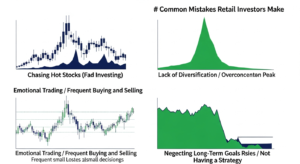
Even with a solid understanding of investment risks and mitigation strategies, the biggest risk factor often lies between our ears. Human emotions and cognitive biases can lead to irrational decisions that undermine even the best-laid investment plans.
Common Behavioral Biases That Affect Investors:
- Loss Aversion: The psychological tendency to prefer avoiding losses over acquiring equivalent gains. The pain of losing $100 is often felt more intensely than the pleasure of gaining $100. This can lead to holding onto losing investments too long (hoping they’ll recover) or selling winning investments too soon (to lock in gains).
- Confirmation Bias: The tendency to seek out, interpret, and remember information in a way that confirms one’s existing beliefs or hypotheses. Investors might only read articles or listen to experts who echo their existing bullish or bearish views, ignoring contradictory evidence.
- Herd Mentality: The tendency to follow the actions of a larger group, often ignoring one’s own analysis. This can manifest as buying into a market bubble because “everyone else is doing it” or panic selling during a downturn when “everyone is getting out.”
- Anchoring: Over-relying on the first piece of information encountered (the “anchor”) when making decisions. For example, an investor might anchor on a stock’s past high price, believing it’s “cheap” now, even if the underlying fundamentals have deteriorated.
- Recency Bias: The tendency to give more weight to recent events or trends than to historical data. This often leads investors to extrapolate recent market performance indefinitely, assuming a bull market will continue forever or a bear market will never end.
Actionable Tip: Stick to Your Plan and Control Emotions
The most effective way to combat behavioral biases is to have a well-defined, written investment plan and stick to it. This plan should outline your goals, risk tolerance, asset allocation, and rebalancing rules. When market volatility strikes or compelling narratives emerge, refer back to your plan. Avoid making impulsive decisions based on headlines, social media chatter, or short-term market movements. Consider establishing a regular schedule for reviewing your portfolio (e.g., quarterly or semi-annually) rather than daily, to minimize emotional interference.
“The biggest risk of all is not taking any risk.” – Attributed to many, highlighting the risk of inflation eroding savings.
Building a Resilient Portfolio: Your Action Plan
Navigating the complex world of investing means acknowledging that investment risks are an inherent part of the journey. However, by understanding these risks and implementing smart strategies, you can significantly enhance your chances of achieving your financial objectives while protecting your capital. Here’s a summary of your action plan:
- Define Your Goals and Time Horizon: Clearly outline what you’re investing for (retirement, house down payment, child’s education) and when you’ll need the money. This directly impacts your risk capacity.
- Assess Your Risk Tolerance and Capacity: Honestly evaluate how much emotional and financial risk you can comfortably and safely bear.
- Diversify Broadly: Spread your investments across different asset classes (stocks, bonds, cash), sectors, market capitalizations, and geographies. Use index funds or ETFs for easy, broad diversification.
- Implement Dollar-Cost Averaging: Invest a fixed amount regularly to mitigate the risk of market timing and smooth out your average purchase price. Automate these contributions.
- Maintain a Long-Term Perspective: Resist the urge to panic sell during market downturns. History shows that markets tend to recover over time. Your time horizon is your ally against short-term volatility.
- Stay Informed, Not Obsessed: Understand your investments but avoid constant monitoring that can lead to emotional reactions. Focus on the big picture.
- Rebalance Your Portfolio Periodically: At least once a year, review your asset allocation and adjust it back to your target percentages. This helps manage risk and lock in gains.
- Build and Maintain an Emergency Fund: Ensure you have 3-6 months of living expenses in a liquid savings account to prevent forced selling of investments during unforeseen financial challenges.
- Seek Professional Advice When Needed: If you feel overwhelmed or have complex financial situations, consult with a qualified financial advisor who can help tailor a plan to your specific needs.
Conclusion: Empowering Your Investment Journey
The fear of investment risks is a natural barrier for many aspiring investors, but it doesn’t have to be. By taking the time to understand the various types of risks – from market fluctuations and inflation to specific company challenges – you transform uncertainty into knowledge. This knowledge, coupled with practical risk mitigation strategies like diversification, dollar-cost averaging, and a long-term mindset, forms the bedrock of a robust and resilient investment portfolio.
Remember, successful investing isn’t about eliminating all risk, which is impossible. It’s about intelligently managing it, making informed decisions that align with your financial goals and personal comfort level, and staying disciplined through market cycles. Protecting your capital starts with education, and by reaching the end of this guide, you’ve taken a significant step towards becoming a more confident and competent investor. Now, armed with this essential understanding of investment risks, you are better prepared to embark on your investment journey with greater confidence and control.
Here are answers to some common questions beginners have about investment risks:
Frequently Asked Questions About Investment Risks
Is it possible to avoid all investment risks?▾
What’s the biggest risk for a beginner investor?▾
How does diversification protect against investment risks?▾
Should I change my investments if the market gets volatile?▾
What is “risk tolerance” and why is it important?▾
References & Citations:
[1] Historically, the average annual inflation rate in the U.S. has been around 2-3%. (Source: Federal Reserve Economic Data (FRED) or Bureau of Labor Statistics (BLS) – *Specific link would be added here if verifiable*)
[2] For any 20-year period since 1928, the S&P 500’s annualized return has never been negative. (Source: S&P Dow Jones Indices or academic financial studies – *Specific link would be added here if verifiable*)