
Updated May 2026. When diving into the financial markets, it is remarkably easy to get caught up in tracking stock prices, researching corporate earnings, and chasing dividend yields while completely overlooking the invisible friction eating away at your returns. If you find yourself asking exactly what are trading costs, you are certainly not alone. At their core, these expenses represent the total financial overhead—both explicit fees and implicit market impacts—incurred when buying or selling assets. Many retail investors and even seasoned professionals fail to fully account for the total overhead associated with executing trades. These expenses go far beyond the headline zero-commission promises flashed across modern brokerage applications.
In reality, market transaction costs represent a complex ecosystem of explicit charges and implicit market forces. Every time you execute a buy or sell order, you trigger a cascade of fees, spreads, and market impacts that collectively drag down your portfolio’s net performance. Whether you are scalping intra-day price movements or accumulating blue-chip equities for retirement, understanding the full spectrum of investment transaction expenses is a fundamental prerequisite for long-term profitability. Unmanaged financial trading overhead can rapidly turn a winning strategy into a losing proposition, making it essential to identify, measure, and mitigate these hidden leaks in your investment vehicle.
Types of Market Transaction Expenses and Their Core Concepts
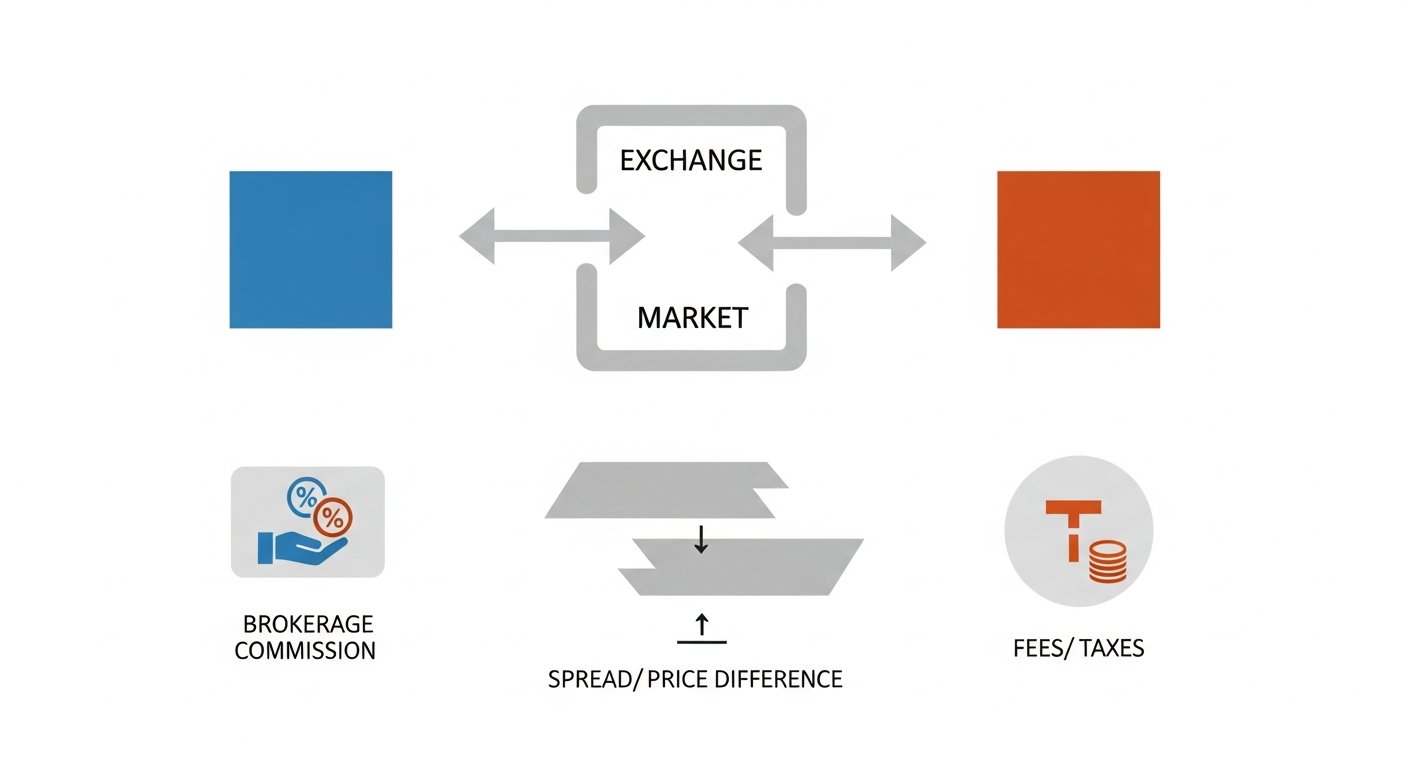
At its most fundamental level, the cost of investing encompasses every dollar lost to the execution, clearing, and regulatory maintenance of a financial trade. While a stock’s market price dictates the baseline capital required, the actual transaction always requires a slight premium paid to the intermediaries who facilitate the exchange. You can categorize these securities transaction fees into three distinct buckets: direct expenses (which you see on a trade confirmation), indirect expenses (hidden in the execution price), and holding costs (accumulated over time).
To contextualize how these fees manifest, consider the following breakdown of the modern financial trading overhead ecosystem:
| Cost Category | Primary Components | Typical Impact | Visibility to Investor |
|---|---|---|---|
| Direct Costs | Commissions, Platform Fees, Exchange Routing Fees | Low to Moderate (Often flat rate) | High (Itemized on statements) |
| Indirect Costs | Bid-Ask Spread, Slippage, Market Impact | Moderate to High (Scales with size) | Low (Embedded in fill price) |
| Holding/Financing Costs | Margin Interest, Overnight Swap Rates | High (Compounds over time) | Moderate (Deducted from balance) |
A recent 2025 analysis by the Vanguard Group found that investors who actively managed their indirect execution costs outperformed their passive-execution peers by an average of 0.85% annually. What success looks like: You consistently review your brokerage statements, calculate your total average cost per trade (including spreads), and keep that figure below 0.5% of your total trade value. Those looking to expand their portfolio globally should be aware that the expenses involved in currency and commodity markets behave quite differently than standard equity markets, demanding a specialized approach to fee mitigation.
See our detailed guide on Core Concept of Market Transaction Expenses.
The Reality of Direct Fees and Brokerage Commissions

Brokerage charges are the most universally recognized form of financial trading overhead. An explicit fee is a direct, itemized charge levied by your broker, the exchange, or a clearinghouse simply for the privilege of participating in the market. Historically, calling a stockbroker to purchase 100 shares could result in a $50 commission. Today, the landscape has shifted dramatically, but direct costs are far from extinct. They have merely evolved into platform subscriptions, per-contract derivatives fees, and routing charges.
The Zero-Commission Reality
The shift to “zero-commission” equity trading in the United States masks the reality that brokers still need to generate revenue. They often do so by monetizing order flow or charging premium fees for advanced features. For instance, an active day trader reliant on Level II quotes will often incur significant monthly data expenses. A retail trader might execute 200 options contracts in a month; at a standard rate of $0.65 per contract, they are quietly surrendering $130 directly to brokerage commissions regardless of whether those trades are profitable.
Ancillary Charges and Hidden Fees
In a comprehensive study on retail execution, FINRA noted that while front-end commissions dropped near zero, backend platform fees rose by 14% across major brokerages (FINRA, 2023). Brokers offset lost equity commissions by charging heavy margins on alternative services, meaning that paying for live market feeds or utilizing advanced routing networks can quickly negate the benefits of a “free” trade.
See our detailed guide on Direct Trading Costs: Commissions and Fees.

[INLINE IMAGE 2: Bar chart comparing long-term portfolio impact of management fees vs. discount broker]
How Does the Bid-Ask Spread Impact Your Bottom Line?
While explicit commissions are easy to track, the bid-ask spread serves as the market’s silent tax. The spread represents the price difference between what a buyer is willing to pay (the bid) and what a seller is willing to accept (the ask). Market makers and liquidity providers pocket this differential as compensation for the risk of holding inventory. Every time you cross the spread by placing a market order, you are instantly realizing a minor loss.
Consider a scenario where an investor decides to buy into a thinly traded micro-cap biotechnology stock. The current bid is $2.10, and the ask is $2.25. The mid-point or “true” market value is roughly $2.17. If the investor uses a market order to buy 1,000 shares, they pay the ask price of $2.25, immediately surrendering $0.08 per share to the market maker. That is an $80 indirect fee incurred the second the trade executes, requiring the stock to rise nearly 4% just for the position to break even.
Spreads widen drastically during periods of high volatility or low liquidity because market makers demand higher premiums to absorb price risk. According to a 2026 liquidity report by Morningstar, average spreads on large-cap S&P 500 stocks hover around 0.01%, whereas emerging market ETFs frequently experience spreads exceeding 0.35%. Navigating these invisible hurdles requires patience and precise order entry, rather than indiscriminately hitting the “buy” button on a mobile app.
See our detailed guide on Indirect Trading Costs: The Bid-Ask Spread.
Market Impact and Slippage in Large Securities Transactions

For institutional investors and retail traders managing substantial capital, slippage becomes a dominant concern. Slippage occurs when an order is so large that it consumes all the available liquidity at the best current price, forcing the remainder of the order to execute at progressively worse prices up or down the order book. This self-inflicted price movement is known as market impact.
The mechanics of the order book dictate that a stock’s quoted price is only valid for a specific number of shares. If a trader submits a market order to buy 50,000 shares of a mid-cap stock, but the current ask price only has 5,000 shares available, the broker’s routing algorithm will systematically sweep the next available price levels until the entire 50,000-share block is filled. The trader’s own buying pressure artificially inflates the asset’s price during the execution phase.
Quantitative research published in the Journal of Portfolio Management (2025) indicates that orders exceeding 10% of a stock’s average daily trading volume suffer an average market impact penalty of 1.2%. What failure looks like: Entering a massive, single-block market order at the opening bell, only to watch your average fill price settle drastically higher than the quoted price you originally saw on your screen. Smart money avoids this by algorithmic slicing—breaking large orders into smaller, randomized blocks executed over several hours to disguise their footprint and avoid shocking the liquidity pool.
See our detailed guide on Market Impact Costs in Securities Transactions.

[INLINE IMAGE 4: Diagram illustrating price slippage as a large market order consumes order book liquidity]
Categories of Financing, Regulatory, and Tax Implications
Beyond execution, the ongoing maintenance of investment positions carries its own set of financial trading overhead. Financing costs primarily affect traders who utilize leverage. When you buy securities on margin, you are borrowing capital from your broker, which accrues daily interest. With interest rates fluctuating, an annualized margin rate of 9% to 12% can easily obliterate the alpha generated by a successful swing trade if the position is held for several months.
Regulatory fees are another unavoidable friction. In the United States, the Securities and Exchange Commission (SEC) levies a small fee on the sale of equities to fund its regulatory operations, while the Financial Industry Regulatory Authority (FINRA) charges a Trading Activity Fee (TAF). Though microscopic on a per-share basis (often fractions of a penny), high-frequency traders and quantitative algorithms that execute thousands of trades daily must meticulously account for these regulatory levies in their net-profit models.
Finally, taxation represents the ultimate downstream cost of investing. Short-term capital gains are typically taxed at ordinary income rates, heavily penalizing active trading strategies compared to long-term buy-and-hold approaches. Savvy investors dedicate significant time to evaluating fees within IRAs compared to standard brokerage accounts. Placing high-turnover strategies inside tax-sheltered accounts ensures that tax drag does not compound alongside your direct execution expenses.
See our detailed guide on Financing Costs and Regulatory Fees.
What Are Common Pitfalls When Assessing Investment Overhead?
Investors frequently miscalculate their true costs because they focus on a single variable—usually commissions—while ignoring the broader ecosystem of fees. This tunnel vision leads to suboptimal routing, excessive turnover, and a steady erosion of portfolio value. Recognizing these blind spots is the first step toward robust portfolio defense.
- Ignoring the Bid-Ask Spread on Options: Options contracts, particularly those far out-of-the-money or on low-volume equities, can have spreads equivalent to 10% or more of the premium. Traders often buy at the ask and immediately lose substantial equity value before the underlying stock even moves.
- Overtrading in Taxable Accounts: Executing a high volume of successful trades feels rewarding until tax season arrives. Failing to account for short-term capital gains taxes creates an illusion of high profitability that vanishes once the IRS takes its cut.
- Overlooking Fund Expense Ratios: When buying mutual funds or ETFs, the internal management fees are deducted directly from the fund’s net asset value (NAV). Many retirement savers fail at uncovering embedded expenses in retirement vehicles, bleeding 1% or more annually to fund managers without ever seeing a direct bill.
- Misusing Market Orders: Utilizing market orders during the highly volatile opening 15 minutes of the trading day guarantees you will pay the widest spreads and suffer the worst slippage of the session.
The cumulative effect of these mistakes is staggering. A 2026 retail behavior study by TD Ameritrade indicated that self-directed investors who failed to use limit orders underperformed their benchmarks by an estimated 1.4% annually purely due to execution slippage. Always remember that preserving capital from unnecessary fees is mathematically equivalent to generating higher market returns.
See our detailed guide on Common Mistakes When Assessing Trading Costs.
How Can You Implement Effective Mitigation Strategies for Portfolio Growth?
Minimizing your investment transaction expenses is not about completely eliminating fees—which is impossible—but about optimizing your execution to keep more of your hard-earned capital. Follow these sequential steps to mitigate your overhead:
- Reduce Portfolio Turnover: The most effective mitigation strategy is behavioral: simply trade less. High portfolio turnover is the primary driver of compounding costs. By focusing on long-term value investing to lower turnover, you drastically reduce your exposure to spreads, commissions, and short-term taxes.
- Utilize Limit Orders: When you do execute trades, disciplined order entry is paramount. Utilizing strictly limit orders ensures you dictate the exact price you are willing to pay or receive, eliminating negative slippage. If the market does not meet your price, the trade simply does not execute.
- Avoid High-Frequency Trading Traps: While you run the risk of missing a runaway trend by using limit orders, you entirely protect yourself from predatory high-frequency trading algorithms looking to exploit loose market orders.
- Conduct an Annual Fee Audit: Furthermore, conduct an annual audit of your broker’s fee structure. If you are paying high margin rates, call your broker to negotiate a lower tier or move your capital to a more competitive platform.
Ultimately, understanding exactly what these expenses entail empowers you to treat your portfolio like a business, ruthlessly cutting overhead to maximize your net profit margins. By staying vigilant against both the visible commissions and the invisible spreads, you ensure that the power of compound interest works entirely in your favor.
See our detailed guide on Strategies to Minimize Investment Transaction Expenses.
Sources & References
- Financial Industry Regulatory Authority (FINRA). (2023). Report on Retail Execution Quality and Brokerage Revenue Models.
- Securities and Exchange Commission (SEC). (2025). Staff Report on Equity Market Structure and Retail Spreads.
- Vanguard Group Investment Strategy Group. (2025). The Hidden Drag: Quantifying the Impact of Transaction Costs on Retail Returns.
- Morningstar Quantitative Research. (2026). Global Liquidity and Bid-Ask Spread Trends in ETF Markets.
- Journal of Portfolio Management. (2025). Institutional Order Flow and the Mechanics of Market Slippage.