The world of digital assets has introduced two revolutionary concepts: Decentralized Finance (DeFi) and Non-Fungible Tokens (NFTs). For those seeking to grasp their impact on personal finance and investing, understanding how DeFi and NFTs explained frameworks operate is crucial. These innovations, both built on the bedrock of blockchain technology, are reshaping traditional financial paradigms and redefining ownership in the digital realm, offering both unprecedented opportunities and unique challenges for investors. This comprehensive guide will explore the intricacies of both, outlining their core functionalities, investment potential, and the distinctions that set them apart within the burgeoning digital economy.
What is Decentralized Finance (DeFi)?
Decentralized Finance, or DeFi, refers to an emerging financial technology built on secure distributed ledgers, primarily blockchains, that aims to remove intermediaries like banks from financial transactions. It’s a key component in understanding the broader landscape of digital assets, including NFTs. At its core, DeFi leverages smart contracts—self-executing agreements with the terms directly written into code—to automate financial services such as lending, borrowing, trading, and insurance. This decentralization allows users to engage directly with protocols, eliminating the need for traditional financial institutions and fostering an ecosystem of open, permissionless, and transparent financial tools accessible to anyone with an internet connection. The primary goal of DeFi is to create a more efficient, equitable, and inclusive global financial system.
Unlike conventional finance, which relies on trusted third parties to facilitate transactions and manage assets, the DeFi ecosystem utilizes blockchain technology to ensure security, immutability, and transparency. This means users retain full custody of their assets and control over their financial decisions. The shift from centralized control to a distributed network represents a fundamental change in how financial services are delivered, presenting a new frontier for personal finance and investment strategies.
Key Components of the DeFi Ecosystem
The vast and rapidly evolving landscape of decentralized finance is built upon several interconnected components, each serving a unique function and contributing to the overall utility and robustness of the system. These components are primarily powered by smart contracts on various blockchains, with Ethereum being a prominent foundation. Understanding these core elements is essential for anyone looking to engage with the crypto DeFi ecosystem.
Lending & Borrowing
DeFi lending and borrowing protocols allow users to earn interest on their cryptocurrency holdings by lending them to others, or to obtain loans by providing collateral. Platforms like Aave and Compound automate these processes using smart contracts, setting interest rates algorithmically based on supply and demand. Borrowers typically over-collateralize their loans, meaning they lock up more value than they borrow, to mitigate risk for lenders. This system removes banks as intermediaries, offering potentially higher yields for lenders and more flexible access to capital for borrowers. For a deeper dive into how these protocols function, explore our guide: [CLUSTER LINK: DeFi Lending & Borrowing Explained]
Decentralized Exchanges (DEXs)
Decentralized Exchanges (DEXs) enable peer-to-peer cryptocurrency trading without the need for a centralized intermediary like Coinbase or Binance. Instead of an order book managed by a single entity, DEXs like Uniswap and SushiSwap utilize automated market makers (AMMs) and liquidity pools. Users contribute their crypto assets to these pools, becoming “liquidity providers” and earning fees from trades. This model ensures constant liquidity and allows for continuous trading. DEXs prioritize user control over funds and transparency of transactions. Learn more about their mechanics here: [CLUSTER LINK: Understanding Decentralized Exchanges]
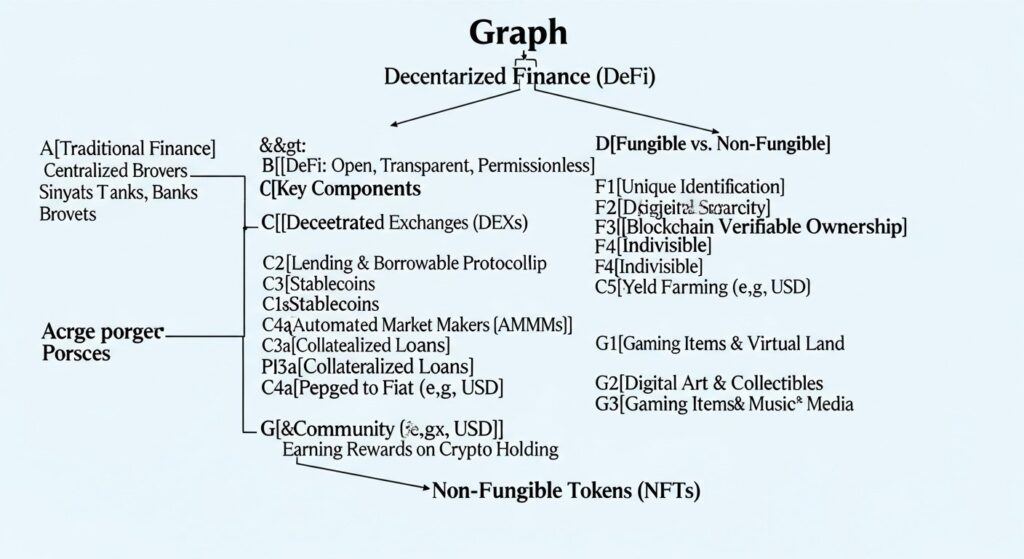
[INLINE IMAGE 1: diagram showing the components of a DeFi ecosystem, including lending protocols, DEXs, stablecoins, and yield farming, with arrows illustrating their interactions.]
Stablecoins
Stablecoins are cryptocurrencies designed to maintain a stable value relative to a specific fiat currency (like the US Dollar) or a basket of assets. They play a crucial role in DeFi by providing price stability within a highly volatile crypto market. This allows users to engage in DeFi activities like lending and borrowing without constant exposure to price fluctuations. Examples include Tether (USDT), USD Coin (USDC), and Dai (DAI). Stablecoins are essential for facilitating transactions and offering a reliable store of value within decentralized applications. To understand their various forms and uses, read our guide: [CLUSTER LINK: What Are Stablecoins?]
Yield Farming
Yield farming involves strategically moving cryptocurrency assets between different DeFi protocols to maximize returns or “yield.” Participants often provide liquidity to DEXs or lend assets to borrowing protocols, earning interest, trading fees, or governance tokens as rewards. This complex strategy can offer high annual percentage yields (APYs), but it also comes with significant risks, including impermanent loss and smart contract vulnerabilities. Success in yield farming often requires a deep understanding of market dynamics and protocol mechanics. Discover advanced yield farming strategies in our detailed guide: [CLUSTER LINK: Advanced Yield Farming Strategies]
Understanding Non-Fungible Tokens (NFTs)
While DeFi revolutionizes financial services, another transformative application of blockchain is Non-Fungible Tokens (NFTs), which focus on unique digital ownership. An NFT represents a unique digital asset whose ownership is recorded on a blockchain. Unlike cryptocurrencies like Bitcoin or Ethereum, which are fungible (meaning each unit is identical and interchangeable), NFTs are non-fungible. Each NFT possesses unique identifying codes and data that distinguish it from every other token, making it irreplaceable. This intrinsic uniqueness allows NFTs to serve as verifiable proof of ownership for digital items, ranging from art and music to collectibles and even real estate.
The concept of unique digital assets fundamentally alters how value is perceived and transacted in the digital realm. Previously, digital items could be endlessly copied and distributed, making scarcity and verifiable ownership challenging. NFTs solve this by providing a public, immutable ledger of ownership, authenticated by blockchain technology. This breakthrough has opened up entirely new markets and possibilities for creators, collectors, and investors, expanding the horizons of what can be owned and traded in the digital age.
How Do NFTs Work and What Can They Be?
Non-Fungible Tokens operate on blockchain networks, primarily Ethereum, using specific token standards like ERC-721 and ERC-1155. When an NFT is “minted,” a record of its creation, its unique metadata, and its initial ownership is permanently etched onto the blockchain. This process generates a unique cryptographic hash that verifies the token’s authenticity and scarcity. Each NFT points to a specific digital asset, which might be stored on the blockchain itself or, more commonly, on decentralized storage systems like IPFS, with the NFT serving as a certificate of ownership for that asset. Understanding Web3 finance and digital collectibles means grasping this foundational mechanism.
The possibilities for what an NFT can represent are incredibly broad, extending far beyond simple images. They are fundamentally about proving unique ownership in a digital world.
Digital Art & Collectibles
This is perhaps the most well-known application of NFTs. Digital artists can tokenize their work, creating verifiable scarcity for digital paintings, animations, and illustrations. Collectors can then purchase these NFTs, gaining provable ownership of the unique digital piece. Examples include CryptoPunks, among the earliest NFT collections, and the Bored Ape Yacht Club, which became cultural phenomena. These NFTs often derive value from their artistic merit, rarity, and community around them. For those interested in digital art, explore platforms and trends in our guide: [CLUSTER LINK: Investing in Digital Art NFTs]
Gaming & Metaverse NFTs
NFTs are revolutionizing the gaming industry by enabling true ownership of in-game assets. Players can own characters, skins, weapons, and virtual land as NFTs, which can then be traded, sold, or even used across different games or metaverse platforms. This creates entirely new play-to-earn economies, where players can earn real value from their time and effort. Axie Infinity is a prominent example of a game built around NFT ownership. Delve deeper into virtual economies: [CLUSTER LINK: Gaming & Metaverse NFTs Explained]
[INLINE IMAGE 2: infographic illustrating the journey of an NFT from creation (minting) through sale on a marketplace, to transfer of ownership on the blockchain.]
Real-World Asset Tokenization
Beyond digital assets, NFTs are increasingly being explored for tokenizing real-world assets. This includes fractional ownership of physical real estate, luxury goods, intellectual property rights, and even legal documents. By linking an NFT to a tangible asset, it becomes possible to prove ownership, facilitate fractionalization, and streamline transfers more efficiently than traditional methods. This application holds significant promise for expanding liquidity and accessibility in various asset classes. Learn about this innovative use case: [CLUSTER LINK: Tokenizing Real-World Assets with NFTs]
NFT Marketplaces
NFT marketplaces are platforms where users can buy, sell, and trade Non-Fungible Tokens. These platforms provide the infrastructure for discovering, displaying, and transacting NFTs, often integrating wallet functionalities and bidding systems. OpenSea is currently the largest and most well-known marketplace, but specialized platforms exist for specific types of NFTs, such as digital art or gaming assets. These marketplaces are crucial for the liquidity and accessibility of the NFT ecosystem. To navigate these platforms, consult our guide: [CLUSTER LINK: Guide to NFT Marketplaces]
DeFi vs. NFTs: What’s the Fundamental Difference?
While both Decentralized Finance and Non-Fungible Tokens are built on blockchain technology and contribute to the broader Web3 landscape, they serve fundamentally different purposes. DeFi focuses on democratizing and decentralizing financial services, dealing with fungible assets like cryptocurrencies and stablecoins that are interchangeable. Its primary goal is to recreate and innovate traditional financial instruments without central authorities. In contrast, NFTs are all about proving unique, verifiable digital ownership of non-fungible assets, where each item is one-of-a-kind and irreplaceable. The core distinction lies in fungibility and application.
To further illustrate the differences and shared foundations of these two pivotal innovations, consider the following comparison:
| Feature | Decentralized Finance (DeFi) | Non-Fungible Tokens (NFTs) |
|---|---|---|
| Primary Purpose | Decentralizing financial services (lending, trading, insurance) | Proving unique ownership of digital assets |
| Asset Fungibility | Fungible (e.g., 1 ETH is interchangeable with another 1 ETH) | Non-fungible (each token is unique and not interchangeable) |
| Value Derivation | Utility in financial transactions, protocol growth, yield generation | Uniqueness, scarcity, artistic/collectible value, utility in games/metaverse |
| Common Use Cases | Lending, borrowing, swapping, staking, yield farming | Digital art, collectibles, gaming items, virtual land, tokenized real-world assets |
| Underlying Technology | Smart contracts on public blockchains (e.g., Ethereum, Solana) | Smart contracts on public blockchains (e.g., Ethereum, Polygon) |
| Risk Profile | Smart contract bugs, impermanent loss, liquidity risk, regulatory risk | Market volatility, illiquidity, intellectual property issues, scam projects |
Investing in DeFi and NFTs: Opportunities and Risks
The allure of decentralized finance and unique digital assets presents both compelling opportunities for wealth accumulation and significant risks that necessitate careful consideration. Investors are drawn to the potential for high returns, innovative use cases, and the disruptive nature of these technologies. However, the nascent and volatile nature of these markets demands a robust understanding of associated perils. Approaching investment in the crypto DeFi and NFT ecosystem requires a strategic mindset, focusing on informed decision-making and robust risk management.
Due Diligence
Thorough due diligence is paramount before investing in any DeFi protocol or NFT project. This involves researching the underlying technology, the development team, the community support, and the specific smart contracts involved. For DeFi, evaluate audit reports, total value locked (TVL), and tokenomics. For NFTs, assess the project’s roadmap, the team’s track record, community engagement, and the rarity traits of the collection. Understanding these factors can help gauge the legitimacy and long-term potential of an investment. Learn how to perform effective due diligence: [CLUSTER LINK: Crypto Due Diligence Strategies]
Portfolio Diversification
As with any high-growth, high-risk asset class, diversification is a critical strategy. Allocating only a small, manageable portion of your overall investment portfolio to DeFi and NFTs can help mitigate the impact of potential losses while still allowing exposure to upside potential. Avoid over-concentrating your portfolio in a single protocol or NFT collection. A balanced approach, considering your personal risk tolerance and financial goals, is always advisable. For insights on building a resilient portfolio, see our guide: [CLUSTER LINK: Diversifying Your Crypto Portfolio]
Regulatory Considerations
The regulatory landscape for both DeFi and NFTs is still evolving globally. Governments are beginning to address issues such as taxation, consumer protection, and anti-money laundering (AML) compliance. Changes in regulations could significantly impact the legality, valuation, and accessibility of certain digital assets and protocols. Investors must stay informed about the regulatory developments in their jurisdiction and understand the potential implications for their holdings. For an up-to-date analysis of global regulations, refer to: [CLUSTER LINK: Global Crypto Regulatory Landscape]
Engaging with digital assets offers unique opportunities but demands a clear understanding of what success and failure might look like:
- What success looks like: A well-diversified portfolio of carefully researched DeFi tokens and NFT projects, held for the long term (e.g., 3-5 years), showing significant appreciation as their underlying technologies gain wider adoption and utility. An investor might have successfully participated in a yield farming pool for 6 months, earning 15% APY without experiencing impermanent loss due to stable market conditions, and liquidating positions profitably.
- What failure looks like: Investing a substantial portion of one’s capital into a single, unvetted NFT project that turns out to be a “rug pull” scam, losing 100% of the initial investment within weeks. Another failure could involve participating in a DeFi protocol with a smart contract vulnerability, leading to the complete loss of deposited funds due to an exploit, or chasing unsustainable high yields only to incur substantial impermanent loss after a sharp market correction.
Understanding the risks is just as important as identifying opportunities:
| Risk Category | DeFi Specific Risk | NFT Specific Risk | Mitigation Strategy |
|---|---|---|---|
| Smart Contract Vulnerabilities | Bugs in protocol code can lead to loss of funds, flash loan attacks, or exploits. | Flaws in the NFT’s minting contract or metadata storage can compromise ownership. | Only interact with audited protocols/projects, review audit reports, stay updated on security news. |
| Market Volatility | Rapid price swings in underlying cryptocurrencies affect collateral value and yields. | NFT values can be highly speculative, leading to significant price crashes. | Invest small amounts, diversify, use stop-loss orders where applicable, long-term perspective. |
| Liquidity Issues | Low trading volume for certain tokens can make it difficult to exit positions quickly without slippage. | Niche NFTs may lack buyers, making them hard to sell at a desired price. | Focus on assets with high trading volume and established marketplaces. |
| Regulatory Uncertainty | New laws could restrict or ban certain DeFi activities, impacting access and value. | Regulations on digital collectibles, IP, or securities could devalue certain NFTs. | Stay informed on global and local regulatory developments, consult legal/financial experts. |
| Scams & Fraud | “Rug pulls,” phishing, fake projects, or ponzi schemes disguised as high-yield opportunities. | Impersonation, fake marketplaces, counterfeit NFTs, or malicious links. | Verify project authenticity, use official links, be wary of unsolicited offers, educate on common scams. |
Common Mistakes When Engaging with DeFi and NFTs
The rapid innovation and high-stakes environment of decentralized finance and non-fungible tokens can lead even experienced investors to make costly errors. Avoiding these common pitfalls is essential for navigating the complex world of blockchain finance and unique digital assets successfully. Many users report that while yield farming offers attractive APYs, the risk of impermanent loss is a significant consideration, often eroding gains during volatile market swings. Similarly, a common mistake for new NFT collectors is underestimating gas fees, which can sometimes exceed the value of a low-cost NFT.
- Chasing Unrealistic Returns: Falling for promises of excessively high, unsustainable annual percentage yields (APYs) in DeFi often leads to exposure to high-risk, unaudited protocols or outright scams.
- Ignoring Gas Fees: Transactions on blockchain networks, especially Ethereum, incur network fees (gas fees). Neglecting these costs can eat into profits, especially for small transactions or frequent trading.
- Lack of Security Practices: Poor management of private keys, clicking malicious links, or falling for phishing scams can lead to irreversible loss of funds or NFTs from digital wallets.
- Insufficient Research (DYOR): Investing in DeFi protocols or NFT projects without understanding their fundamentals, team, smart contract audits, or community can lead to significant losses.
- Over-Leveraging: Taking on excessive debt through DeFi lending protocols, especially with volatile collateral, can lead to rapid liquidations during market downturns.
- Failing to Understand Impermanent Loss: For liquidity providers in DEXs, impermanent loss is a significant risk where the value of their pooled assets can decline relative to simply holding them, particularly during volatile price movements.
- Ignoring Regulatory and Tax Implications: Not understanding how digital asset transactions are taxed or complying with evolving regulatory frameworks can lead to legal and financial penalties.
- Emotional Investing: Making impulsive decisions based on hype, social media trends, or fear of missing out (FOMO) rather than sound analysis and a long-term strategy.
The Future of DeFi and NFTs in Personal Finance
Looking ahead, the trajectories of decentralized finance and non-fungible tokens point towards a future where these technologies become increasingly integrated into mainstream personal finance. The ongoing development of layer-2 scaling solutions is addressing the scalability and cost issues that currently limit mass adoption, paving the way for more efficient and accessible decentralized applications. As interfaces become more user-friendly and regulatory frameworks mature, individuals may find themselves engaging with DeFi for routine banking services, mortgages, and investment opportunities without even realizing they are interacting with blockchain technology.
NFTs, similarly, are poised to evolve beyond speculative art and collectibles. Their utility as verifiable proofs of ownership could transform areas such as digital identity, academic credentials, medical records, and even ticketing for events. Imagine a future where your passport, university degree, or car title is an NFT, providing immutable and easily transferable proof of ownership or status. This convergence suggests a world where personal wealth management includes both traditional assets and a diverse range of unique digital assets, demanding a broader understanding of financial instruments than ever before. This expansion promises new avenues for wealth accumulation and management, making the crypto’s next frontier: DeFi & NFTs, a critical area for financial literacy.
Is Investing in DeFi and NFTs Right for Your Portfolio?
Deciding whether to allocate capital to decentralized finance and non-fungible tokens depends heavily on individual financial goals, risk tolerance, and investment horizon. For investors with a high-risk appetite and a long-term perspective (typically 5-10 years), DeFi and NFTs offer exposure to groundbreaking technologies with the potential for substantial growth. They represent a frontier of innovation that could fundamentally reshape finance and digital ownership, aligning with strategies focused on high-growth, disruptive sectors.
However, for individuals with a low-to-moderate risk tolerance, or those primarily focused on capital preservation, the extreme volatility and regulatory uncertainty currently associated with these assets may make them unsuitable. Consulting with a qualified financial advisor who understands digital assets is highly recommended. They can help assess your personal financial situation, integrate these new asset classes appropriately, and ensure your investment strategy remains aligned with your broader wealth accumulation goals. Ultimately, a well-informed decision, based on thorough research and a clear understanding of the risks involved, is the cornerstone of responsible engagement with these innovative digital assets.
In conclusion, the realms of DeFi and NFTs explained represent more than just technological advancements; they symbolize a paradigm shift in how we conceive of finance and ownership in the digital age. While presenting exciting opportunities for personal finance and investing, they also come with inherent complexities and risks that demand careful navigation. Staying informed, practicing due diligence, and adopting a balanced approach are key to participating in this evolving landscape responsibly.
Sources & References
- Ethereum.org – Decentralized Finance (DeFi)
- Ethereum.org – Non-fungible tokens (NFTs)
- CoinDesk – What Is DeFi? Exploring the Decentralized Finance Ecosystem
- Investopedia – Non-Fungible Token (NFT): What It Is, How It Works, Example
- Binance Blog – NFT Risks: What To Look Out For
Meet Your Financial Empowerment Expert
Kaelen Silva, Financial Empowerment Coach — I help individuals navigate the complexities of financial markets and build lasting wealth through smart investing, disciplined trading, and practical money management.
Reviewed by David Chang, Senior Financial Editor — Last reviewed: April 06, 2026