Master the Market: Proven Day Trading Strategies for Beginners in 2026
The landscape of the financial markets has shifted dramatically as we move into 2026. For retail investors, the barriers to entry have never been lower, yet the complexity of the intraday environment has never been higher. Day trading—the practice of buying and selling financial instruments within the same trading day—offers the allure of financial independence and the thrill of active participation in the global economy. However, for the uninitiated, it can also be a swift path to capital depletion.
The modern retail trader in 2026 benefits from lightning-fast execution, AI-assisted screening tools, and zero-commission structures that were once reserved for institutional desks. But success isn’t found in the tools alone; it is found in the strategy. To survive and thrive, beginners must focus on cost-minimization, disciplined risk management, and the mastery of a few high-probability setups. This guide outlines the essential day trading strategies for beginners, specifically designed for those looking to maximize returns while keeping overhead costs at an absolute minimum.
The Foundation of Day Trading: Understanding the 2026 Landscape
Before diving into specific strategies, it is crucial to understand what day trading actually entails in today’s market. Unlike swing trading or long-term investing, day trading requires all positions to be closed before the market bell rings at the end of the day. This eliminates “overnight risk”—the danger of a stock price gapping down due to bad news released while the markets are closed.
In 2026, the market is characterized by high liquidity and rapid price movements driven by both human sentiment and algorithmic execution. For a retail investor, this means you are competing with high-frequency trading (HFT) firms. To win, you don’t need to be faster than a computer; you need to be more patient. Beginners often make the mistake of overtrading, which leads to “death by a thousand cuts” through slippage and mental fatigue. A successful day trader views themselves as a predator, waiting for the perfect market conditions to align before striking. By focusing on liquid assets—such as high-volume stocks, ETFs, or major currency pairs—you ensure that you can enter and exit positions without significantly moving the price against yourself.
Cost-Effective Trading: The Retail Investor’s Blueprint
For the retail trader, every dollar spent on fees, commissions, or software is a dollar that must be earned back through profitable trades. In 2026, minimizing costs is a strategy in itself. High-frequency trading models often thrive on razor-thin margins, but retail traders need to be more surgical.
#
Choosing the Right Broker The first step in cost-minimization is selecting a broker that offers a true zero-commission model. While “free” trading became the standard years ago, savvy traders in 2026 look closer at the “payment for order flow” (PFOF) and execution quality. If your broker provides poor execution, you may lose more money on the “spread” (the difference between the buy and sell price) than you would have paid in a flat commission. Look for brokers that offer direct market access (DMA) or those that have transparent routing policies.
#
Managing the Bid-Ask Spread The spread is a hidden cost that many beginners ignore. If you buy a stock at $10.05 and the sell price is $10.00, you are immediately down $0.05 per share. To minimize this cost, beginners should focus on high-volume stocks where the spread is typically only a cent or two. Avoiding “penny stocks” or low-liquidity assets is essential, as the wide spreads in those markets can wipe out your profits before you even have a chance to manage the trade.
#
Tax Efficiency and Software Utilizing free charting software like TradingView (basic tiers) or the native tools provided by your broker can save hundreds of dollars a month in subscription fees. Additionally, being mindful of the tax implications of short-term capital gains is vital. While day trading is inherently a short-term endeavor, maintaining a meticulous log of trades can help you utilize tax-loss harvesting to offset gains, ensuring you keep more of what you earn.
Strategy 1: Momentum Trading – Riding the Wave
Momentum trading is perhaps the most popular strategy for beginners because it relies on a simple premise: assets that are moving strongly in one direction tend to stay in that direction for a short period. In 2026, momentum is often ignited by “catalysts”—earnings reports, product launches, or macroeconomic shifts.
#
How to Execute Momentum Trades To succeed with momentum trading, you need to find stocks that are “in play.” These are stocks with high relative volume (RVOL)—meaning they are trading significantly more shares today than their average over the last 30 days. When a stock breaks out of a consolidation pattern on high volume, the momentum trader enters the position, betting that the influx of buyers will continue to drive the price higher.
The key to this strategy is the “entry.” You don’t want to chase a stock that has already moved 10% in a straight line. Instead, look for a “bull flag” or a “pullback to the 9-period Exponential Moving Average (EMA).” This allows you to enter the trade during a brief pause in the action, providing a clear level to set your stop-loss.
Strategy 2: Mean Reversion – Trading Against the Grain
While momentum traders look for things that are moving, mean reversion traders look for things that have moved *too far*. This strategy is based on the statistical concept that prices eventually return to their historical average (the mean).
#
Using the RSI and Bollinger Bands In 2026, retail traders use oscillators like the Relative Strength Index (RSI) to identify overbought or oversold conditions. If a stock’s RSI climbs above 70 or 80, it is often considered “overextended” to the upside. Conversely, an RSI below 30 or 20 suggests it is “oversold.”
Mean reversion requires nerves of steel. You are essentially “catching a falling knife” or “shorting a rocket ship.” To minimize risk, traders often use Bollinger Bands. When the price touches or exceeds the outer bands, it signals a high probability of a snap-back toward the center moving average. For a beginner, the safest way to play mean reversion is to wait for a “reversal candle”—such as a hammer or a doji—to confirm that the momentum has stalled before entering the trade.
Strategy 3: Breakout Trading – Identifying the Shift
Breakout trading involves identifying a specific price level that a stock has failed to move past (resistance) or fallen below (support). When the price finally breaks through these levels with significant volume, it often leads to a rapid price expansion.
#
The Anatomy of a Breakout In the 2026 market, many breakouts are “hunted” by algorithms, leading to “fake-outs” (where the price breaks a level and immediately reverses). To avoid this, retail traders should look for a “retest.”
A high-probability breakout strategy works like this: 1. Identify a clear horizontal resistance level where the price has peaked at least twice. 2. Wait for the price to break above that level on high volume. 3. Instead of buying the initial break, wait for the price to dip back down and touch the old resistance level (which should now act as support). 4. Enter the trade when the price bounces off that retest.
This “break-retest-go” pattern is one of the most reliable ways to minimize costs and maximize the probability of success, as it confirms that the market participants have accepted the new price level.
The Golden Rules of Risk Management
You can have the best strategy in the world, but without risk management, you will eventually blow up your account. For the retail trader looking to minimize costs, protecting your principal capital is the only way to stay in the game.
#
The 1% Rule Never risk more than 1% of your total account balance on a single trade. If you have a $10,000 account, your maximum loss on any trade should be $100. This doesn’t mean you only buy $100 worth of stock; it means the distance between your entry price and your stop-loss, multiplied by the number of shares, equals $100. This ensures that even a string of ten losses only results in a 10% drawdown, which is manageable to recover from.
#
Hard Stops vs. Mental Stops In the volatile 2026 environment, “mental stops” are a recipe for disaster. Emotional bias—the hope that a stock will “come back”—can turn a small intraday loss into a catastrophic portfolio-killing event. Always use “hard” stop-loss orders placed with your broker. This removes the emotional burden of having to click the “sell” button when the trade goes against you.
#
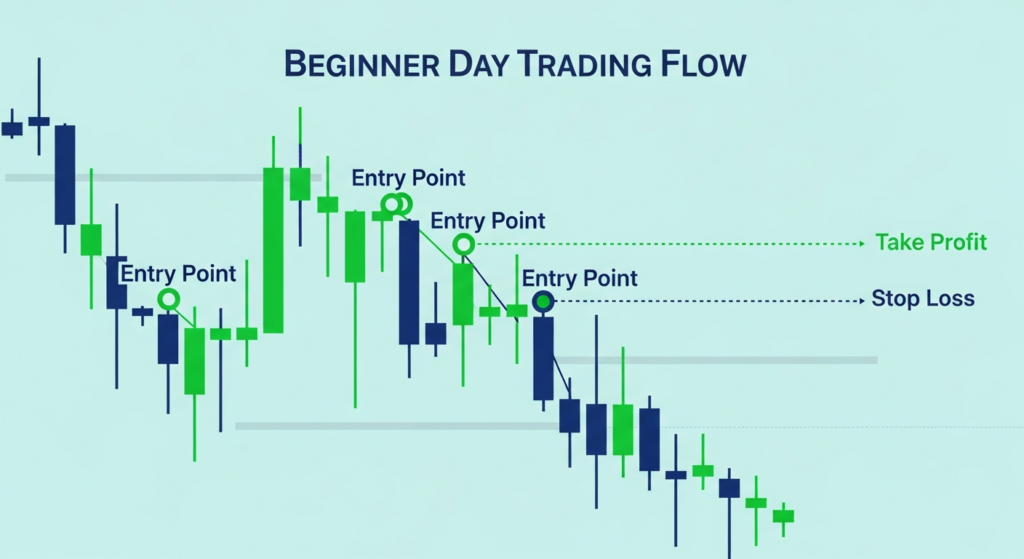
Risk-to-Reward Ratio Aim for a minimum risk-to-reward ratio of 1:2. This means that if you are risking $100 to find out if you are right, your profit target should be at least $200. By maintaining this ratio, you only need to be right 34% of the time to remain profitable. This takes the pressure off having to be “perfect” and allows the math of the markets to work in your favor.
FAQ: Frequently Asked Questions for 2026 Beginners
**Q1: How much money do I need to start day trading in 2026?** In the United States, the Pattern Day Trader (PDT) rule requires a minimum of $25,000 in a brokerage account to day trade stocks frequently. However, for those with less capital, trading micro-futures or utilizing a “cash account” (where you trade only with settled funds) are viable alternatives that allow you to start with as little as $1,000 to $2,000.
**Q2: Can I day trade while working a full-time job?** It is difficult but possible. Many part-time traders focus on the “market open”—the first 90 minutes of the trading day—where volatility and volume are highest. By 11:00 AM EST, most of the day’s significant moves have occurred, allowing traders to finish their session before the workday ramps up.
**Q3: Which indicator is the most important for beginners?** Volume. Volume is the “truth serum” of the markets. It tells you whether a price move is backed by institutional conviction or just retail noise. Regardless of the strategy—momentum, mean reversion, or breakout—high volume is necessary to confirm the validity of the move.
**Q4: Is day trading essentially gambling?** If you trade without a plan, a stop-loss, or a statistical edge, it is gambling. However, if you treat it as a business, apply strict risk management, and only take trades that meet specific criteria, it is a profession based on probability and risk assessment.
**Q5: How do I handle the emotional stress of losing trades?** Acceptance is key. In 2026, the most successful traders view losses as the “cost of doing business,” similar to a restaurant paying for electricity. When you realize that no single trade defines your success, the emotional weight of a loss diminishes.
Conclusion: The Path to Professionalism
Day trading in 2026 remains one of the most challenging yet rewarding ways to engage with the financial markets. For the retail investor, the path to success is paved with discipline and a relentless focus on cost-minimization. By mastering simple, high-probability strategies like momentum, mean reversion, and breakout trading—and anchoring them with a rigid 1% risk rule—beginners can navigate the volatility of the modern market.
Success does not come from finding a “holy grail” indicator; it comes from consistency. It comes from showing up every day, following your plan, and having the humility to accept when you are wrong. As the markets evolve, the traders who survive are those who protect their capital, minimize their overhead, and wait patiently for the market to provide an opportunity. Start small, stay disciplined, and remember that in the world of day trading, the best offense is a great defense.
One often-overlooked part of “minimizing overhead” is options trading fees specifically. If your day trading strategy includes options contracts, see our full breakdown of options contract fees across top brokers to make sure per-contract costs are not eating into your edge.