Mastering Risk Management: How to Use Stop Loss Orders Like a Pro
The financial markets are a landscape of inherent uncertainty. Whether you are a seasoned swing trader or a retail investor building a long-term portfolio, the ability to control your downside is the single most important factor in your long-term survival. As we navigate the complex economic environment of 2026, market volatility has become a constant companion rather than an occasional guest. This is where the stop-loss order comes into play—the ultimate tool for capital preservation.
A stop-loss order is essentially an automated instruction sent to your broker to sell a security when it reaches a specific price. For the retail investor, it serves as an emotional circuit breaker, removing the “hope” factor that often leads to devastating losses. By understanding how to use stop-loss orders effectively, you can minimize trading costs, protect your hard-earned capital, and ensure that a single bad trade doesn’t wipe out months of progress. In this guide, we will break down the mechanics, strategies, and nuances of stop-loss orders to help you trade with confidence and discipline.
What is a Stop-Loss Order and Why Do You Need One?
At its core, a stop-loss order is a risk management tool designed to limit an investor’s loss on a security position. If you buy a stock at $100 and set a stop-loss order at $90, your broker will automatically attempt to sell the stock if the price touches or drops below $90.
The necessity of this tool cannot be overstated. Retail traders often fall into the trap of “loss aversion”—a psychological bias where the pain of losing is twice as powerful as the joy of gaining. This leads many to hold onto losing positions in the hope that the price will “eventually come back.” In many cases, it doesn’t, and a manageable 5% loss turns into a catastrophic 50% drawdown.
In the high-speed trading environment of 2026, prices can move faster than a human can react. A stop-loss order acts as your 24/7 sentry. It ensures that your exit strategy is executed even if you are away from your screen or sleeping. By pre-determining your “uncle point”—the price at which your original thesis for the trade is proven wrong—you transform trading from a game of chance into a disciplined business process.
Types of Stop-Loss Orders: Choosing the Right Shield
Not all stop-losses are created equal. Depending on your goals and the volatility of the asset, you might choose one of three primary types:
#
1. The Standard Stop-Loss (Market Order)
This is the most common type. Once the “stop price” is hit, the order becomes a market order. It guarantees execution but does not guarantee the price. In a fast-moving market or a “gap down,” you might get filled at a price lower than your stop. This is known as slippage.
#
2. The Stop-Limit Order
A stop-limit order combines a stop price with a limit price. Once the stop price is reached, the order becomes a limit order instead of a market order. This gives you control over the price you receive, but there is a major risk: if the price falls rapidly past your limit, the order may never be filled, leaving you holding a plummeting asset. This is generally avoided by retail traders in highly volatile sectors.
#
3. The Trailing Stop-Loss
The trailing stop is a dynamic tool that “trails” the price of a security as it moves in your favor. If you set a trailing stop of 5% on a stock that rises from $100 to $120, the stop price moves up to $114. However, if the price drops, the stop price stays at $114. This allows you to lock in profits while still giving the trade room to grow. For cost-conscious investors, trailing stops are excellent for “letting winners run” without constant manual monitoring.
Strategic Placement: Where to Set Your Stop-Loss to Avoid Being “Stopped Out”
One of the biggest frustrations for retail traders is being “stopped out”—when the price hits your stop-loss, triggers a sell, and then immediately reverses and heads back up. Setting your stop too tight is just as dangerous as not having one at all. Here are three professional methods for placement:
#
The Percentage-Based Method
Many traders use a flat percentage, such as 5% or 7% below their entry price. While simple, this method is often flawed because it doesn’t account for the specific volatility of the asset. A 5% move in a stable utility stock is a major event, while a 5% move in a tech startup or cryptocurrency is just daily noise.
#
Technical Support Levels
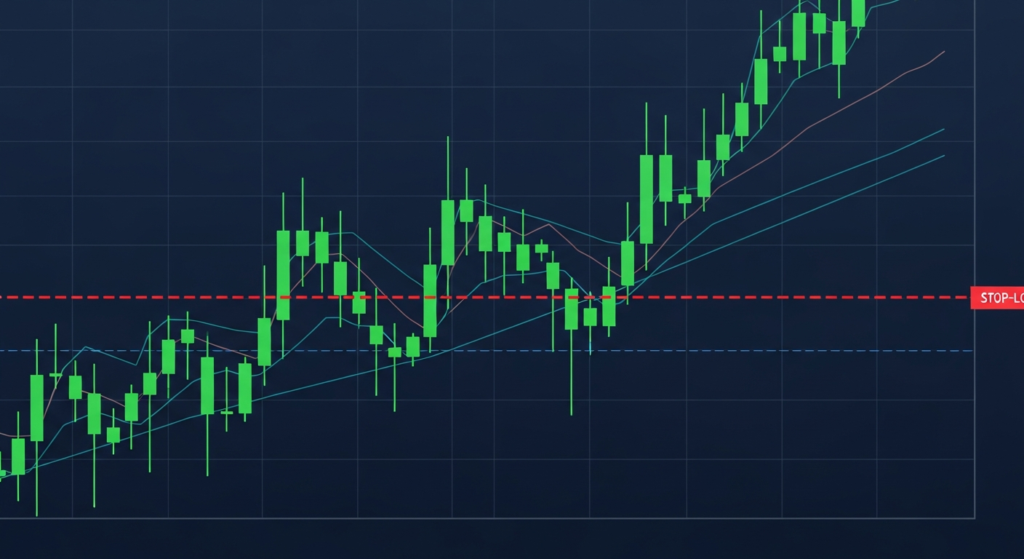
A more sophisticated approach is to place stops just below key technical support levels. Support levels are price points where a downtrend tends to pause due to a concentration of demand. By placing your stop slightly below a major moving average (like the 50-day or 200-day) or a previous “swing low,” you ensure that your order is only triggered if the stock’s upward trend has actually broken.
#
The Volatility-Based (ATR) Method
The Average True Range (ATR) is an indicator that measures market volatility. Pro traders often set their stops at a multiple of the ATR (e.g., 2x ATR) away from their entry price. This “gives the trade room to breathe” based on how much the asset typically moves. In 2026, with algorithmic trading dominating the markets, using volatility-based stops is often the best way to avoid being shaken out by minor price fluctuations.
Common Pitfalls: How Improper Stop-Loss Use Can Increase Costs
While stop-loss orders are designed to save money, improper use can actually lead to unnecessary costs and losses. Retail investors must be aware of these three pitfalls:
**1. The “Stop-Hunt” and Liquidity Grabs:**
Large institutional players often look for “clusters” of retail stop-loss orders sitting just below obvious support levels. They may temporarily drive the price down to trigger these stops, allowing them to buy the shares at a discount. To minimize this risk, avoid placing your stops at “round numbers” (like $50.00 or $100.00) where everyone else’s stops are likely sitting.
**2. Over-Tightening:**
In an attempt to minimize risk, beginners often set stops so close to the current price that the natural “wiggle” of the market triggers them. Every time you are stopped out and have to re-enter, you incur transaction costs, slippage, and tax implications. Discipline is about protecting capital, but you must allow the market enough room to move in your direction.
**3. Ignoring “Gaps”:**
A stop-loss order is only as good as the market’s liquidity. If a company announces bad news after hours and the stock “gaps down” from $50 to $40 at the next morning’s open, your $45 stop-loss will trigger at $40. This is why position sizing—not just stop-loss placement—is critical for total risk management.
Stop-Loss Strategies for Different Asset Classes
The way you use stop-loss orders should change depending on what you are trading. The retail landscape in 2026 includes a wide variety of assets, each requiring a tailored approach.
* **Blue-Chip Stocks:** These are generally less volatile. You can often use tighter stops (3-5%) and rely on standard technical support levels.
* **Cryptocurrencies:** Digital assets are notoriously volatile. A 10% dip in an afternoon is common. If you use a tight 5% stop in crypto, you will almost certainly be stopped out prematurely. Use wider stops (15-20%) or use a “stop-limit” with a wide spread to ensure you don’t get caught in a “flash crash.”
* **ETFs and Index Funds:** Since these represent a basket of stocks, they are less prone to individual company shocks. Many long-term retail investors use “hard stops” at 10-15% to protect against a broader market crash while ignoring the daily fluctuations.
* **Forex:** The foreign exchange market is highly leveraged. Small price movements result in large gains or losses. Here, volatility-adjusted stops (ATR) are the industry standard for minimizing costs.
Advanced Risk-Reward Ratios: Integrating Stop-Loss into Your Plan
A stop-loss order is half of a mathematical equation. To be a profitable trader in 2026, you must combine your stop-loss with a “take profit” target to create a Risk-Reward Ratio.
A common target is a 1:2 or 1:3 ratio. This means if you are willing to lose $100 on a trade (your stop-loss), you should be aiming to make at least $200 or $300 in profit. The beauty of this math is that you don’t need to be right all the time. If you use a 1:3 risk-reward ratio, you can be wrong 60% of the time and still remain profitable over the long run.
The stop-loss also dictates your **position sizing**. Instead of asking “how many shares can I afford?”, ask “how many shares can I buy so that if my stop-loss is hit, I only lose 1% of my total account?” This calculation is the hallmark of professional retail trading. It ensures that no single event can end your trading career.
Frequently Asked Questions (FAQ)
**1. Can a stop-loss order fail to execute?**
A standard market stop-loss will almost always execute as long as there is a buyer on the other side. However, in a “limit down” scenario or a total lack of liquidity, it may take time to fill. A “stop-limit” order is much more likely to fail if the price drops past your limit price too quickly.
**2. Does it cost extra to place a stop-loss order?**
Most modern brokerage platforms do not charge extra fees for placing or maintaining stop-loss orders. They are part of the standard order entry system. However, the indirect “costs” come from slippage (the difference between your stop price and the execution price) in fast markets.
**3. Should I use a stop-loss for long-term “Buy and Hold” investing?**
This is a matter of debate. Some believe long-term investors should ignore price fluctuations. However, many pros suggest using a “catastrophic stop-loss” (perhaps 25-30% below value) to protect against a complete company collapse or a prolonged bear market.
**4. Where is the best place to set a trailing stop?**
A good rule of thumb is to set a trailing stop just outside the asset’s normal “noise.” If a stock typically fluctuates 3% daily, a 5% or 7% trailing stop is appropriate. In 2026, many platforms offer “smart” trailing stops that automatically adjust based on ATR.
**5. How do I avoid “slippage” with my stop-loss?**
To minimize slippage, trade highly liquid assets (stocks with high daily volume) and avoid holding small-cap stocks through high-risk events like earnings reports or FDA approvals. In those scenarios, the price can “jump” over your stop-loss entirely.
Conclusion: The Discipline of the Exit
Mastering how to use stop-loss orders is less about technical analysis and more about emotional discipline. For the retail investor in 2026, the market offers more opportunities—and more traps—than ever before. A stop-loss is your ultimate defense against the most dangerous trader in the room: yourself.
By automating your exit, you accept a small, known loss to prevent a large, unknown disaster. This preserves not just your capital, but your mental energy. Instead of watching tickers with anxiety, you can trade with the peace of mind that your downside is capped. Remember, the goal of trading is not to be right every time; it is to stay in the game long enough for your winners to outshine your losers. Use your stop-losses wisely, respect the volatility of the market, and treat your risk management with the same rigor as your profit-seeking.