Mastering the Fundamentals: A Beginner’s Comprehensive Guide to Options Trading
In the dynamic world of financial markets, options contracts have emerged as powerful, yet often misunderstood, instruments offering unique opportunities for leverage, income generation, and risk management. For the astute investor or personal finance enthusiast looking to expand their toolkit, understanding options is no longer an esoteric pursuit but a vital component of a sophisticated investment strategy. At TradingCosts, our mission is to demystify complex financial topics, providing data-driven insights to empower your decisions. This comprehensive guide is designed to introduce you to the core principles of options trading, equipping you with the foundational knowledge needed to navigate this exciting, albeit intricate, market with confidence and a clear understanding of the inherent risks.
Disclaimer: This article is for informational purposes only and does not constitute financial advice. Options trading involves substantial risk and is not suitable for all investors. You could lose all or more than your initial investment. Consult with a qualified financial professional before making any investment decisions.
What Are Options? Deconstructing the Contract
At its heart, an option is a financial derivative contract that grants the buyer the right, but not the obligation, to buy or sell an underlying asset at a predetermined price on or before a specified date. The seller of the option, conversely, takes on the obligation to fulfill the contract if the buyer chooses to exercise their right. This fundamental asymmetry—right for the buyer, obligation for the seller—is crucial to understanding options dynamics.
Key Components of an Options Contract:
- Underlying Asset: The security on which the option is based. This can be a stock (e.g., Apple, Microsoft), an Exchange-Traded Fund (ETF), an index (e.g., S&P 500), commodities, or even currencies.
- Strike Price (Exercise Price): The fixed price at which the underlying asset can be bought (for a call option) or sold (for a put option) if the option is exercised.
- Expiration Date: The last day the option contract is valid. After this date, the option expires worthless if it’s not exercised or closed out. Most equity options expire on the third Friday of the month, but weekly and quarterly options are also common.
- Premium: The price the buyer pays to the seller for the option contract. This is the seller’s compensation for taking on the obligation. The premium is determined by several factors, including the strike price relative to the current market price, time to expiration, and the volatility of the underlying asset.
- Contract Multiplier: In the U.S. equity options market, one options contract typically represents 100 shares of the underlying stock. So, if an option is quoted at $2.50, the total cost for one contract would be $2.50 x 100 = $250.
Two Primary Types of Options:
Understanding the distinction between calls and puts is foundational:
-
Call Options: The Right to Buy
A call option gives the holder the right to buy the underlying asset at the strike price on or before the expiration date. Buyers of call options are typically bullish, expecting the underlying asset’s price to rise significantly above the strike price before expiration. If the price does indeed rise, they can buy the shares at the lower strike price and potentially sell them in the open market for a profit. Sellers of call options (call writers) are typically bearish or neutral, believing the price will stay below the strike or not rise substantially.
Example: You buy an XYZ $100 Call option expiring in 3 months for a premium of $3.00. This means you pay $300 (3.00 x 100) for the right to buy 100 shares of XYZ at $100 per share. If XYZ’s stock price rises to $110 before expiration, your option is “in the money” by $10 per share. You could exercise the option, buy 100 shares at $100, and immediately sell them for $110, making a gross profit of $1,000. After deducting your $300 premium, your net profit is $700.
-
Put Options: The Right to Sell
A put option gives the holder the right to sell the underlying asset at the strike price on or before the expiration date. Buyers of put options are typically bearish, expecting the underlying asset’s price to fall significantly below the strike price. They can profit from a declining stock price without shorting the stock directly. Sellers of put options (put writers) are typically bullish or neutral, believing the price will stay above the strike or not fall substantially.
Example: You buy an ABC $50 Put option expiring in 2 months for a premium of $2.00. You pay $200 (2.00 x 100) for the right to sell 100 shares of ABC at $50 per share. If ABC’s stock price drops to $40 before expiration, your option is “in the money” by $10 per share. You could exercise the option, buy 100 shares in the market at $40, and immediately sell them at your strike price of $50, making a gross profit of $1,000. After deducting your $200 premium, your net profit is $800.
Why Trade Options? Unlocking Diverse Investment Strategies
Options are versatile tools that can serve various financial objectives, from aggressive speculation to conservative portfolio protection. Understanding these motivations is key to aligning options strategies with your personal risk tolerance and investment goals.
1. Leverage: Amplifying Gains (and Losses)
Perhaps the most enticing aspect for many beginners is the leverage options offer. For a relatively small premium, you can control a much larger underlying asset position. If the underlying asset moves favorably, the percentage return on your premium can be significantly higher than if you had bought the shares directly. For instance, a 10% move in a stock might translate to a 100% or more return on an out-of-the-money call option. However, this leverage is a double-edged sword; adverse movements can lead to rapid and substantial losses, often resulting in the complete loss of your premium.
2. Income Generation: Selling Options
For investors with a neutral to moderately bullish/bearish outlook, selling options can generate consistent income. Strategies like covered calls (selling calls against shares you own) or cash-secured puts (selling puts with enough cash to buy the shares if assigned) allow you to collect premiums. Historically, a significant percentage of options contracts—often cited around 70-80% by some studies, though this varies greatly by market conditions and option type—expire worthless, meaning the seller keeps the entire premium. This can be an attractive strategy for long-term investors looking to enhance portfolio returns, but it comes with the obligation to buy or sell the underlying asset if the option is exercised.
3. Hedging: Protecting Your Portfolio
Options excel as risk management tools. Just as insurance protects your car, options can protect your stock portfolio. Buying put options on stocks you own, for example, can act as portfolio insurance, limiting potential downside losses while allowing you to participate in upside gains. This is particularly useful in volatile markets or when anticipating a short-term downturn without wanting to sell your long-term holdings. The cost of this “insurance” is the premium paid for the put options.
4. Speculation: Profiting from Price Movements
For those with strong convictions about the future direction or volatility of an underlying asset, options offer a way to capitalize on these beliefs. Whether you anticipate a sharp rise (buy calls), a significant fall (buy puts), or even expect the market to stay within a tight range (sell iron condors, a more advanced strategy), options provide a tailored approach to express your market view. However, speculative options trading is inherently high-risk and requires rigorous analysis and disciplined risk management.
Essential Options Terminology and Concepts
To trade options effectively, you must become fluent in its unique lexicon. These terms define an option’s value and how it behaves.
Moneyness: In-the-Money, At-the-Money, Out-of-the-Money
- In-the-Money (ITM): An option is ITM if it has intrinsic value.
- Call: Underlying price > Strike price. (e.g., Stock at $105, $100 Call)
- Put: Underlying price < Strike price. (e.g., Stock at $95, $100 Put)
- At-the-Money (ATM): An option is ATM if the underlying price is equal or very close to the strike price.
- Out-of-the-Money (OTM): An option is OTM if it has no intrinsic value.
- Call: Underlying price < Strike price. (e.g., Stock at $95, $100 Call)
- Put: Underlying price > Strike price. (e.g., Stock at $105, $100 Put)
Intrinsic Value vs. Extrinsic Value (Time Value)
- Intrinsic Value: The immediate profit an option would yield if exercised instantly. For ITM options, it’s the difference between the strike price and the underlying price. OTM and ATM options have no intrinsic value.
- Extrinsic Value (Time Value): The portion of an option’s premium that exceeds its intrinsic value. It represents the market’s expectation of the option potentially becoming profitable before expiration. Extrinsic value is influenced by time to expiration, volatility, and interest rates. It erodes over time, a phenomenon known as “time decay.”
Implied Volatility (IV)
Implied volatility is a crucial metric that reflects the market’s expectation of how much the underlying asset’s price will fluctuate in the future. It’s an input into options pricing models (like Black-Scholes). Higher IV generally leads to higher option premiums, as there’s a greater perceived chance of a significant price move. Conversely, lower IV leads to lower premiums. Traders often compare IV to historical volatility to gauge if options are “cheap” or “expensive.”
The “Greeks”: Measuring Option Sensitivities
The Greeks are a set of measures that quantify an option’s sensitivity to various factors. While complex, understanding their basic meaning is vital for risk management.
- Delta (Δ): Measures how much an option’s price is expected to change for every $1 change in the underlying asset’s price.
- Call options have positive Delta (0 to 1). A Delta of 0.50 means the option price should increase by $0.50 if the underlying stock rises by $1.
- Put options have negative Delta (-1 to 0). A Delta of -0.50 means the option price should increase by $0.50 if the underlying stock falls by $1.
- ITM options have higher absolute Delta (closer to 1 or -1); OTM options have lower absolute Delta (closer to 0).
- Gamma (Γ): Measures the rate of change of Delta. A high Gamma means Delta will change rapidly as the underlying price moves. This indicates a more volatile option price sensitivity.
- Theta (Θ): Measures the rate at which an option’s premium decays over time (time decay). Theta is almost always negative for long option positions, meaning the option loses value each day as it approaches expiration, all else being equal. This is why options are often called “wasting assets.”
- Vega (ν): Measures an option’s sensitivity to changes in implied volatility. A positive Vega means the option’s price will increase if implied volatility rises and decrease if implied volatility falls. Options with longer expirations are more sensitive to Vega.
Basic Options Strategies for Beginners
While options offer a myriad of complex strategies, beginners should start with foundational approaches that illustrate core concepts and risk profiles. Each strategy has a maximum potential profit and loss, which is critical to understand before execution.
1. Long Call (Buying a Call Option)
- Outlook: Bullish (expecting a significant price increase).
- Objective: Speculate on upside potential with limited risk.
- Max Profit: Unlimited (as the stock can theoretically rise indefinitely).
- Max Loss: Limited to the premium paid. If the stock doesn’t rise above the strike price plus premium, the option expires worthless.
- Break-even: Strike Price + Premium.
- Considerations: High leverage, but also high probability of loss if the stock doesn’t move enough or quickly enough. Time decay (Theta) works against you. Historically, a substantial percentage of OTM options bought by retail traders expire worthless, often cited in the 80-90% range for short-term speculative calls/puts.
2. Long Put (Buying a Put Option)
- Outlook: Bearish (expecting a significant price decrease).
- Objective: Speculate on downside potential or hedge an existing long stock position.
- Max Profit: Substantial (as the stock can fall to $0).
- Max Loss: Limited to the premium paid.
- Break-even: Strike Price – Premium.
- Considerations: Similar to a long call, high leverage but also high probability of loss if the stock doesn’t fall enough or quickly enough. Time decay (Theta) works against you.
3. Covered Call (Selling a Call Option Against Owned Stock)
- Outlook: Neutral to moderately bullish on the stock you already own.
- Objective: Generate income (premium) from your existing stock holdings, slightly reducing your cost basis.
- Max Profit: Limited to the premium received + (Strike Price – Stock Purchase Price). If the stock rises above the strike, your shares will likely be “called away” (sold) at the strike price.
- Max Loss: The potential loss on the underlying stock, minus the premium received. If the stock plummets, you still own the shares and are exposed to the full downside, offset only slightly by the premium.
- Break-even: Stock Purchase Price – Premium Received.
- Considerations: A conservative strategy often favored by long-term investors. It caps your upside potential on the stock but provides a small buffer against minor declines. It’s considered one of the safest options strategies but still carries risk.
4. Cash-Secured Put (Selling a Put Option with Cash to Buy)
- Outlook: Neutral to moderately bullish on a stock you’d be willing to own at a lower price.
- Objective: Generate income (premium) or acquire shares at a lower effective price.
- Max Profit: Limited to the premium received.
- Max Loss: If the stock falls to $0, your loss is the strike price minus the premium received (per share). You are obligated to buy the shares at the strike price.
- Break-even: Strike Price – Premium Received.
- Considerations: This strategy is often used by investors who want to buy a particular stock but believe it’s currently overvalued. They sell a put at a lower strike price, hoping to either collect the premium if the stock stays above the strike or buy the stock at a discount if it falls. The capital required to buy the shares must be held in your account as collateral.
It’s crucial to practice these strategies in a paper trading account before committing real capital. Most reputable brokers offer this feature.
Risk Management in Options Trading: A Paramount Concern
Options trading inherently involves significant risk. A robust risk management framework is not merely advisable but absolutely essential for long-term survival and success in this market. Ignoring risk management is a direct path to substantial capital loss.
1. Understand Maximum Loss Before Entry
For every options trade, you must know your maximum potential loss. For long options (buying calls/puts), this is limited to the premium paid. For short options (selling naked calls/puts), the maximum loss can be unlimited (naked calls) or substantial (naked puts, covered calls, cash-secured puts). Never enter a trade without clearly defining your worst-case scenario.
2. Capital Allocation and Position Sizing
Never allocate a disproportionate amount of your trading capital to a single options trade. A common guideline for highly speculative trades is to risk no more than 1-2% of your total trading capital on any single position. For example, if you have $10,000 in your trading account, a 1% risk means your maximum loss on any one trade should not exceed $100. This discipline prevents a few bad trades from wiping out a significant portion of your account.
3. Utilize Stop-Loss Orders (Where Applicable)
While not always perfectly executed in the fast-moving options market, stop-loss orders can help limit losses on long options positions. For short options, managing risk often involves buying back the option at a predetermined loss threshold or employing more complex strategies like spreads to define maximum risk upfront.
4. Be Mindful of Time Decay (Theta)
If you are buying options (long calls or puts), time decay is your enemy. The value of your options will erode every day, even if the underlying stock price remains stagnant. You need significant price movement in your favor, and quickly, to overcome Theta. Conversely, if you are selling options, Theta works in your favor, as the options you sold will lose value over time, increasing your probability of profit.
5. Manage Implied Volatility (IV)
High IV inflates option premiums, making long options more expensive but offering more premium to sellers. Low IV makes long options cheaper but offers less premium to sellers. Understanding the current IV environment relative to historical IV can help you determine if options are “cheap” or “expensive,” influencing whether you prefer to buy or sell options.
6. Avoid Over-Leveraging
The allure of leverage is strong, but it’s also the primary reason many new options traders fail. While options can control a large number of shares with a small capital outlay, this magnification applies equally to losses. Be conservative with your position sizing, especially when starting out.
7. Continuous Education and Practice
The options market is complex. Continuously educate yourself through reputable resources, books, and courses. Utilize paper trading accounts extensively to test strategies and build experience without risking real capital. Platforms like Interactive Brokers, Charles Schwab, and tastytrade offer excellent paper trading environments.
Choosing an Options Broker and Platform
Selecting the right brokerage is paramount for options traders, especially beginners. A good broker provides not just execution but also educational resources, robust tools, competitive pricing, and reliable customer support. Here are key considerations and examples:
Key Features to Look For:
- Commissions and Fees: Options commissions can vary significantly. Many brokers now offer commission-free stock and ETF trading, but options often still carry a per-contract fee (e.g., $0.50 – $0.75 per contract). Look for transparency in pricing, including assignment/exercise fees.
- Platform Usability and Tools:
- Paper Trading: Essential for beginners to practice strategies risk-free.
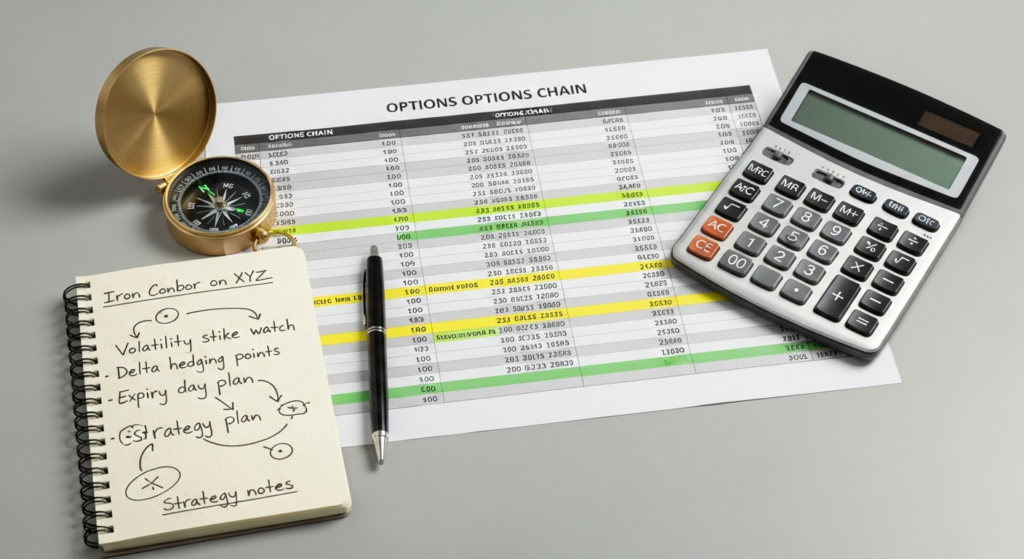
- Options Chain: A clear, customizable options chain is vital for analyzing strike prices, expiration dates, premiums, open interest, and implied volatility.
- Strategy Builders: Tools that help you construct multi-leg options strategies and visualize their profit/loss profiles.
- Analytics: Access to implied volatility charts, historical data, and “the Greeks.”
- Mobile App: A robust mobile app for on-the-go monitoring and trading.
- Educational Resources: Look for brokers offering extensive articles, tutorials, webinars, and courses specifically on options trading.
- Customer Support: Responsive and knowledgeable support is crucial, especially when dealing with complex options issues.
- Margin Requirements: Understand the margin requirements for various strategies, as these can impact your buying power and risk.
Recommended Brokerages for Options Traders:
- Interactive Brokers (IBKR): Widely regarded as a top choice for active and professional traders due to its low commissions (e.g., $0.65 per contract, tiered pricing can be lower), extensive range of products, advanced trading platforms (Trader Workstation – TWS), and powerful analytical tools. Their paper trading account is highly realistic. While powerful, TWS can have a steep learning curve for absolute beginners.
- Charles Schwab (including former TD Ameritrade’s thinkorswim): Schwab’s acquisition of TD Ameritrade brought the industry-leading thinkorswim platform under its umbrella. Thinkorswim is renowned for its sophisticated charting, advanced options analysis tools, strategy builders, and excellent paper trading capabilities. Commissions are typically $0.65 per contract. It offers a balance of power and user-friendliness for serious options traders.
- tastytrade: Specifically designed for options and futures traders. tastytrade offers a highly intuitive platform focused on statistical probabilities and efficient order entry for options strategies. Their commission structure is competitive (e.g., $1.00 per contract to open, $0.00 to close, with a cap per leg). They also provide extensive free educational content geared towards active options trading.
- Fidelity: Known for its robust research, excellent customer service, and strong educational offerings. Fidelity’s platform has improved significantly for options traders, offering competitive commissions (e.g., $0.65 per contract) and solid analytical tools. It’s a good choice for those who value a comprehensive investment experience with reliable support.
- Robinhood: While popular for its commission-free options trading, Robinhood is generally not recommended for beginners in options due to its simplified interface which can sometimes obscure the true risks involved in complex options strategies. Its educational resources are less comprehensive compared to dedicated options brokers. While it removes per-contract fees, it may not offer the depth of analysis or risk management tools crucial for informed trading.
Before opening an account, compare features, test paper trading platforms, and read reviews to find the best fit for your specific needs and experience level.
Tax Implications of Options Trading
The tax treatment of options can be complex and depends on whether they are considered Section 1256 contracts, their holding period, and your overall trading activity. This is a general overview; always consult a qualified tax professional.
- Section 1256 Contracts: Many actively traded options (e.g., options on broad-based indices like the S&P 500) are classified as Section 1256 contracts. These receive a favorable 60/40 tax treatment: 60% of gains/losses are treated as long-term capital gains/losses, and 40% as short-term, regardless of the actual holding period. This can result in a lower overall tax burden for profitable traders.
- Non-Section 1256 Contracts: Options on individual stocks and ETFs are typically not Section 1256 contracts. Gains and losses are treated as short-term if held for one year or less, and long-term if held for more than one year, just like stocks. Short-term capital gains are taxed at your ordinary income tax rate, which is often higher than long-term capital gains rates.
- Wash Sale Rule: This rule applies to options just as it does to stocks. If you sell an option for a loss and buy a “substantially identical” option (or stock) within 30 days before or after the sale, the loss may be disallowed for tax purposes.
- Assignment/Exercise: If an option is exercised or assigned, the transaction’s cost basis and holding period implications can become intricate, affecting your tax liability.
Given the complexity, it is imperative to keep meticulous records of all options trades and consult a tax advisor experienced in derivatives to ensure compliance and optimize your tax strategy.
Frequently Asked Questions (FAQ) About Options Trading
- Q: What is the minimum capital required to start options trading?
- A: While you can buy a single options contract for as little as a few dollars, most brokers require a minimum balance, typically $2,000 to $25,000, to enable options trading, especially for selling options or more complex strategies. For pattern day trading rules, accounts must maintain at least $25,000. It’s advisable to start with at least $5,000 to $10,000 to allow for proper diversification and risk management, even for basic strategies.
- Q: Can I lose more than I invest in options?
- A: Yes, absolutely. While buying calls or puts limits your loss to the premium paid, selling “naked” (uncovered) options, particularly naked calls, carries theoretically unlimited risk. Even for seemingly safer strategies like cash-secured puts, if the underlying stock drops to zero, your loss can be substantial (strike price minus premium per share). Always understand the maximum potential loss of any strategy before entering a trade.
- Q: How do options expire? Do I have to exercise them?
- A: Most options are “American-style,” meaning they can be exercised at any time up to expiration. “European-style” options can only be exercised at expiration (common for index options). However, most retail traders do not exercise options. Instead, they typically close out their positions before expiration by selling long options or buying back short options. Options that are in-the-money at expiration are usually automatically exercised by the broker, while out-of-the-money options expire worthless.
- Q: Are options suitable for long-term investing?
- A: While some options strategies, like covered calls or long-term equity anticipatory options (LEAPS), can complement a long-term investment strategy, the vast majority of options contracts are short-to-medium term instruments. Their inherent time decay (Theta) makes them generally unsuitable for direct “buy and hold” investing over many years, unlike stocks or ETFs. Options are more geared towards active portfolio management, hedging, or generating income.
- Q: What is the most common mistake beginners make in options trading?
- A: The most common mistake is over-leveraging and failing to manage risk. Many beginners are attracted by the potential for high returns but underestimate the probability of loss and the speed at which options can lose value due to time decay and adverse price movements. Trading without a clear plan, inadequate position sizing, and neglecting stop-losses are frequent pitfalls. Starting with paper trading and a small, well-defined portion of capital is crucial.