The Ultimate Swing Trading Guide for Retail Investors: Maximizing Gains while Minimizing Costs
Swing trading has emerged as the premier strategy for the modern retail investor. Unlike day trading, which requires constant screen monitoring, or long-term “buy and hold” investing, which can leave capital stagnant during market rotations, swing trading offers a balanced middle ground. It allows participants to capture significant price “swings” over several days or weeks, leveraging market volatility to generate consistent returns. As we look toward the financial landscape of 2026, the barriers to entry have never been lower, yet the need for a disciplined, cost-effective approach has never been higher. This guide is designed to navigate the complexities of the market, focusing on technical precision and rigorous cost management. Whether you are balancing a full-time career or looking to optimize your personal portfolio, mastering the art of the swing trade is your gateway to professional-grade market participation without the institutional overhead.
What is Swing Trading? The Sweet Spot for the Modern Retail Trader
Swing trading is a speculative strategy where assets are held for anywhere from two days to several weeks to profit from expected price shifts. For the retail investor, this is often considered the “Goldilocks zone” of trading. It provides enough time for a market thesis to play out—allowing the “noise” of daily volatility to settle—while remaining active enough to compound gains faster than traditional indexing.
In the 2026 market environment, where algorithmic trading dominates the intraday movements, retail investors often find themselves at a disadvantage in the seconds-and-minutes timeframe. However, swing trading levels the playing field. By focusing on multi-day trends, retail traders can ignore the high-frequency “stop-hunting” that occurs during the market open and close. The goal is simple: identify an asset showing momentum, enter at a point of technical confluence, and exit once the move exhausted its primary impulse. This approach requires less time commitment than day trading, making it ideal for those who cannot watch tickers during business hours, yet it offers more agility than passive investing during periods of economic transition.
Building Your 2026 Swing Trading Toolkit: Essential Technical Indicators
To succeed in swing trading, you must move away from “gut feelings” and toward data-driven execution. Retail investors should focus on a lean set of indicators that provide clarity rather than confusion. Over-complicating a chart is a common pitfall; instead, master these four pillars:
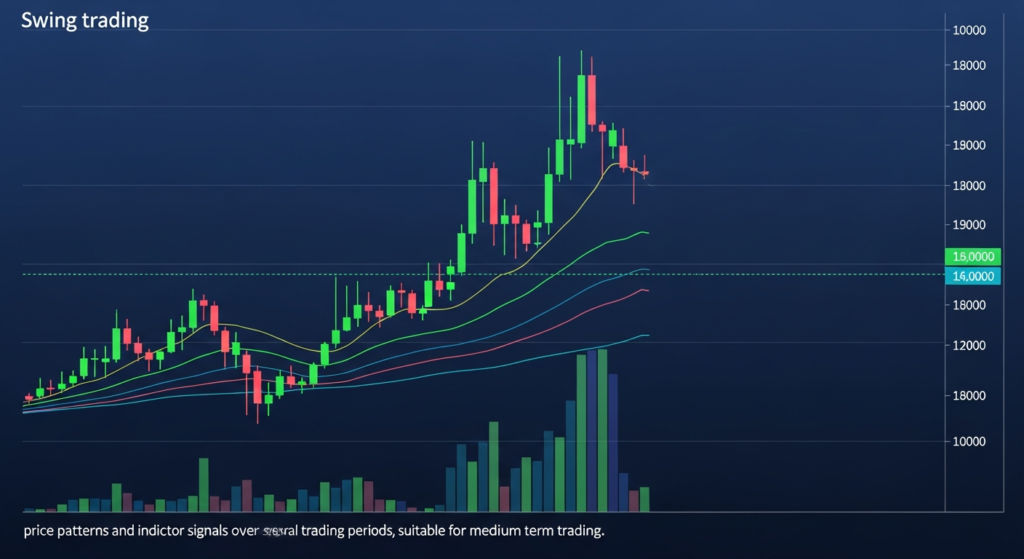
1. **Moving Averages (MA):** The 50-day and 200-day simple moving averages are the industry standards for identifying the primary trend. A “Golden Cross” (50-day crossing above the 200-day) often signals a long-term bullish swing. For shorter entries, the 10-day and 20-day exponential moving averages (EMA) act as dynamic support and resistance.
2. **Relative Strength Index (RSI):** This momentum oscillator measures the speed and change of price movements. In swing trading, look for “divergences”—when the price makes a new high but the RSI does not. This often signals that a swing is losing steam and a reversal is imminent.
3. **Volume Profiles:** Price movement without volume is often a “fake-out.” High volume on a breakout confirms institutional participation, suggesting the swing has the “legs” to continue for several days.
4. **Support and Resistance Levels:** These are the horizontal zones where the price has historically struggled to move above (resistance) or below (support). Successful swing traders buy near support and sell near resistance, rather than chasing a stock in the middle of a range.
By integrating these tools, you create a checklist. A trade should only be taken when multiple indicators “agree,” a concept known as confluence.
Cost-Efficiency: How to Minimize Fees, Slippage, and Taxes
For the retail investor, the greatest “alpha” (excess return) often comes from what you *don’t* spend. In a competitive market, high trading costs can quietly erode a profitable strategy. To maximize your net returns in 2026, you must be a “low-cost” operator.
First, prioritize zero-commission brokers, but look deeper than the “free” sticker. Many brokers profit from “Payment for Order Flow” (PFOF), which can result in worse execution prices (slippage). To combat this, use **Limit Orders** instead of Market Orders. A market order fills your trade at whatever price is available, often resulting in “slippage” where you pay a few cents more per share than intended. Over hundreds of trades, this adds up to thousands of dollars.
Second, consider the “bid-ask spread.” This is the difference between what a buyer is willing to pay and what a seller wants. Swing trade highly liquid stocks or ETFs (like the SPY or QQQ) where the spread is usually only a penny. Avoiding “thin” stocks prevents you from being trapped in a position where you have to take a loss just to get out.
Finally, be mindful of the tax implications. Swing trades are typically subject to short-term capital gains taxes, which are higher than long-term rates. To minimize this burden, consider trading within a tax-advantaged account like an IRA or 401(k) if your local regulations allow, or ensure your winners are large enough to comfortably cover the tax liability while still outperforming a passive benchmark.
Risk Management: Protecting Your Capital in Volatile Markets
The cardinal rule of swing trading is: “Live to fight another day.” You can have a 70% win rate and still go broke if your losses are significantly larger than your gains. Risk management is the mathematical shield that protects your portfolio.
The most effective tool is the **1% Rule**. Never risk more than 1% of your total account value on a single trade. For example, if you have a $50,000 account, you should not lose more than $500 if a trade goes wrong. Note that this doesn’t mean your *position size* is $500; it means the distance between your entry price and your **Stop-Loss** price, multiplied by the number of shares, should equal $500.
Stop-losses are non-negotiable. A stop-loss is a pre-set order that automatically sells your position if it hits a certain price, preventing a small mistake from becoming a portfolio-destroying catastrophe. In 2026’s volatile environment, placing your stop-loss just below a key support level or a moving average ensures that you exit the trade only when your “thesis” is proven wrong. Additionally, consider “Position Sizing” based on volatility. If a stock is highly volatile (high ATR – Average True Range), you should hold fewer shares to maintain the same 1% risk profile.
Step-by-Step: Executing Your First Swing Trade
Theory is useless without execution. Follow this workflow to find and manage your first swing trade:
* **Step 1: The Scan.** Use a stock screener to find companies making “New 52-Week Highs” or those with a “Relative Strength” higher than the S&P 500. You want to trade the leaders, not the laggards.
* **Step 2: The Setup.** Wait for a “pullback.” Do not buy a stock that has gone up five days in a row. Instead, wait for it to revert to its 20-day EMA or a previous resistance-turned-support level.
* **Step 3: The Entry.** Once the price touches support and shows a “bullish engulfing” candle or an uptick in volume, enter using a limit order.
* **Step 4: The Management.** Once the trade moves in your favor, move your stop-loss to the “break-even” point. This creates a “risk-free” trade.
* **Step 5: The Exit.** Don’t be greedy. Set a profit target, such as a 2:1 Reward-to-Risk ratio. If you are risking $500, aim for a $1,000 gain. When the price hits your target or the RSI enters “overbought” territory (above 70), exit the position and move to the next opportunity.
Advanced Strategies for 2026: AI-Assisted Scanning and Sector Rotation
As we navigate through 2026, technology has provided retail investors with tools previously reserved for hedge funds. Artificial Intelligence (AI) and machine learning scanners can now filter thousands of stocks in milliseconds, looking for specific chart patterns like “Cup and Handles” or “Head and Shoulders.” Utilizing these tools saves hours of manual charting and reduces the emotional fatigue of “hunting” for trades.
Furthermore, successful swing traders focus on **Sector Rotation**. Money in the market is like water; it flows from one sector to another. When interest rates are high, money might flow into Energy or Utilities. When the economy is booming, it flows into Technology and Consumer Discretionary. By using a “Top-Down” approach—analyzing the market, then the sector, then the individual stock—you ensure you are swimming with the current rather than against it. Using “Relative Strength” lines to see which sectors are outperforming the broader index allows you to focus your capital where the momentum is strongest, significantly increasing your probability of success.
FAQ: Common Questions for Retail Swing Traders
#
1. How much capital do I need to start swing trading?
While you can start with as little as $1,000, many experienced traders recommend $5,000 to $10,000. This allows for proper diversification and ensures that transaction costs (even small ones) and the “bid-ask spread” don’t consume too high a percentage of your capital.
#
2. Is swing trading better than day trading?
For most retail investors, yes. Day trading requires intense focus, high-speed internet, and sophisticated software. It is also subject to the “Pattern Day Trader” (PDT) rule in some jurisdictions, requiring a $25,000 minimum balance. Swing trading is more accessible, has lower stress levels, and allows for much larger percentage moves.
#
3. What are the best indicators for a beginner?
Start with the “Big Three”: Volume, the 50-day Moving Average, and the RSI. These three provide a complete picture of the trend, the institutional conviction, and the momentum without over-complicating your charts.
#
4. How do I handle a “gap down” against my position?
A “gap down” occurs when a stock opens significantly lower than it closed the previous day, often due to bad news or earnings. This can bypass your stop-loss. The best defense is diversification and avoiding holding concentrated positions through earnings reports. If a gap occurs, assess the new technical level; if support is broken, exit immediately to preserve capital.
#
5. How much time does swing trading take daily?
Once you have your “watch list” and automated alerts set up, swing trading should take no more than 30 to 60 minutes a day. Most of this time is spent reviewing your current positions and scanning for new setups after the market closes.
Conclusion: Consistency Over Perfection
Swing trading is not a “get rich quick” scheme; it is a skill that rewards patience, discipline, and meticulous record-keeping. As a retail investor in 2026, your greatest advantages are your ability to remain liquid, your lower overhead, and your access to institutional-grade information. By focusing on minimizing costs through limit orders and liquid assets, and protecting your downside with the 1% risk rule, you position yourself to thrive in any market condition.
The most successful traders are not those who never lose, but those who manage their losses so effectively that their winners inevitably pull the account balance higher. Start small, document every trade in a journal, and focus on the process rather than the profits. Over time, the “swings” of the market will become the waves you ride toward long-term financial independence. Keep your costs low, your stops tight, and your eyes on the data.