Navigating Futures and Forex Trading Costs
For those venturing beyond traditional stock and bond portfolios, exploring the dynamic realms of futures and forex trading can open doors to unique opportunities and challenges. These sophisticated financial instruments, central to advanced personal finance and investing, allow participants to speculate on asset price movements or currency fluctuations with the potential for amplified returns. However, the advanced nature and inherent leverage demand a rigorous understanding of market mechanics, risk management, and strategic execution. This comprehensive guide aims to demystify futures contracts and foreign exchange markets, providing aspiring traders with the foundational knowledge needed to navigate these exciting yet complex avenues of **futures and forex trading**.
In essence, futures contracts involve agreements to buy or sell an asset at a predetermined price on a future date, while foreign exchange (forex) trading centers on the simultaneous buying of one currency and selling of another. Both present distinct characteristics regarding market structure, regulation, and underlying assets, yet share commonalities in their use of leverage and the critical need for robust risk management. Understanding these markets is not merely about identifying potential profits, but also about mastering the tools and strategies that mitigate substantial financial exposure. This overview will serve as your pillar, guiding you through the intricacies and preparing you for a deeper dive into each specific area.
What are the Essentials of Futures and Forex Trading?
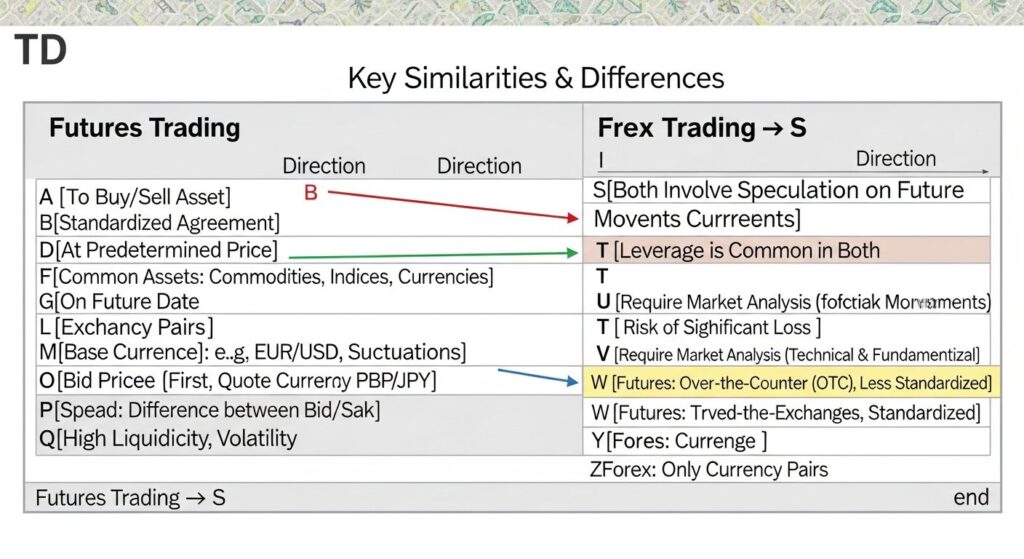
| Feature | Futures Trading | Forex Trading | Key Takeaway |
|---|---|---|---|
| **Underlying Assets** | Commodities (Oil, Gold), Stock Indices (S&P 500), Currencies, Interest Rates | Currency Pairs (EUR/USD, GBP/JPY) | Futures offer broader asset exposure; Forex is currency-specific. |
| **Market Structure** | Centralized, Exchange-Traded | Decentralized, Over-the-Counter (OTC) | Futures have transparent pricing; Forex relies on interbank market. |
| **Regulation** | Highly Regulated (CFTC, NFA in US) | Regulated by multiple national bodies (NFA, FCA, ASIC) | Both are regulated, but Forex regulation varies by jurisdiction. |
| **Leverage (Typical)** | Variable (often 1:10 to 1:50) | High (often 1:50 to 1:500+) | Forex typically offers higher leverage, amplifying risk/reward. |
| **Expiration** | Specific Contract Expiration Dates | No Expiration for Spot Trades | Futures require rollovers or closing positions; Forex is continuous. |
| **Liquidity** | High for Major Contracts | Extremely High for Major Pairs | Both are liquid, with Forex being the world’s largest market. |
| **Trading Hours** | Exchange-specific (e.g., 6 days a week for indices, nearly 24 hrs) | 24 hours a day, 5 days a week | Forex offers more continuous trading opportunities. |
What are Futures Contracts and How Do They Work?
Futures contracts are standardized legal agreements to buy or sell an asset at an agreed-upon price on a specified future date. These agreements are traded on regulated exchanges, providing a transparent and organized marketplace for price discovery and risk management. The “underlying asset” can be incredibly diverse, ranging from physical commodities like crude oil or gold, to financial instruments such as stock market indices (e.g., S&P 500 E-mini futures), currencies, and interest rates. Each contract is standardized in terms of its size, quality, and delivery specifications, making them fungible and highly liquid.
Participants in futures markets include hedgers, who use contracts to lock in prices and mitigate future risk, and speculators, who aim to profit from anticipating price movements. The contract size is crucial; for instance, a crude oil futures contract typically represents 1,000 barrels, and a small price move can have a significant impact on profit or loss. Furthermore, these contracts have distinct expiration dates, typically monthly or quarterly, meaning positions must be closed or “rolled over” to a new contract month before expiration. Margin requirements are another foundational aspect, as traders only need to deposit a fraction of the contract’s total value to control a much larger position, effectively utilizing leverage.
What are the Different Types of Futures Instruments?
Futures markets encompass a vast array of underlying assets, each with its own characteristics and trading hours. Financial futures, such as those based on stock indices like the Nasdaq 100 or S&P 500, are immensely popular for speculating on broader market movements. Currency futures allow for hedging or speculating on exchange rate fluctuations, while interest rate futures track the future direction of borrowing costs. Beyond financial instruments, commodity futures are perhaps the most historically significant, covering energy products (oil, natural gas), precious metals (gold, silver), agricultural goods (corn, wheat), and industrial metals. The diversity of these contracts provides ample opportunities for portfolio diversification or specialized speculation.
How Do Clearing Houses and Margin Work in Futures Trading?
A central clearing house sits between every buyer and seller in the futures market, guaranteeing the performance of each contract. This vital function eliminates counterparty risk, ensuring that trades are settled even if one party defaults. To manage this risk, clearing houses require traders to post an initial margin—a good-faith deposit that represents a small percentage of the contract’s total value. As prices fluctuate, the margin account is adjusted daily through a process called “marking to market.” If losses cause the margin account to fall below a certain maintenance margin level, a “margin call” is issued, requiring the trader to deposit additional funds to bring the account back to the initial margin level. Failure to meet a margin call can lead to the forced liquidation of positions.
What is Leverage and How are Futures Regulated?
Leverage is an intrinsic feature of futures trading, allowing participants to control large contract values with relatively small capital outlays. For example, controlling an S&P 500 E-mini contract worth over $200,000 with an initial margin of just a few thousand dollars demonstrates the powerful amplification of potential gains or losses. This amplification is a double-edged sword, necessitating stringent risk management. In the United States, futures markets are rigorously regulated by the Commodity Futures Trading Commission (CFTC) and the National Futures Association (NFA), ensuring fair practices, transparency, and consumer protection. These bodies oversee exchanges, brokers, and traders to maintain market integrity, making it a highly regulated segment of the financial industry.

What is the Forex Market and How Does it Operate?
The foreign exchange (forex or FX) market is the largest and most liquid financial market in the world, with trillions of dollars exchanged daily. It is a global, decentralized over-the-counter (OTC) market where currencies are traded around the clock, five days a week. Unlike futures, there isn’t a central exchange; instead, trading occurs directly between participants (banks, institutions, retail traders) via an electronic network. The primary objective of forex trading is to speculate on the relative strength of one currency against another, aiming to profit from fluctuations in exchange rates. Every forex trade involves a currency pair, such as EUR/USD, where you are simultaneously buying one currency (e.g., Euro) and selling another (e.g., US Dollar).
The vast liquidity of the forex market means that large trades can typically be executed without significantly impacting market prices, especially for major currency pairs. This high liquidity also contributes to tight bid/ask spreads, which are the differences between the buying and selling prices, representing a cost of trading. The 24/5 nature of the market, spanning major financial centers from Sydney to Tokyo, London, and New York, offers continuous trading opportunities, allowing participants to react to global economic news and geopolitical events as they unfold.
What are Major and Minor Currency Pairs?
Currency pairs are categorized based on their trading volume and liquidity. “Major pairs” involve the most frequently traded currencies against the US Dollar and account for the vast majority of daily turnover. These include EUR/USD (Euro/US Dollar), USD/JPY (US Dollar/Japanese Yen), GBP/USD (British Pound/US Dollar), AUD/USD (Australian Dollar/US Dollar), USD/CHF (US Dollar/Swiss Franc), USD/CAD (US Dollar/Canadian Dollar), and NZD/USD (New Zealand Dollar/US Dollar). “Minor pairs” (or cross-currency pairs) do not involve the US Dollar but are still highly liquid, such as EUR/GBP or AUD/JPY. “Exotic pairs” involve one major currency and one currency from a developing or emerging economy, characterized by lower liquidity and wider spreads, making them riskier for new traders.
How are Pips, Lots, and Spreads Defined in Forex?
Understanding the terminology is fundamental to currency exchange markets. A “pip” (point in percentage) is the smallest unit of price movement in a currency pair, typically the fourth decimal place for most pairs (e.g., a move from 1.1000 to 1.1001 for EUR/USD is one pip). For JPY pairs, it’s usually the second decimal place. The value of a pip depends on the currency pair and the “lot” size. A “lot” refers to a standardized unit of transaction size: a standard lot is 100,000 units of the base currency, a mini lot is 10,000 units, and a micro lot is 1,000 units. The “spread” is the difference between the bid (price at which you can sell) and ask (price at which you can buy) price, which is how brokers primarily make money. A tighter spread means lower transaction costs.
What is the OTC Nature and 24/5 Operation of Forex?
The decentralized, over-the-counter (OTC) nature of the forex market means that transactions occur directly between two parties, typically through a network of banks and brokers. There is no central clearing house like in futures. While this structure contributes to its unparalleled liquidity and 24/5 trading hours, it also implies that pricing can vary slightly between brokers. Regulatory oversight varies by jurisdiction, with bodies like the NFA and CFTC in the US, the Financial Conduct Authority (FCA) in the UK, and the Australian Securities and Investments Commission (ASIC) providing investor protection and ensuring fair practices among regulated brokers. The continuous operation allows traders to react instantly to market-moving news, but also requires disciplined management to avoid exhaustion and overtrading.
What are the Key Distinctions Between Futures and Forex Trading?
While both derivatives trading and currency exchange markets involve speculation and leverage, their underlying structures, regulatory frameworks, and asset classes present significant differences that traders must understand. Futures contracts are characterized by their exchange-traded, centralized nature, offering standardized contracts and guaranteed clearing. This provides a high degree of transparency and reduced counterparty risk. Foreign exchange, on the other hand, operates as a decentralized, over-the-counter market, with trades executed directly between participants. This difference in market structure impacts pricing, liquidity aggregation, and regulatory oversight.
Beyond market structure, the assets traded differ fundamentally. Futures provide exposure to a vast range of asset classes, from commodities and stock indices to currencies and interest rates, often with defined expiration dates. This allows for diverse speculative and hedging opportunities across various sectors. Foreign exchange trading is exclusively focused on currency pairs, with spot forex having no expiration, allowing positions to be held indefinitely (though subject to rollover costs). These distinctions are critical for determining which market aligns best with a trader’s capital, risk tolerance, and strategic objectives.
How Do Market Structure and Regulation Differ?
The market structure is perhaps the most defining difference. Futures markets, operating on regulated exchanges like the Chicago Mercantile Exchange (CME), provide a central order book where all bids and offers are visible. This transparency ensures that all participants have access to the same pricing information and that the clearing house guarantees settlement. The Commodity Futures Trading Commission (CFTC) and National Futures Association (NFA) in the US provide strict regulatory oversight, mandating specific rules for reporting, risk management, and client fund segregation.
In contrast, the decentralized nature of the currency exchange market means there is no single central exchange. Instead, a global network of banks, brokers, and other financial institutions facilitates trading. While major currency brokers are regulated by financial authorities in their respective jurisdictions (e.g., NFA/CFTC for US-based brokers, FCA in the UK, ASIC in Australia), the absence of a central clearing house means that counterparty risk, though mitigated by reputable brokers, is inherently present to a minor degree. The regulatory environment can also vary significantly from one country to another, impacting investor protections.
What are the Differences in Asset Classes and Expiration?
The breadth of tradable assets sets these markets apart. Futures offer a direct way to speculate on price movements of physical commodities (e.g., Brent Crude oil, Gold), financial instruments (e.g., E-mini S&P 500 futures, US Treasury bond futures), and even specific economic sectors. Each futures contract has a defined expiration date, requiring traders to either close their position or roll it over to a later contract month, incurring additional transaction costs. This finite lifespan influences trading strategies, often favoring shorter to medium-term positions or those with specific hedging goals.
Forex trading, however, is exclusively about the exchange rates between different national currencies. While this may seem narrower, the interplay of global economics, central bank policies, and geopolitical events provides immense depth. Spot forex positions typically do not have an expiration date, allowing traders to hold positions for extended periods, though they are subject to “swap” or “rollover” fees/credits for positions held overnight. This continuous nature makes it appealing for longer-term trend following strategies or short-term day trading without the complexities of contract expiration.
How Do Leverage and Margin Approaches Differ?
While both types of markets are known for their use of leverage, the typical ratios and margin requirements can differ. Futures markets offer substantial leverage, but it’s generally more conservative than in the currency exchange market. For example, a futures contract on a major index might require initial margin equivalent to 3-10% of the contract value (e.g., 1:10 to 1:30 leverage). This allows significant control over large assets.
The currency exchange market, particularly through retail brokers, often provides much higher leverage ratios, sometimes ranging from 1:50 up to 1:500 or even higher, depending on the regulatory jurisdiction and the currency pair. This means a trader could control a $50,000 position with just $100 of their own capital. While enticing for amplifying potential returns, this extreme leverage also dramatically magnifies potential losses, making disciplined risk management paramount. Both markets operate on a margin system, but the impact of margin calls can be more abrupt and severe with higher leverage.
Futures vs. Forex: A Detailed Comparison

What are the Common Risks in Leveraged Trading and How Can They Be Mitigated?
Engaging in leveraged financial instruments presents a unique set of risks that must be thoroughly understood and meticulously managed. While the allure of magnified returns is strong, the potential for magnified losses is equally real. Without a robust risk management framework, even a few unfavorable trades can quickly deplete a trading account. The primary risks stem from the inherent volatility of financial markets, the amplifying effect of leverage, and the specific characteristics of centralized versus decentralized trading environments. Successful participation in these advanced markets hinges not just on identifying opportunities, but more critically, on preserving capital through proactive risk mitigation.
How Do Leverage Amplification and Margin Calls Impact Traders?
Leverage is a double-edged sword. It allows traders to control positions much larger than their initial capital, significantly amplifying potential gains. However, it equally amplifies potential losses. A small adverse price movement, when leveraged, can translate into a substantial percentage loss on the invested capital. For instance, with 1:100 leverage, a mere 1% unfavorable move in the market translates to a 100% loss of the initial margin deposited for that trade. This extreme sensitivity makes margin calls a constant threat. A margin call occurs when a trader’s account equity falls below the maintenance margin level, requiring additional funds to be deposited immediately. Failure to meet a margin call can result in the forced liquidation of positions by the broker, often at unfavorable prices, crystallizing losses.
What are the Risks of Volatility and Market Gaps?
Both futures and currency exchange markets are characterized by periods of high volatility, especially around major economic data releases, central bank announcements, or geopolitical events. During such times, prices can move rapidly and unpredictably, making it difficult to exit trades at desired levels. This volatility can lead to “slippage,” where a stop-loss order (an order to close a trade at a specific price to limit losses) is executed at a worse price than intended due to the rapid market movement.
Another significant risk is “market gaps.” Gaps occur when the market opens at a significantly different price than where it closed, often after a weekend or a period of news. For instance, if a major central bank announcement causes a currency pair to open 200 pips lower than its Friday close, any stop-loss orders placed within that gap may not be triggered until the market opens at the gapped price, leading to much larger losses than anticipated. This risk is particularly pronounced in forex due to its 24/5 schedule and in futures after extended market closures.
How Does Counterparty Risk Affect Decentralized Markets?
While futures markets largely mitigate counterparty risk through centralized clearing houses, the decentralized, OTC nature of the forex market means that trades are executed directly between you and your broker. While highly regulated brokers provide robust protections, there is always an underlying, albeit small, risk associated with the solvency of the counterparty (the broker itself). Choosing a highly regulated and reputable broker from a well-established jurisdiction (e.g., US, UK, Australia) is crucial to minimize this risk. This means researching their regulatory licenses, financial stability, and client fund segregation policies. Furthermore, the E-E-A-T signals from your broker – Expertise, Experience, Authoritativeness, and Trustworthiness – are just as important as your own.
What are Effective Strategies for Speculative Market Participation?
Successful engagement in speculative markets requires more than just identifying promising assets; it demands a systematic approach encompassing analysis, planning, and disciplined execution. While there’s no single “holy grail” strategy, a combination of analytical techniques and robust risk management principles forms the bedrock of sustainable trading. Whether participating in futures or currency exchange markets, traders typically lean on either technical analysis, fundamental analysis, or a blend of both to inform their decisions. Beyond analysis, the psychological aspect of trading and the strict adherence to a pre-defined trading plan are equally critical for long-term success.
What is the Difference Between Technical and Fundamental Analysis?
**Technical analysis** involves studying past market data, primarily price and volume, to identify patterns and predict future price movements. Traders use various tools like chart patterns (head and shoulders, double tops/bottoms), indicators (moving averages, Relative Strength Index, MACD), and trend lines to determine entry and exit points. The core assumption is that all available information is already reflected in the price, and human psychology creates recurring patterns. For example, a technical trader might identify a strong support level in an S&P 500 E-mini futures chart, signaling a potential buying opportunity.
**Fundamental analysis**, conversely, focuses on evaluating the intrinsic value of an asset by examining economic, financial, and other qualitative and quantitative factors. In forex, this involves analyzing macroeconomic data like interest rates, inflation, GDP, employment figures, and central bank monetary policies, as well as geopolitical events, to forecast currency strength. For commodity futures, it might involve supply-demand dynamics, weather patterns, and global economic growth. A fundamental trader might anticipate a central bank interest rate hike, leading to a stronger national currency and a buying opportunity in a specific currency pair. Most successful traders blend both approaches, using fundamental analysis to identify long-term trends and technical analysis for precise timing of entries and exits.
How to Develop a Robust Risk Management Plan
A comprehensive risk management plan is non-negotiable for any trader venturing into leveraged markets. This plan dictates how much capital to risk per trade, where to place stop-loss orders, and how to manage open positions. A common guideline is to risk no more than 1-2% of total trading capital on any single trade. This means if you have a $10,000 account, you should aim to lose no more than $100-$200 on any given trade if it goes against you.
Key components include:
* **Position Sizing:** Calculating the appropriate contract or lot size based on your stop-loss distance and maximum risk per trade.
* **Stop-Loss Orders:** Mandatory orders placed at a specific price level to automatically close a losing trade, limiting potential downside.
* **Take-Profit Orders:** Orders to close a winning trade at a predetermined price, locking in gains.
* **Risk-Reward Ratio:** Aiming for trades where the potential profit is significantly greater than the potential loss (e.g., 2:1 or 3:1).
* **Emotional Discipline:** Adhering to the plan even when fear or greed tempts deviation.
What are Hedging Strategies in Trading?
Hedging involves taking positions in the market to offset potential losses from an existing position or a future exposure. For instance, a company anticipating a large payment in a foreign currency might buy currency futures or use options to lock in an exchange rate, mitigating the risk of adverse currency fluctuations. Similarly, a farmer might sell corn futures to lock in a price for their harvest, protecting against a future drop in corn prices. While hedging can reduce risk, it often comes at a cost (e.g., opportunity cost of limiting potential gains, or direct costs of futures contracts/options premiums). It’s a sophisticated application of these instruments primarily used by businesses or large investors with existing market exposure, rather than pure speculators.
What are Common Mistakes to Avoid in Advanced Trading?
The path to becoming a proficient trader in leveraged markets is often fraught with missteps. Recognizing and actively avoiding common pitfalls can significantly accelerate a trader’s learning curve and preserve precious capital. Many of these mistakes stem from a lack of discipline, insufficient preparation, or emotional interference, rather than purely analytical errors.
- **Over-leveraging:** Using excessive leverage that exposes a disproportionately large portion of capital to minor market fluctuations, leading to swift margin calls and account depletion.
- **Lack of a Trading Plan:** Entering trades without predefined entry/exit points, risk-reward ratios, and position sizing, resulting in impulsive and inconsistent decision-making.
- **Ignoring Risk Management:** Failing to use stop-loss orders, risking too much capital per trade, or not understanding the potential worst-case scenario.
- **Emotional Trading:** Allowing fear (e.g., cutting winning trades too short) or greed (e.g., holding losing trades for too long, overtrading) to override logical analysis and a disciplined trading plan.
- **Chasing the Market:** Entering trades late after a significant move has already occurred, often leading to buying tops or selling bottoms.
- **Lack of Education/Practice:** Jumping into live trading without a thorough understanding of market mechanics, analytical tools, or sufficient practice on a demo account.
- **Revenge Trading:** Trying to recoup losses by taking larger, riskier trades immediately after a losing streak, often leading to further losses.
- **Trading Unregulated Brokers:** Operating with brokers that lack proper regulatory oversight, exposing capital to unnecessary counterparty risk and potential fraud.
**What success looks like:** A disciplined trader carefully analyzes the EUR/USD pair, identifies a clear technical setup with confluence from fundamental news (e.g., strong EU economic data), enters with a 0.5 standard lot position, places a 30-pip stop-loss and a 90-pip take-profit (1:3 risk-reward). The trade moves in their favor, hitting the take-profit, resulting in a $450 profit on an initial risk of $150 (assuming $10/pip). This represents a controlled gain of 4.5% on a $10,000 account, with only 1.5% of capital at risk. This consistent, controlled approach, coupled with strong risk management, allows for steady account growth over time, even with occasional losses.
**What failure looks like:** An impulsive trader, reacting to a headline, buys Crude Oil futures without a clear plan, over-leveraging their $5,000 account with 5 contracts. They place no stop-loss. Suddenly, unexpected supply news hits, and the price drops rapidly. A 50-cent decline per barrel (typical contract multiplier of $10 per tick/point) means a $2,500 loss on their 5 contracts, effectively wiping out 50% of their account in a single, uncontrolled trade. They then engage in revenge trading, doubling down on another asset, only to incur further losses, quickly leading to account depletion and a margin call.
Is Advanced Derivatives and Currency Trading Right for You?
Deciding whether to engage in advanced derivatives and currency trading is a significant personal finance decision that requires honest self-assessment. These markets are not suitable for everyone, particularly those new to investing, with limited capital, or who cannot tolerate substantial risk. Before diving in, it’s imperative to consider your financial goals, risk appetite, available capital, and dedication to continuous learning. This is an arena for committed individuals willing to invest time in education, practice, and strict discipline. Approaching these markets without proper preparation is akin to sailing into a storm without a compass.
What are the Essential Prerequisites and Mindset for Advanced Trading?
Successful participation in these markets demands several key prerequisites. First, a **strong educational foundation** is paramount, covering market mechanics, technical and fundamental analysis, and most importantly, risk management. Second, **adequate starting capital** is essential. While leverage can amplify small accounts, it also magnifies the emotional impact of losses. Starting with capital you can afford to lose—money not needed for daily living expenses or other financial obligations—is crucial. Third, cultivate a **disciplined and patient mindset**. The ability to stick to a trading plan, manage emotions, and learn from mistakes is far more valuable than innate analytical brilliance. Overtrading, impulsive decisions, and emotional responses to market volatility are common pitfalls for the undisciplined.
How to Select a Regulated Broker for Futures and Forex Trading
Choosing a reputable and well-regulated broker is a foundational step in ensuring the safety of your funds and the integrity of your trading experience. For futures, ensure the broker is registered with relevant regulatory bodies like the CFTC and NFA in the US. For forex, look for brokers regulated by top-tier authorities such as the NFA/CFTC (US), FCA (UK), ASIC (Australia), or CySEC (Cyprus, for EU clients). These regulators impose strict rules on capital requirements, client fund segregation, and operational transparency. Avoid offshore, unregulated brokers promising unrealistic returns, as they often lack consumer protections and can pose significant risks to your capital. Research reviews, check regulatory licenses, and understand their fee structure (spreads, commissions, swap fees) before committing funds.
Why are Demo Accounts Important for Practice?
Before risking real capital, utilizing a demo or practice account is an indispensable step. Most reputable brokers offer free demo accounts that simulate live trading conditions with virtual money. This allows aspiring traders to:
- **Familiarize themselves** with the broker’s trading platform (e.g., MetaTrader 4/5, NinjaTrader).
- **Test and refine** trading strategies without financial risk.
- **Practice** risk management, including setting stop-loss and take-profit orders.
- **Experience** market volatility and emotional responses in a safe environment.
Treat a demo account as if it were real money. Developing good habits and discipline in a simulated environment will seamlessly translate to live trading. Many recommend practicing on a demo account for several months, achieving consistent profitability, before transitioning to a live account with real funds.
Sources & References
- Chicago Mercantile Exchange (CME Group). (2026). *Understanding Futures*. Retrieved from https://www.cmegroup.com/education/learn-about-trading/understanding-futures.html
- National Futures Association (NFA). (2026). *NFA Investor Information*. Retrieved from https://www.nfa.futures.org/investors/investor-education/index.html
- Financial Conduct Authority (FCA). (2026). *Forex and CFDs*. Retrieved from https://www.fca.org.uk/consumers/forex-cfds
- Hull, J. C. (2026). *Options, Futures, and Other Derivatives* (10th ed.). Pearson. https://www.amazon.com/Options-Futures-Other-Derivatives-10th/dp/0134472138
About the Author
Kaelen Silva, Financial Empowerment Coach — I help individuals navigate the complexities of financial markets and build lasting wealth through smart investing, disciplined trading, and practical money management.
Reviewed by David Chang, Senior Financial Editor — Last reviewed: April 06, 2026
Reviewed by David Chang, Senior Financial Editor — Last reviewed: April 06, 2026