Stock Market Investing for Beginners: Complete Guide 2026

TL;DR: The stock market is a system where buyers and sellers trade ownership stakes
stock market investing for beginners 2026
TL;DR: The stock market is a system where buyers and sellers trade ownership stakes in companies. Major U.S. exchanges include the NYSE (trades ~$22 billion/day) and NASDAQ (home to Apple, Microsoft, Amazon, and Alphabet). For beginners, the simplest strategy is buying a low-cost S&P 500 index fund — this beats 85-90% of active fund managers over 20-year periods.
Embarking on the journey of stock market investing can feel like stepping into a complex labyrinth, especially for those new to the world of finance. The terminology, the market fluctuations, and the sheer volume of information can be overwhelming. However, understanding the stock market is not only achievable but also a vital step towards securing your financial future. As we look towards 2026, the landscape of investing continues to evolve, presenting both new opportunities and familiar challenges. This comprehensive guide is designed to demystify stock market investing, providing beginners with the foundational knowledge, practical steps, and strategic insights needed to confidently navigate the market and build lasting wealth.

Understanding the Basics: What is the Stock Market?

Before you dive into buying your first share, it’s crucial to grasp what the stock market actually is and how it functions. At its core, the stock market is a collection of exchanges and other venues where buying, selling, and issuing of shares of publicly-held companies take place. It’s a marketplace where investors can buy and sell ownership stakes in companies.

What are Stocks?

A stock, also known as equity, represents a fractional ownership in a company. When you buy a company’s stock, you become a shareholder, meaning you own a tiny piece of that business. As an owner, you have a claim on a portion of the company’s assets and earnings. The value of your stock can increase (or decrease) based on the company’s performance, industry trends, economic conditions, and investor sentiment.

  • Common Stock: This is the most prevalent type of stock. It gives shareholders voting rights in corporate decisions and the potential for capital appreciation and dividends.
  • Preferred Stock: Typically does not carry voting rights but usually pays a fixed dividend and has a higher claim on assets and earnings than common stock if the company goes bankrupt.

How Do Stocks Make Money?

There are two primary ways investors make money from stocks:

  • Capital Appreciation: This occurs when the price of the stock increases from your purchase price, and you sell it for a profit. For example, if you buy a stock for $50 and sell it for $70, you’ve made a $20 profit per share.
  • Dividends: Some companies distribute a portion of their profits to shareholders in the form of dividends. These are typically paid quarterly and can be a significant source of income, especially for long-term investors.

Stock Exchanges and Market Indices

Stocks are bought and sold on stock exchanges. In the United States, the two largest and most well-known exchanges are the New York Stock Exchange (NYSE) and the NASDAQ. These exchanges provide the infrastructure for trading, ensuring transparency and efficiency.

Market indices, such as the S&P 500, Dow Jones Industrial Average (DJIA), and NASDAQ Composite, are benchmarks that track the performance of a specific group of stocks. They serve as barometers for the overall health and direction of the stock market or particular sectors. For example, the S&P 500 tracks 500 of the largest U.S. companies and is often considered a good indicator of the broader U.S. stock market’s performance.

Why Invest in the Stock Market for 2026 and Beyond?

Stock Market Investing For Beginners 2026

Investing in the stock market is one of the most powerful tools available for building long-term wealth. While it comes with inherent risks, the potential rewards far outweigh simply letting your money sit in a low-interest savings account. For beginners looking towards 2026, understanding the core benefits can provide the motivation to start.

Potential for Significant Growth

Historically, the stock market has outperformed most other asset classes over the long term. While past performance is not indicative of future results, the market’s ability to generate substantial returns through capital appreciation and dividends makes it a compelling option for wealth creation. Companies grow, innovate, and expand, and as they do, their stock values tend to increase, sharing that prosperity with shareholders.

Hedge Against Inflation

Inflation, the gradual increase in the price of goods and services over time, erodes the purchasing power of your money. If your money isn’t growing at a rate that beats inflation, you’re effectively losing money. Stocks, particularly those of strong, growing companies, have historically served as an effective hedge against inflation, as company earnings and asset values tend to rise with inflation, protecting and even growing your purchasing power.

The Power of Compounding

Perhaps the most magical aspect of investing is compounding. Compounding is the process where the earnings from your investments are reinvested, generating even more earnings. It’s earning returns on your returns. The earlier you start investing, the more time compounding has to work its magic, turning even modest initial investments into substantial sums over decades. This is why starting early, even with a small amount, is so often emphasized for beginners.

Accessibility and Liquidity

In 2026, investing in the stock market is more accessible than ever before. With online brokerages, fractional shares, and low-cost exchange-traded funds (ETFs), you no longer need a large sum of money to begin. Furthermore, stocks are generally considered liquid assets, meaning they can be easily bought and sold for cash on demand, though market conditions can affect the price you receive.

Diversification Opportunities

The stock market offers a vast array of investment opportunities across different industries, geographies, and company sizes. This allows investors to diversify their portfolios, spreading risk across various assets rather than putting all their eggs in one basket. Diversification is a critical strategy for managing risk and achieving more stable long-term returns.

Before You Invest: Essential Preparations for Beginners

💡 Pro Tip

Jumping into the stock market without proper preparation is akin to building a house without a foundation. For beginners eyeing 2026, a solid financial groundwork is paramount. This involves more than just having money; it’s about financial health and strategic planning.

Assess Your Current Financial Situation

Before you even think about buying a stock, take an honest look at your overall financial picture. Understand your income, expenses, assets, and liabilities. Create a budget to see where your money is going and identify areas where you can save more. A clear understanding of your cash flow is the first step towards successful investing.

Establish an Emergency Fund

This is non-negotiable. An emergency fund is a stash of readily accessible cash (typically in a high-yield savings account) that can cover 3-6 months of living expenses. This fund acts as a financial safety net, preventing you from having to sell investments at an inopportune time if an unexpected expense or job loss occurs. Investing should only begin once your emergency fund is adequately funded.

Eliminate High-Interest Debt

Carrying high-interest debt, such as credit card debt or personal loans, can severely hinder your ability to build wealth. The interest rates on these debts often far exceed the average returns you might expect from the stock market. Therefore, a critical step before investing is to aggressively pay down and eliminate these liabilities. For those wondering How To Get Out Credit Card Debt, strategies often include the snowball or avalanche method, consolidating debt, or negotiating with creditors. Freeing yourself from this burden will not only improve your credit score but also free up more capital for investing.

Define Your Investment Goals and Time Horizon

Why are you investing? Are you saving for retirement, a down payment on a house, your children’s education, or something else? Your goals will dictate your investment strategy, risk tolerance, and time horizon. A long-term goal (e.g., retirement in 30 years) allows for more aggressive investments, as you have time to recover from market downturns. Short-term goals (e.g., a down payment in 3 years) typically require a more conservative approach.

Understand Your Risk Tolerance

Risk tolerance is your psychological comfort level with the possibility of losing money. Are you comfortable with significant fluctuations in your portfolio’s value for the chance of higher returns, or do you prefer more stability, even if it means lower potential gains? There’s no right or wrong answer, but understanding your own risk tolerance is vital for choosing appropriate investments and avoiding panic selling during market volatility.

Getting Started: Practical Steps for Stock Market Investing in 2026

Stock Market Investing For Beginners 2026

With your financial foundation in place, it’s time to take the practical steps to begin investing in the stock market for 2026. The process has become incredibly streamlined, making it easier than ever for beginners to participate.

Choose a Brokerage Account

To buy and sell stocks, you’ll need a brokerage account. These accounts are offered by financial institutions that act as intermediaries between you and the stock exchanges. When selecting a brokerage, consider:

  • Fees: Look for brokerages with low (or zero) trading commissions. Many popular online brokers now offer commission-free trading for stocks and ETFs.
  • Investment Options: Ensure the brokerage offers the types of investments you’re interested in (stocks, ETFs, mutual funds, fractional shares).
  • Research Tools & Education: Beginner-friendly platforms often provide extensive research tools, educational resources, and user-friendly interfaces.
  • Customer Service: Good customer support can be invaluable when you’re starting out.
  • Account Minimums: Some brokers require a minimum deposit to open an account, though many now have no minimums, making it easier for beginners to start investing little money in 2026.

Select Your Investment Account Type

You’ll typically choose between a taxable brokerage account or a tax-advantaged retirement account.

  • Taxable Brokerage Account: A general investment account where gains are subject to capital gains tax. There are no contribution limits, offering flexibility.
  • Retirement Accounts (e.g., Roth IRA, Traditional IRA): These accounts offer significant tax benefits, such as tax-deferred growth or tax-free withdrawals in retirement. They have contribution limits and rules regarding withdrawals, but are excellent vehicles for long-term retirement savings. For beginners, a Roth IRA is often recommended if you expect to be in a higher tax bracket in retirement.

Fund Your Account

Once your account is open, you’ll need to transfer money into it. This can typically be done via electronic bank transfer (ACH), wire transfer, or by mailing a check. Remember to only invest money you won’t need for your emergency fund or for immediate expenses.

Start Investing Little Money in 2026

A common misconception is that you need a large sum of money to start investing. This is no longer true, especially looking at 2026’s market landscape. Many brokerages offer:

  • Fractional Shares: This allows you to buy a fraction of a share of expensive stocks for as little as $1. It’s a fantastic way to diversify and invest in high-quality companies without needing hundreds or thousands of dollars for a single share.
  • ETFs and Mutual Funds: These are baskets of investments (stocks, bonds, etc.) managed by professionals. They offer instant diversification and can be bought with relatively small amounts. Low-cost index ETFs or mutual funds are often recommended for beginners because they provide broad market exposure at minimal cost.
The key message for How To Start Investing Little Money 2026 is consistency. Setting up automatic, recurring investments (e.g., $50 or $100 per month) is far more effective than trying to time the market with large, infrequent contributions.

Building Your Portfolio: Strategies for Beginner Investors

Once you’ve opened and funded your account, the next step is to actually select investments and build your portfolio. For beginners, simplicity and a long-term perspective are key.

Embrace Diversification

Diversification is the most important concept for managing risk in your portfolio. It means spreading your investments across various assets, industries, and geographies to reduce the impact of any single investment performing poorly. A well-diversified portfolio might include:

  • Different Asset Classes: Primarily stocks for growth, but potentially bonds for stability as you get closer to your financial goals.
  • Different Industries: Don’t put all your money into tech, for example. Spread it across healthcare, consumer goods, finance, etc.
  • Different Company Sizes: A mix of large-cap, mid-cap, and small-cap companies.
  • Geographic Diversification: Don’t limit yourself to just the U.S. market; consider international stocks.

For beginners, investing in broad-market index funds or ETFs (like an S&P 500 index fund) is an excellent way to achieve instant, low-cost diversification without having to pick individual stocks.

Dollar-Cost Averaging

Dollar-cost averaging is an investment strategy where you invest a fixed amount of money at regular intervals, regardless of the market price. For example, investing $100 every month. When prices are high, your fixed amount buys fewer shares; when prices are low, it buys more shares. Over time, this strategy helps to average out your purchase price, reduces the risk of investing a lump sum at a market peak, and takes the emotion out of investing. It’s particularly effective for beginners who may be unsure when to buy.

Focus on Long-Term Growth

The stock market is not a get-rich-quick scheme. For beginners, it’s crucial to adopt a long-term mindset. Market fluctuations are normal, and short-term downturns can be unsettling. However, historically, the market has always recovered and continued its upward trend over extended periods. Resist the urge to constantly check your portfolio or make impulsive decisions based on daily news. Invest in quality assets and let compounding do its work over years, even decades.

Start with Low-Cost Index Funds or ETFs

As mentioned, these are ideal for beginners. They offer:

  • Instant Diversification: A single fund can hold hundreds or thousands of stocks.
  • Low Costs: Expense ratios (the annual fee charged by the fund) are typically very low for index funds.
  • Simplicity: You don’t need to research individual companies.
  • Strong Performance: Historically, most actively managed funds fail to beat their benchmark index over the long term.

Understand Risk and Return

There’s an inherent trade-off between risk and potential return. Generally, investments with higher potential returns also come with higher risk. As a beginner, it’s wise to start with a moderate risk level that aligns with your risk tolerance and gradually adjust as you gain experience and confidence. Never invest money you cannot afford to lose, and always remember that all investments carry some degree of risk.

Beyond Basics: Advanced Considerations for 2026 Investors

Once you’ve mastered the fundamentals, there are additional considerations that can refine your investment strategy as you look towards 2026 and beyond. These topics build upon the core principles and allow for a more nuanced approach to portfolio management.

Impact Investing and ESG Considerations for 2026

A growing trend in investing is the integration of Environmental, Social, and Governance (ESG) factors into investment decisions. Impact Investing ESG Guide 2026 highlights how investors are increasingly looking to align their financial goals with their values. This means investing in companies that demonstrate strong performance in areas like environmental sustainability, fair labor practices, ethical governance, and community engagement.

  • Environmental (E): Focuses on a company’s impact on the environment, including carbon emissions, waste management, resource depletion, and climate change policies.
  • Social (S): Examines a company’s relationships with its employees, suppliers, customers, and the communities where it operates. This includes labor standards, diversity, human rights, and consumer protection.
  • Governance (G): Deals with a company’s leadership, executive pay, audits, internal controls, and shareholder rights. Strong governance ensures transparency and accountability.

For beginners interested in making a positive impact with their investments, many brokerages now offer ESG-focused ETFs and mutual funds, making it easier to build a socially conscious portfolio. Researching a company’s ESG score or investing in funds that specifically screen for these criteria can be a powerful way to invest ethically while still pursuing financial returns.

Rebalancing Your Portfolio

Over time, the initial allocation of your portfolio (e.g., 80% stocks, 20% bonds) can drift due to varying asset performance. Rebalancing is the process of adjusting your portfolio back to your target asset allocation. If stocks have performed exceptionally well, they might now represent 90% of your portfolio. Rebalancing would involve selling some stocks and buying more bonds to bring it back to 80/20. This helps manage risk and ensures your portfolio remains aligned with your long-term goals and risk tolerance. Rebalancing is typically done annually or semi-annually.

Understanding Tax Implications

Taxes are an unavoidable part of investing. Understanding how your investments are taxed can significantly impact your net returns. Key concepts include:

  • Capital Gains Tax: Profits from selling investments are subject to capital gains tax. Short-term capital gains (assets held for one year or less) are taxed at your ordinary income tax rate, while long-term capital gains (assets held for more than one year) are taxed at preferential rates.
  • Dividend Tax: Dividends received from stocks are also taxable, though qualified dividends may be taxed at lower rates similar to long-term capital gains.
  • Tax-Advantaged Accounts: As discussed, accounts like IRAs and 401(k)s offer tax benefits that can help your investments grow more efficiently.

It’s always advisable to consult with a tax professional to understand your specific tax situation and optimize your investment strategy for tax efficiency, especially as your portfolio grows.

Staying Informed, Not Overwhelmed

While it’s important to stay informed about market trends, economic news, and global events that could impact your investments, it’s equally important not to get overwhelmed or make impulsive decisions based on every headline. Focus on credible sources, understand the underlying fundamentals of your investments, and stick to your long-term plan. Avoid the temptation to chase fads or react emotionally to short-term market volatility.

U.S. Stock Market Structure: NYSE, NASDAQ, and the Major Indices

Understanding the infrastructure of the stock market demystifies how trading actually works:

  • NYSE (New York Stock Exchange): Founded 1792, world’s largest stock exchange by market capitalization (~$26 trillion listed). Physical trading floor at 11 Wall Street. Lists blue-chip companies like JPMorgan Chase, Berkshire Hathaway, and Walmart. Governed by NYSE Regulation (subsidiary of Intercontinental Exchange / ICE).
  • NASDAQ (National Association of Securities Dealers Automated Quotations): Fully electronic exchange founded 1971. Home to the largest tech companies by market cap: Apple (AAPL), Microsoft (MSFT), Amazon (AMZN), Alphabet/Google (GOOGL), NVIDIA (NVDA), and Meta (META). NASDAQ Composite Index tracks all ~3,300 listed companies.
  • S&P 500 (Standard & Poor’s 500): Index tracking 500 largest U.S. publicly traded companies by market cap, maintained by S&P Dow Jones Indices. Covers ~80% of total U.S. equity market value. Managed by a committee using criteria including $14.5B minimum market cap (2026), 4 consecutive quarters of GAAP earnings, and float-adjusted market cap eligibility.
  • Dow Jones Industrial Average (DJIA): Price-weighted index tracking 30 large U.S. companies. Created by Charles Dow in 1896. Oldest U.S. market index still in operation. Less representative than the S&P 500 due to small sample size and price-weighting (a $400 stock moves the index more than a $40 stock regardless of market cap).
  • Russell 2000: Tracks 2,000 small-cap U.S. stocks (bottom 2,000 of the Russell 3000 Index). Key indicator of U.S. small-cap market health. Maintained by FTSE Russell.

Essential Stock Market Terms: Quick-Reference Glossary

Term Definition Why It Matters
Market Cap Share price × shares outstanding Indicates company size; large-cap (>$10B) = more stable
P/E Ratio Price ÷ earnings per share Valuation gauge; S&P 500 historical avg = 16-17x
Dividend Yield Annual dividends ÷ share price Income from holding; S&P 500 avg ~1.3% (2026)
Bull/Bear Market Bull: +20% from low; Bear: -20% from high Defines broad market trend direction
Bid-Ask Spread Difference between buyer’s max and seller’s min Hidden cost of trading; use limit orders to control
Expense Ratio Annual fund operating cost as % of assets Direct drag on returns; target <0.10% for index funds
52-Week High/Low Highest/lowest price over trailing year Context for current valuation vs recent range
Short Selling Borrowing shares to sell, hoping to buy lower Advanced strategy; unlimited loss potential — avoid as beginner

Common Pitfalls and How to Avoid Them

The path to successful investing is rarely a straight line. Many beginners fall prey to common mistakes that can derail their progress. Being aware of these pitfalls is the first step to avoiding them and building a resilient investment strategy for 2026.

Emotional Investing

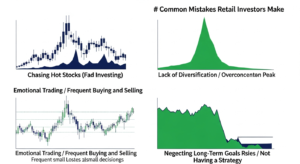
One of the biggest enemies of a successful investor is emotion. Fear and greed can lead to poor decisions. During market downturns, fear might prompt you to sell your investments at a loss, missing out on the inevitable recovery. Conversely, during bull markets, greed might lead you to chase “hot” stocks or take on excessive risk, only to suffer significant losses when the market corrects. Stick to your investment plan, rely on dollar-cost averaging, and remember that market volatility is a normal part of investing.

Chasing Fads and Hype

It’s tempting to jump on the bandwagon when a particular stock or sector is generating a lot of buzz. However, by the time a stock becomes a media sensation, much of its growth potential may already be priced in, and you could be buying at the peak. Focus on fundamental analysis, understand the businesses you’re investing in, and avoid speculative investments based purely on hype. Long-term success comes from sound, disciplined investing, not from trying to get rich quickly.

Lack of Diversification

As emphasized earlier, putting all your eggs in one basket is a recipe for disaster. If a significant portion of your portfolio is concentrated in a single stock or a few related assets, a downturn in that specific company or sector can wipe out a substantial portion of your wealth. Always ensure your portfolio is well-diversified across different asset classes, industries, and geographies to mitigate risk.

Ignoring Fees

While often seemingly small, investment fees can eat into your returns significantly over the long term. This includes brokerage commissions, expense ratios for mutual funds and ETFs, and advisory fees. For beginners, choosing low-cost index funds and brokerages with commission-free trading is crucial. Be vigilant about understanding all fees associated with your investments.

Not Having a Plan (or Not Sticking to It)

Investing without a clear plan is like embarking on a journey without a map. Before you invest, define your goals, risk tolerance, and time horizon. Once you have a plan, the discipline to stick to it through market ups and downs is equally important. Regularly review your plan (e.g., annually) to ensure it still aligns with your life circumstances, but avoid making frequent, reactive changes.

Trying to Time the Market

Predicting the short-term movements of the stock market is notoriously difficult, even for seasoned professionals. Many beginners attempt to buy low and sell high, but this often leads to buying after a significant rise and selling after a significant fall. Instead of trying to time the market, focus on “time in the market.” Consistent, long-term investing through strategies like dollar-cost averaging tends to yield better results than attempting to predict market swings.

Frequently Asked Questions

How much money do I need to start investing in the stock market in 2026?
You can start investing with surprisingly little money in 2026. Many online brokerages have no minimum deposit requirements, and with the availability of fractional shares, you can buy a portion of a stock for as little as $1. Investing in low-cost index ETFs or mutual funds also allows you to start with small, regular contributions, making it accessible for nearly everyone to begin building wealth.
Is the stock market safe for beginners?
The stock market inherently carries risk, meaning there’s always a possibility of losing money. However, for beginners with a long-term perspective (5+ years), investing in a diversified portfolio of low-cost index funds or ETFs is generally considered a prudent strategy. Historically, the stock market has always recovered from downturns and delivered positive returns over long periods. The key is to manage risk through diversification, invest money you don’t need immediately, and avoid emotional decisions.
What are the best stocks for beginners in 2026?
Instead of trying to pick individual “best stocks,” which requires significant research and carries higher risk, beginners are generally advised to start with broad-market index funds or Exchange Traded Funds (ETFs). These funds hold a basket of hundreds or even thousands of stocks (e.g., an S&P 500 index fund), providing instant diversification and exposure to the overall market’s growth without the need to research individual companies. As you gain experience, you might explore individual stocks, but always prioritize diversification.
How much time do I need to dedicate to managing my investments?
For beginners employing a long-term, passive investing strategy (like investing in index funds and dollar-cost averaging), the time commitment is minimal. Once your accounts are set up and automatic contributions are in place, you might only need to spend a few hours per year reviewing your portfolio, rebalancing if necessary, and ensuring your strategy still aligns with your goals. Active trading, conversely, requires significant time and research, which is generally not recommended for beginners.
How do taxes work with stock market investments?
Profits from selling investments (capital gains) and income from dividends are generally subject to taxes. The tax rate for capital gains depends on how long you held the investment (short-term vs. long-term). Tax-advantaged accounts like IRAs and 401(k)s offer benefits like tax-deferred growth or tax-free withdrawals in retirement. It’s crucial to keep good records of your trades and consult with a tax professional to understand your specific obligations and optimize your tax strategy.
Should I wait for a market crash to invest?
Trying to “time the market” by waiting for a crash is a strategy that rarely works, even for professional investors. It’s impossible to predict when a market crash will occur or how long it will last. Missing even a few of the market’s best performing days can significantly reduce your long-term returns. For beginners, a more effective strategy is “time in the market” through consistent, regular investments (dollar-cost averaging). This approach ensures you’re investing through various market conditions, averaging out your purchase price over time, and benefiting from the market’s long-term upward trend.