What Are ETFs and Why Are They Great for Beginners?
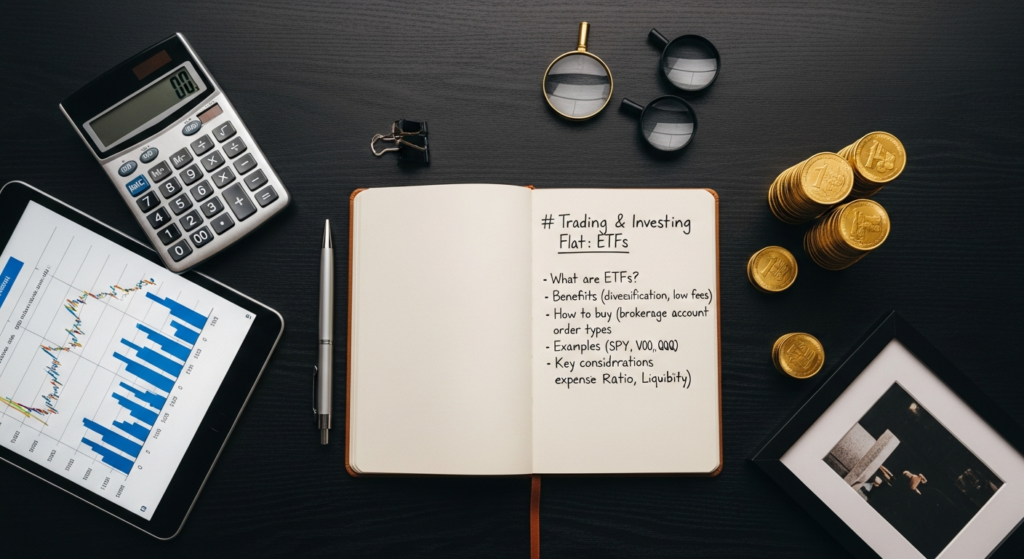
Before diving into the mechanics of investing, it’s crucial to understand what an ETF is and why these investment vehicles have become so popular, especially among new investors. An Exchange-Traded Fund (ETF) is essentially a basket of securities – like stocks, bonds, or commodities – that tracks an underlying index, sector, commodity, or other asset, but trades like a regular stock on an exchange. This unique structure combines the diversification benefits of mutual funds with the trading flexibility of individual stocks.
Understanding Exchange-Traded Funds (ETFs)
Imagine you want to invest in the entire U.S. stock market. Buying individual shares of every company in an index like the S&P 500 would be impractical and extremely expensive. An S&P 500 ETF, however, allows you to invest in all those companies with a single purchase. When you buy a share of an ETF, you’re buying a small piece of that diversified basket of assets. This core characteristic underpins many of their advantages:
- Diversification: ETFs inherently offer diversification because they hold multiple assets. This spreads your risk across various companies or asset classes, meaning if one stock performs poorly, its impact on your overall investment is mitigated by the performance of others.
- Low Costs: Generally, ETFs boast lower expense ratios (the annual fee charged as a percentage of your investment) compared to actively managed mutual funds. This is largely because most ETFs are passively managed, simply aiming to track an index rather than having fund managers constantly buying and selling to beat the market.
- Flexibility: Unlike mutual funds that trade only once a day after the market closes, ETFs can be bought and sold throughout the trading day at market prices, just like stocks. This provides greater liquidity and control over when you enter or exit positions.
- Transparency: Most ETFs disclose their holdings daily, giving investors a clear picture of what they own. This level of transparency is often higher than that of traditional mutual funds, which might only disclose holdings quarterly.
- Accessibility: ETFs have opened up investment opportunities that were once difficult for individual investors to access, such as specific sectors, international markets, or commodities, all within a single, easy-to-trade product.
Why ETFs are Ideal for New Investors
For someone just starting their investment journey, the prospect of navigating thousands of individual stocks, bonds, and other complex assets can be overwhelming. ETFs simplify this process significantly, making them an excellent starting point:
- Simplicity: Instead of analyzing individual company financials, a beginner can simply choose an ETF that tracks a broad market index, like the total U.S. stock market or a global bond index. This immediately provides exposure to a wide range of assets without requiring deep, specific company research.
- Cost-Effectiveness: The lower expense ratios mean more of your money stays invested and works for you over time. For beginners, who might be starting with smaller amounts, minimizing fees is crucial to maximize returns. Many brokers even offer commission-free ETF trading, further reducing costs.
- Risk Mitigation: The built-in diversification of ETFs helps reduce specific company risk. While all investments carry market risk, an ETF reduces the chances of a single bad investment devastating your portfolio, which is a common fear for new investors. This allows beginners to gain market exposure with a greater sense of security.
In essence, ETFs provide a powerful, efficient, and user-friendly way for beginners to get started in the world of investing, offering a balanced combination of growth potential, risk management, and affordability.
Before You Invest: Setting Your Financial Foundation
While the allure of market returns is strong, a solid financial foundation is paramount before you commit your hard-earned money to investments. Rushing into investing without proper preparation can undermine your financial security and force you to liquidate investments at inopportune times. This section will guide you through the essential steps to ensure you’re financially ready to begin investing in ETFs.
Assessing Your Financial Health
Think of your personal finances as the bedrock upon which your investment portfolio will be built. A shaky foundation puts everything at risk. Here’s what to prioritize:
- Build an Emergency Fund: This is non-negotiable. An emergency fund is a readily accessible pool of money, typically held in a high-yield savings account, sufficient to cover 3-6 months of essential living expenses. Its purpose is to act as a financial buffer against unexpected events like job loss, medical emergencies, or significant car repairs. Without it, an unforeseen expense could force you to sell your ETF investments prematurely, potentially at a loss.
- Tackle High-Interest Debt: Before you funnel money into investments, it’s often more financially prudent to pay down high-interest debt, such as credit card balances. The interest rates on credit cards can easily exceed the average annual returns you might expect from even a well-performing ETF portfolio. For instance, if your credit card charges 20% interest, paying that off guarantees a 20% return on your money – a return that’s hard to beat consistently in the market. We highly recommend reviewing resources like “How To Get Out Credit Card Debt” to develop a strategic plan for eliminating these liabilities. Reducing debt frees up cash flow and significantly lowers financial stress, making you a more confident investor.
- Define Your Financial Goals: What are you investing for? Retirement? A down payment on a house? Your child’s education? Each goal might have a different time horizon and require a different investment strategy. Clearly defined goals will help you choose appropriate ETFs and stay disciplined through market fluctuations.
Defining Your Investment Goals and Risk Tolerance
Once your financial house is in order, you need to align your investment strategy with your personal objectives and comfort level with risk.
- Long-Term vs. Short-Term: ETFs are generally best suited for long-term goals (5+ years). This allows your investments time to recover from market downturns and benefit from compounding returns. If you have short-term financial needs (e.g., saving for a vacation next year), traditional savings accounts or short-term CDs are usually more appropriate due to market volatility.
- Risk Appetite: How comfortable are you with the possibility of your investment value fluctuating, or even temporarily decreasing? Your risk tolerance is a deeply personal factor. A higher risk tolerance might lead you to ETFs with greater exposure to growth stocks or emerging markets, while a lower tolerance might steer you towards more conservative bond ETFs or broad market funds. Be honest with yourself; don’t take on more risk than you can comfortably stomach, as this can lead to impulsive decisions during market corrections.
Starting Small: “How To Start Investing Little Money 2026”
Many beginners are deterred by the misconception that you need a large sum of money to start investing. This couldn’t be further from the truth, especially with ETFs. Thanks to fractional share investing offered by many online brokers, you can often buy fractions of an ETF share with as little as $5 or $10. This makes it incredibly accessible to begin building your portfolio, even if you only have a small amount to contribute regularly.
For the aspiring investor in 2026, the emphasis on starting small and consistently is more relevant than ever. Regular, small contributions over time, through a strategy known as dollar-cost averaging (which we’ll discuss later), can be far more effective than trying to save up a large lump sum. This approach smooths out your purchase price over time and instills a valuable habit of consistent investing. Don’t wait for the perfect moment or a large windfall; the best time to start investing is often now, even if it’s with a modest amount.
Choosing the Right ETFs: A Step-by-Step Guide
Step 1: Understand Different Types of ETFs
ETFs are categorized by the assets they hold or the strategy they employ. Knowing these categories will help you align them with your investment goals and risk tolerance:
- Stock ETFs: These funds hold shares of various companies. They can be very broad, tracking an entire market index (e.g., S&P 500 ETFs, Total U.S. Stock Market ETFs), or more specific, focusing on particular sectors (e.g., technology ETFs, healthcare ETFs), company sizes (e.g., small-cap ETFs), or geographic regions (e.g., emerging markets ETFs). They offer potential for capital appreciation.
- Bond ETFs: Investing in a diversified portfolio of bonds, these ETFs are generally considered less volatile than stock ETFs and are often used for income generation and portfolio stability. They can hold government bonds, corporate bonds, municipal bonds, or a mix, with varying maturities and credit qualities.
- Commodity ETFs: These funds invest in physical commodities (like gold, silver, oil) or derivatives related to them. They can be used to diversify away from traditional stocks and bonds, and often serve as a hedge against inflation.
- Sector/Industry ETFs: These focus on specific industries (e.g., renewable energy, cybersecurity). While they offer targeted growth potential, they also carry higher risk due to lack of broad diversification.
- ESG ETFs: An increasingly popular category for the socially conscious investor, ESG (Environmental, Social, and Governance) ETFs focus on companies that meet specific criteria related to sustainability, ethical practices, and corporate responsibility. If you’re looking to align your investments with your values, exploring an “Impact Investing Esg Guide 2026” can provide deeper insights into this growing segment of the market. These ETFs allow you to support companies that are making a positive impact while still aiming for financial returns.
- Geographic ETFs: These funds target specific countries or regions (e.g., Europe ETFs, China ETFs) allowing investors to gain exposure to international markets.
Step 2: Research and Due Diligence
Once you have a general idea of the types of ETFs that align with your goals, it’s time to dig into the specifics. Here are the key factors to evaluate:
- Expense Ratios: This is the annual fee charged by the ETF provider, expressed as a percentage of your investment. Lower expense ratios are almost always better, especially for long-term investments, as fees can significantly erode returns over time. Even a difference of 0.1% can amount to thousands of dollars over decades. Many broad market ETFs have expense ratios well under 0.10%.
- Tracking Error: Since most ETFs aim to track an underlying index, tracking error measures how closely the ETF’s performance aligns with that index. A lower tracking error indicates a more efficient fund. While a perfect match is rare due to fees and operational costs, significant deviation can be a red flag.
- Liquidity: This refers to how easily you can buy or sell shares of the ETF without significantly impacting its price. Higher trading volume generally indicates better liquidity. For most major ETFs, this won’t be an issue, but for niche or smaller funds, it’s worth checking. A liquid ETF means you can enter and exit positions efficiently.
- Underlying Holdings: Always examine what the ETF actually holds. For a stock ETF, look at the top 10-20 holdings. Do they align with your understanding of the fund’s objective? Are you comfortable owning these companies? For bond ETFs, look at the credit quality and average maturity of the bonds.
- Fund Size: While not a strict rule, larger ETFs (in terms of assets under management) tend to be more stable and less likely to be closed down due to lack of investor interest.
Step 3: Consider Diversification and Asset Allocation
The goal isn’t just to pick good individual ETFs, but to build a cohesive portfolio. Diversification across different asset classes (stocks, bonds), geographies, and sectors is crucial. Asset allocation is the strategy of dividing your investment portfolio among different asset categories. Your ideal asset allocation will depend on your age, risk tolerance, and time horizon. A common strategy for younger investors might be a higher percentage in stock ETFs, gradually shifting towards more bond ETFs as retirement approaches.
Don’t put all your eggs in one basket. Instead of buying just one tech ETF, consider a broad market stock ETF, a bond ETF, and perhaps a small allocation to an international or ESG ETF to create a well-rounded portfolio. This balanced approach helps smooth out returns and protects against downturns in any single market segment.
How to Buy ETFs: Opening an Account and Placing Orders
Once you’ve done your research and identified the ETFs you want to invest in, the next step is to execute your trades. This involves choosing a brokerage, opening an account, and understanding how to place buy orders. The process is straightforward, but knowing the nuances will help you trade efficiently and effectively.
Step 1: Choose a Brokerage Account
To buy ETFs, you need a brokerage account. These are accounts specifically designed for holding investments. You have a few main options:
- Online Brokers: These are the most popular choice for beginners due to their low costs, user-friendly platforms, and extensive educational resources. Major players like Fidelity, Charles Schwab, Vanguard, E*TRADE, and TD Ameritrade (now part of Schwab) offer commission-free trading for most ETFs. They provide tools for research, portfolio tracking, and allow you to manage your investments independently. This option is ideal if you want to be hands-on with your investment decisions.
- Robo-Advisors: If you prefer a more hands-off approach, robo-advisors (e.g., Betterment, Wealthfront) can manage an ETF portfolio for you. You answer a questionnaire about your financial goals and risk tolerance, and the robo-advisor uses algorithms to build and manage a diversified portfolio of low-cost ETFs. They automatically rebalance your portfolio and often offer tax-loss harvesting. While they charge a small management fee (typically 0.25% – 0.50% of assets), this can be a great option for those who want professional management without the high costs of a traditional financial advisor.
When choosing a broker, consider factors like minimum deposit requirements, available ETFs, trading fees (especially if you plan to trade frequently, though most major ETFs are commission-free), research tools, customer service, and ease of use of their platform.
Step 2: Open and Fund Your Account
The account opening process is similar across most brokers:
- Application: You’ll typically fill out an online application providing personal information (name, address, Social Security number), employment details, and financial situation.
- Identity Verification: Brokers are legally required to verify your identity. This might involve uploading a photo of your ID or other documents.
- Account Funding: Once approved, you’ll need to fund your account. Common methods include:
- Electronic Funds Transfer (EFT): Linking your bank account allows you to transfer money electronically. This is usually the easiest and most common method.
- Wire Transfer: Faster for large sums but often incurs fees.
- Check Deposit: Mailing a check is another option, though slower.
- Account Transfer: If you have an existing investment account elsewhere, you can transfer assets directly to your new brokerage.
Be aware of any minimum funding requirements, though many brokers have eliminated these for standard accounts, making it easier for those looking for “How To Start Investing Little Money 2026” strategies.
Step 3: Placing Your First ETF Order
With your account funded, you’re ready to make your first purchase. Here’s what you need to know:
- Search for the ETF: Use the ETF’s ticker symbol (e.g., SPY for an S&P 500 ETF) or its full name to find it on your broker’s platform.
- Specify Order Type:
- Market Order: This instructs your broker to buy or sell the ETF immediately at the best available current market price. While simple, the price you get might be slightly different from what you saw seconds before, especially in fast-moving markets. For beginners, this is usually acceptable for highly liquid ETFs.
- Limit Order: This allows you to set a maximum price you’re willing to pay (for a buy order) or a minimum price you’re willing to accept (for a sell order). Your order will only execute if the ETF reaches that price or better. Limit orders provide more control over the execution price but there’s no guarantee the order will be filled if the price isn’t met. For beginners, sticking to market orders for broad, highly liquid ETFs is often sufficient.
- Enter Quantity: Specify how many shares you want to buy. If your broker offers fractional shares, you can enter a dollar amount (e.g., “$100 worth of XYZ ETF”) instead of a number of shares. This is incredibly useful for beginners who are “starting with little money.”
- Review and Confirm: Always double-check all the details of your order before confirming the trade.
Consider adopting a strategy called Dollar-Cost Averaging (DCA). This involves investing a fixed amount of money at regular intervals (e.g., $100 every month) regardless of the ETF’s price. When the price is high, your fixed amount buys fewer shares; when the price is low, it buys more. Over time, this strategy helps to average out your purchase price, reduces the impact of market volatility, and removes the emotional temptation to try and “time the market” – a strategy that even seasoned investors struggle with.
Managing Your ETF Investments: What Comes Next?
Investing in ETFs isn’t a “set it and forget it” endeavor, although it can be quite hands-off compared to individual stock picking. Once you’ve purchased your ETFs, ongoing management is necessary to ensure your portfolio remains aligned with your financial goals and risk tolerance. This involves periodic reviews, understanding dividends, and being aware of tax implications.
Monitoring and Rebalancing Your Portfolio
While you don’t need to check your portfolio daily, regular monitoring is crucial. We recommend reviewing your portfolio at least once or twice a year, or whenever there’s a significant change in your financial situation or market conditions. During these reviews, consider the following:
- Performance Check: How are your ETFs performing relative to their benchmarks and your expectations? Remember that short-term fluctuations are normal, but consistent underperformance might warrant investigation. Focus on the long-term trend.
- Goal Alignment: Are your current ETF holdings still helping you achieve your financial goals? For instance, if you’re approaching retirement, you might want to gradually shift from higher-risk stock ETFs to more stable bond ETFs.
- Rebalancing: Over time, the performance of different assets in your portfolio will cause your asset allocation to drift from your initial target. For example, if your stock ETFs perform exceptionally well, they might grow to represent a larger percentage of your portfolio than you originally intended, increasing your overall risk. Rebalancing involves selling some of the overperforming assets and buying more of the underperforming ones to bring your portfolio back to your desired allocation. This is a disciplined way to manage risk and maintain your desired portfolio structure. For beginners, rebalancing once a year is usually sufficient.
Resist the urge to panic during market downturns. Historically, markets have always recovered. Selling in a panic often locks in losses and causes you to miss out on subsequent recoveries. Stay disciplined and remember your long-term objectives.
Understanding Dividends and Reinvestment
Many ETFs, particularly stock and bond ETFs, pay out dividends or interest income to their shareholders. These payments are typically distributed quarterly or monthly, depending on the fund.
- Cash Payout: You can choose to receive these payments as cash, which will be deposited into your brokerage account.
- Dividend Reinvestment Plan (DRIP): Most brokers offer a DRIP option, where your dividends are automatically used to buy more shares (or fractional shares) of the same ETF. This is a highly recommended strategy for long-term investors, as it leverages the power of compounding. By reinvesting dividends, you acquire more shares over time, which then generate even more dividends, accelerating your wealth accumulation without any extra effort on your part.
Tax Implications of ETF Investing
Understanding the tax implications of your ETF investments is an important part of maximizing your returns. Tax rules can be complex and vary by jurisdiction, so it’s always advisable to consult with a tax professional, especially for the tax year 2026 and beyond, as regulations can change.
- Capital Gains Tax: When you sell an ETF for a profit, you incur a capital gain.
- Short-term capital gains: If you hold the ETF for one year or less, these gains are typically taxed at your ordinary income tax rate.
- Long-term capital gains: If you hold the ETF for more than one year, these gains are taxed at more favorable long-term capital gains rates, which are often significantly lower than ordinary income tax rates. This is another reason why a long-term investment horizon is beneficial.
- Dividend Income: Dividends received from ETFs are generally taxable in the year they are paid, even if you reinvest them.
- Qualified dividends: These are taxed at the lower long-term capital gains rates.
- Non-qualified (ordinary) dividends: These are taxed at your ordinary income tax rate.
- Tax-Advantaged Accounts: Consider investing in ETFs within tax-advantaged accounts like an Individual Retirement Account (IRA) or a 401(k).
- Traditional IRA/401(k): Contributions are often tax-deductible, and your investments grow tax-deferred until retirement, when withdrawals are taxed as ordinary income.
- Roth IRA/401(k): Contributions are made with after-tax dollars, but qualified withdrawals in retirement are completely tax-free.
These accounts provide significant tax benefits that can dramatically boost your long-term returns, making them an excellent choice for ETF investing, particularly for retirement savings.
Common Mistakes to Avoid for Beginner ETF Investors
The path to successful investing is often paved with learning from mistakes. While ETFs simplify many aspects of investing, beginners can still fall prey to common pitfalls. Being aware of these traps can help you navigate the market more effectively and protect your capital.
- Chasing Hot Trends: It’s tempting to jump into an ETF that has seen stellar returns recently, especially in niche sectors or emerging technologies. However, past performance is no guarantee of future results. By the time an ETF is “hot,” much of its potential growth may have already occurred. Chasing trends often leads to buying high and selling low. Stick to your long-term strategy and diversified core holdings rather than reacting to short-term market fads.
- Ignoring Expense Ratios: While many broad market ETFs have very low expense ratios, some specialized or actively managed ETFs can have significantly higher fees. A seemingly small difference of 0.5% or 1% in expense ratio can compound over decades to cost you tens of thousands of dollars in lost returns. Always check the expense ratio before investing; lower is almost always better for passive index-tracking ETFs.
- Over-Diversification or Under-Diversification:
- Under-diversification: Investing in only one or two ETFs, especially if they are highly correlated (e.g., two technology sector ETFs), exposes you to unnecessary risk. If that sector performs poorly, your entire portfolio suffers.
- Over-diversification: Paradoxically, owning too many ETFs (say, dozens) can also be a mistake. It complicates portfolio management, makes it harder to track performance, and can dilute your returns, essentially turning your highly diversified portfolio into an expensive version of a broad market index. A well-constructed portfolio often needs only 3-7 core ETFs to achieve broad diversification across asset classes and geographies.
- Panicking During Market Downturns: Market corrections and bear markets are an inevitable part of investing. For beginners, seeing their portfolio value drop significantly can be frightening, leading to the impulse to sell everything to stop further losses. This is often the worst thing you can do. Selling during a downturn locks in your losses and prevents you from participating in the eventual market recovery. Successful long-term investors understand that volatility is normal and use downturns as opportunities to buy more shares at lower prices (through dollar-cost averaging).
- Not Understanding Holdings: While ETFs provide diversification, it’s crucial to know what you’re actually investing in. Some ETFs might have significant exposure to a few large companies or specific types of bonds that you’re not comfortable with. Always review the top holdings and the fund’s objective to ensure it aligns with your expectations. Don’t invest in something you don’t understand, even if it’s an ETF.
- Trying to Time the Market: This is arguably the most common and costly mistake. Attempting to predict market highs and lows to buy at the bottom and sell at the top is exceedingly difficult, even for professional investors. A far more effective strategy for beginners is consistent investing over time through dollar-cost averaging, focusing on long-term growth rather than short-term market fluctuations. Time in the market generally beats timing the market.
By being mindful of these common pitfalls, beginner ETF investors can set themselves up for a more disciplined, less stressful, and ultimately more successful investment journey.
Frequently Asked Questions
Recommended Resources
Learn more about this topic in What Is A Roth Ira And Should You Open One at AssetBar.
Explore How To Increase Website Traffic 2026 for additional insights.
Major ETF Issuers & Representative Funds
| Issuer | ETF | Tracks | Expense Ratio |
|---|---|---|---|
| Vanguard | VTI | CRSP US Total Market Index | 0.03% |
| Vanguard | VOO | S&P 500 | 0.03% |
| State Street (SPDR) | SPY | S&P 500 | 0.0945% |
| BlackRock (iShares) | IVV | S&P 500 | 0.03% |
| Invesco | QQQ | NASDAQ-100 | 0.20% |
| BlackRock (iShares) | IWM | Russell 2000 (small-cap) | 0.19% |
The four dominant ETF issuers — Vanguard, BlackRock (iShares), State Street (SPDR), and Invesco — collectively manage trillions in assets under management (AUM). When comparing ETFs tracking the same index (e.g., SPY vs IVV vs VOO all tracking the S&P 500), always compare the expense ratio (also called Total Expense Ratio or TER) and the tracking error — the degree to which the fund’s returns deviate from its benchmark index.
How ETFs Actually Work: Key Mechanics
Unlike mutual funds, ETFs use a unique creation/redemption mechanism involving large institutional traders called Authorized Participants (APs). APs can exchange a basket of the underlying securities for new ETF shares (creation) or redeem ETF shares back for the underlying basket (redemption). This process keeps the ETF’s market price close to its Net Asset Value (NAV) — the fair value of underlying holdings per share.
- NAV / iNAV: Net Asset Value — the per-share value of the fund’s holdings, calculated at end-of-day. iNAV (indicative NAV) is the real-time estimated value published during trading hours.
- Bid-ask spread: The difference between the price buyers offer and sellers ask. More liquid ETFs (higher daily trading volume) have tighter spreads, meaning lower implicit trading costs. SPY, for example, typically has a bid-ask spread of just $0.01.
- Physical vs. Synthetic ETFs: Physical ETFs directly hold the underlying securities (e.g., actual S&P 500 stocks). Synthetic ETFs use derivatives (swaps) to replicate index performance without holding the securities — more common in certain international markets but carry counterparty risk.
- Tax efficiency: The creation/redemption mechanism means ETFs rarely distribute capital gains (unlike mutual funds), making them more tax-efficient in taxable brokerage accounts. The SEC requires ETFs to register under the Investment Company Act of 1940.
- Form 1099-B: When you sell ETF shares in a taxable account, your broker issues a 1099-B reporting the transaction to the IRS for capital gains tax purposes.
International & Bond ETFs: Completing the Portfolio
A well-diversified portfolio extends beyond US equities. Here are the key ETFs for international exposure and fixed income:
| Category | Ticker | Index / Focus | Expense Ratio |
|---|---|---|---|
| Intl. (ex-US) | VXUS | FTSE Global All Cap ex US | 0.07% |
| Intl. (Developed) | EFA | MSCI EAFE Index (Europe, Australasia, Far East) | 0.32% |
| Emerging Markets | VWO | FTSE Emerging Markets | 0.08% |
| Global (All World) | VT | FTSE Global All Cap (US + International) | 0.07% |
| US Aggregate Bond | BND | Bloomberg US Aggregate Bond Index | 0.03% |
| US Aggregate Bond | AGG | Bloomberg US Aggregate Bond Index (iShares) | 0.03% |
| Inflation-Protected | SCHP | Bloomberg US TIPS Index (Treasury Inflation-Protected Securities) | 0.03% |
Tax note: When you sell ETF shares in a taxable account, your broker issues a Form 1099-B (capital gains) and Form 1099-DIV (dividend income) for tax filing. Qualified dividends from stock ETFs are taxed at lower long-term capital gains rates; bond ETF interest income is typically taxed as ordinary income. For this reason, placing bond ETFs in tax-advantaged accounts (IRA, 401k) and keeping equity ETFs in taxable accounts (where they generate fewer taxable events) is a widely recommended asset location strategy. ETF screening tools like ETF.com and Morningstar provide free comparison of expense ratios, AUM, and tracking error across all major ETFs.
How are ETFs taxed differently from mutual funds?
ETFs are generally more tax-efficient than mutual funds due to their creation/redemption mechanism, which allows shares to be exchanged in-kind without triggering capital gains distributions. Traditional mutual funds must sell holdings to meet redemptions, which can trigger capital gains distributed to all shareholders — even those who didn’t sell. In taxable accounts, ETFs typically generate fewer annual capital gains distributions. When you sell ETF shares, you receive a Form 1099-B for capital gains. ETF dividends appear on Form 1099-DIV. Qualified dividends (from stocks held 60+ days) are taxed at lower capital gains rates (0%, 15%, or 20% depending on income).
How do I pick the first ETF to buy as a beginner?
For most beginners, start with a single broad-market US stock ETF: VTI (Vanguard Total Stock Market, 0.03%), VOO (Vanguard S&P 500, 0.03%), or SCHB (Schwab US Broad Market, 0.03%). These three give you exposure to hundreds or thousands of US companies at the lowest possible cost. Once you have your core US holding, consider adding an international ETF (VXUS, 0.07%) and a bond ETF (BND, 0.03%) to complete a classic three-fund portfolio. Prioritize the lowest expense ratio within each category — that single metric, compounded over decades, has more impact on your returns than almost any other factor.
What is an ETF’s tracking error and how does it affect returns?
Tracking error (also called tracking difference) is the gap between an ETF’s returns and the returns of the index it tracks. A perfectly efficient ETF would have 0% tracking error, but in practice fees, cash drag (uninvested dividends), sampling (not holding all index constituents), and securities lending offset each other. Most broad-market ETFs from Vanguard, BlackRock (iShares), and Schwab have tracking error under 0.05% annually — meaning they closely mirror their benchmark. High tracking error (above 0.2–0.3%) is a red flag, especially for index-tracking funds where the whole point is to replicate the index accurately. Check ETF.com or Morningstar for tracking difference data before investing.