The Beginner’s Guide to Thematic ETF Investing: Profiting from Tomorrow’s Trends
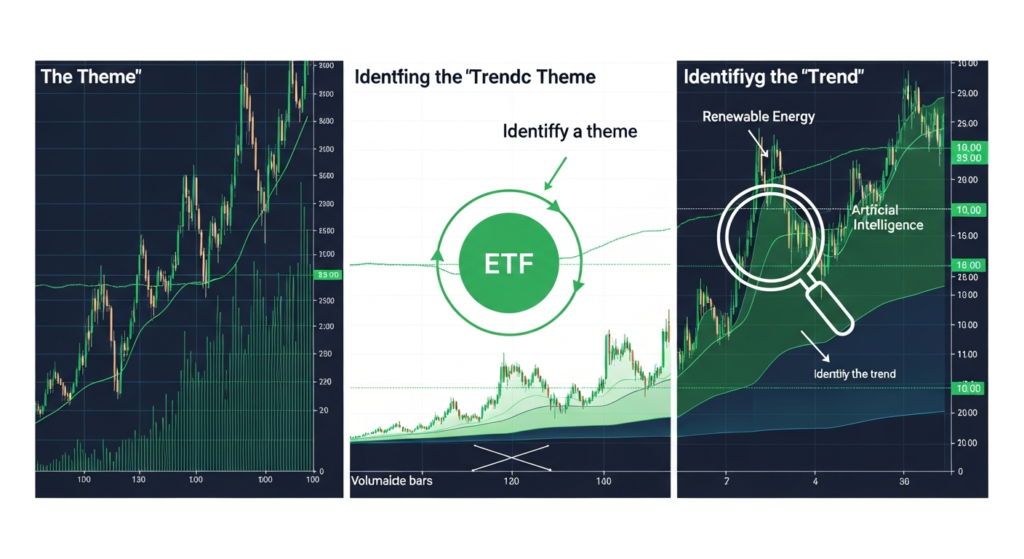
The investment landscape has shifted dramatically over the last decade. Gone are the days when retail investors were limited to picking individual stocks or settling for broad market index funds that track the S&P 500. Today, the rise of thematic ETF investing has opened a new door, allowing traders to put their capital behind the specific ideas, social shifts, and technological breakthroughs they believe will shape the future. Whether it is the expansion of artificial intelligence, the transition to renewable energy, or the breakthrough of genomic medicine, thematic ETFs provide a diversified way to bet on a “big idea.”
For the cost-conscious retail investor, the challenge lies in balancing the pursuit of high-growth trends with the necessity of keeping management fees low. Thematic investing is inherently more expensive than broad-market indexing, but with the right strategy, you can capture explosive growth without eroding your returns through excessive costs. This guide will walk you through the fundamentals of thematic ETF investing, how to identify sustainable trends for 2026, and how to build a portfolio that prioritizes long-term efficiency.
—
What is Thematic ETF Investing?
Thematic ETF investing is a strategy that focuses on identifying macro-level trends—long-term structural shifts in technology, society, or the environment—and investing in a basket of companies that stand to benefit from those shifts. Unlike traditional sector investing, which groups companies by their industry (such as “Financials” or “Utilities”), thematic investing cuts across sectors.
For example, a “Cybersecurity” theme doesn’t just include software companies; it might include hardware manufacturers, defense contractors, and specialized consulting firms. The goal is to capture the growth of an entire ecosystem rather than betting on a single winner. For retail investors, this provides a “one-click” solution to gain exposure to complex industries that would otherwise require hundreds of hours of individual stock research. By 2026, many of these themes are expected to move from the “emerging” phase into the “mainstream” phase, making the current window a critical time for strategic entry.
Identifying Sustainable “Mega-Trends” for 2026
The biggest mistake a beginner can make is confusing a “fad” with a “trend.” A fad is a short-lived burst of interest (like specific pandemic-era meme stocks), whereas a mega-trend is a structural shift that plays out over a decade or more. As we look toward 2026, several key themes are showing signs of sustained institutional backing and consumer adoption:
#
1. Artificial Intelligence and Automation
While AI has dominated headlines recently, the next phase—shifting from AI development to AI implementation—is where the real value lies. Investors are looking for ETFs that focus on the “picks and shovels” of the industry: semiconductor manufacturers, data center REITs, and enterprise software companies integrating generative AI into their workflows.
#
2. The Clean Energy Transition
The global push toward decarbonization is a multi-trillion-dollar transition. Thematic ETFs in this space often cover solar, wind, hydrogen, and lithium mining. By 2026, the focus is expected to shift toward smart-grid technology and long-term energy storage, which are essential for making renewable energy viable on a national scale.
#
3. Healthcare Innovation and Genomics
With an aging global population, the demand for advanced healthcare is skyrocketing. Thematic ETFs focusing on genomic sequencing, CRISPR technology, and personalized medicine allow investors to benefit from the convergence of biology and technology. This theme is less sensitive to economic cycles, providing a potential defensive growth element to a portfolio.
#
4. Cybersecurity and Digital Defense
As the world becomes more digitized, the “threat surface” for cyberattacks grows. Cybersecurity is no longer an optional expense for corporations; it is a mandatory part of their infrastructure. This theme offers high “revenue purity,” as companies in this space generally have recurring, subscription-based income.
The Benefits of Thematic Investing for Retail Traders
The primary appeal of thematic ETFs for retail traders is the democratization of professional-grade strategies. In the past, only hedge funds or institutional players had the resources to build a diversified portfolio around a niche concept like “The Space Economy” or “Robotics.”
#
Diversification Beyond the S&P 500
Standard index funds are often heavily weighted toward a few massive tech giants. If you own a total market fund, you already have significant exposure to Apple, Microsoft, and Amazon. Thematic ETFs allow you to tilt your portfolio toward smaller, specialized companies that may be the giants of 2026. This diversification helps mitigate the “concentration risk” inherent in modern cap-weighted indexes.
#
Emotional Alignment and Conviction
Many retail investors find it easier to stay invested during market volatility when they believe in the “story” behind their investments. It is easier to hold onto a “Clean Water” ETF during a downturn if you believe that water scarcity is a permanent global challenge that will eventually drive value. This conviction can prevent the panic-selling that often plagues beginner traders.
#
Accessibility and Liquidity
Unlike private equity or venture capital, thematic ETFs offer high liquidity. You can enter or exit a position in seconds during market hours. For a trader minimizing costs, this means you don’t have to worry about the lock-up periods or high entry minimums associated with traditional “alternative” investments.
Managing the Cost of Theme-Based Portfolios
One of the most significant hurdles in thematic investing is the **Expense Ratio**. While a standard S&P 500 ETF might charge 0.03% annually, a thematic ETF can charge anywhere from 0.45% to 0.75%. For a retail investor, these fees can compound over time and significantly eat into profits. To minimize costs, follow these guidelines:
#
Look for “Low-Cost” Leaders
As thematic investing has become more popular, competition among fund providers (like Vanguard, BlackRock, and State Street) has driven fees down. Always compare three or four ETFs within the same theme. You might find that one Cybersecurity ETF charges 0.60% while a newer competitor charges 0.35% for very similar holdings.
#
Evaluate “Theme Purity” vs. Cost
Sometimes a cheaper ETF is cheaper because it simply holds large-cap tech stocks that vaguely relate to the theme. For example, a “Cloud Computing” ETF that is 20% Microsoft and 10% Alphabet is essentially a high-fee tech fund. If you already own a broad tech fund, you are paying a premium for overlap. A more expensive fund with “purer” exposure to small and mid-cap specialists might actually provide better value despite the higher fee.
#
Watch the Bid-Ask Spread
For active traders, the management fee isn’t the only cost. Thematic ETFs often have lower trading volumes than major indexes. This leads to wider “bid-ask spreads”—the difference between the price you buy at and the price you sell at. To minimize these costs, always use **limit orders** rather than market orders when trading niche thematic funds.
How to Evaluate a Thematic ETF Before Buying
Before clicking the “buy” button, you must look under the hood. Not all thematic ETFs are created equal. Use these three criteria to vet your choices:
1. **Index Methodology:** How does the fund choose its stocks? Does it use AI to scan company filings for keywords, or is there an active management team selecting the companies? Active thematic funds are usually more expensive but may be better at weeding out companies that are “theme-washing” (pretending to be part of a trend to boost their stock price).
2. **Market Cap Weighting:** Most ETFs are market-cap weighted, meaning the biggest companies have the most influence. If you want exposure to disruptive innovation, look for “equal-weighted” thematic ETFs. These give smaller, more agile companies an equal voice in the fund’s performance.
3. **AUM and Longevity:** Assets Under Management (AUM) is a sign of stability. If an ETF has less than $50 million in assets, it is at risk of being closed by the provider. For a long-term 2026 horizon, look for funds with at least $100 million in AUM to ensure liquidity and institutional support.
Strategy: The Core-Satellite Approach
For retail investors looking to balance growth with cost-efficiency, the “Core-Satellite” strategy is often the most effective.
* **The Core (70-80%):** This is the foundation of your portfolio. It should consist of low-cost, broad-market ETFs (like a Total World Stock Market fund). These funds provide the “beta”—the general market return—at an ultra-low cost.
* **The Satellites (20-30%):** This is where thematic ETFs come in. You select 3 to 5 themes that you believe will outperform the general market over the next several years. By keeping thematic investments as “satellites,” you limit your exposure to the higher fees and higher volatility of these niche sectors.
By 2026, a successful core-satellite portfolio might have a core of global equities, with satellites in **Fintech, Infrastructure, and Biotech**. This allows you to capture the “alpha” (excess return) of these specific trends without risking your entire retirement on a single idea.
—
FAQ: Thematic ETF Investing
**1. How do thematic ETFs differ from sector ETFs?**
Sector ETFs follow the Global Industry Classification Standard (GICS), grouping companies by their primary business (e.g., Energy, Consumer Staples). Thematic ETFs ignore these boundaries and group companies by an idea (e.g., Robotics), which can include companies from the Tech, Industrial, and Healthcare sectors simultaneously.
**2. Are thematic ETFs better for short-term trading or long-term investing?**
While they can be traded short-term, thematic ETFs are designed for long-term structural shifts. Most themes take years to reach full profitability. Investors should generally look at a 3-to-5-year horizon, aiming toward 2026 and beyond, to see the theme’s thesis play out.
**3. What is “Theme Drift”?**
Theme drift occurs when an ETF begins holding companies that don’t strictly fit the theme, often to increase the fund’s stability or size. For example, a “Drone Technology” ETF that starts buying large amounts of Boeing or Lockheed Martin (traditional aerospace) may be experiencing drift.
**4. How many thematic ETFs should I own?**
For most retail investors, owning 3 to 5 thematic ETFs is sufficient. Owning more can lead to “over-diversification,” where your portfolio essentially begins to mimic the broad market but with much higher fees.
**5. Why are thematic ETFs more volatile than the S&P 500?**
Thematic funds often invest in growth-oriented, mid-cap companies. These stocks are more sensitive to interest rate changes and economic sentiment than the “Blue Chip” companies found in major indexes. Expect larger swings in both directions.
—
Conclusion
Thematic ETF investing offers a powerful way for retail investors to participate in the most exciting growth stories of the decade. By focusing on structural mega-trends like AI, cybersecurity, and clean energy, you can position your portfolio to benefit from the world of 2026. However, success in this space requires more than just picking a “cool” theme. It requires a disciplined approach to cost management, a critical eye toward fund holdings, and a robust strategy like the core-satellite model.
As the market continues to evolve, the ability to identify “purity” in a fund and avoid high-fee traps will separate the successful traders from the rest. Start small, do your homework on expense ratios, and remember that while themes provide the excitement, a low-cost, diversified foundation provides the security. By blending the two, you can navigate the complexities of the modern market with confidence.