
Pros and Cons of Mutual Funds: A 2026 Guide for Cost-Conscious Investors
As we navigate the financial landscape of 2026, the retail investment world has undergone a significant transformation. The era of high-commission brokerage accounts is largely behind us, replaced by a sophisticated ecosystem of low-cost platforms and digitized asset management. However, the fundamental vehicle for most retail portfolios remains the mutual fund. For the modern investor, the challenge is no longer just finding a way to access the market, but doing so while ruthlessly minimizing costs to protect long-term returns. Mutual funds offer a gateway to diversified markets, yet they carry structural nuances that can either accelerate or hinder your wealth-building journey. Whether you are a long-term “buy and hold” enthusiast or a strategic trader looking for stability, understanding the multifaceted nature of these instruments is essential. This guide breaks down the pros and cons of mutual funds, focusing specifically on how to navigate fees, management styles, and tax implications in today’s market.
Understanding Mutual Funds: The Foundation of Retail Portfolios
A mutual fund is a collective investment vehicle that pools money from many investors to purchase a diversified portfolio of stocks, bonds, or other securities. Each investor owns shares, which represent a portion of the holdings of the fund. In 2026, the industry has seen a massive shift toward “clean shares”—classes of mutual funds that strip out hidden marketing fees—making them more transparent than ever before.
For the retail investor, mutual funds serve as a bridge between individual stock picking (which carries high idiosyncratic risk) and institutional-level diversification. The fund is managed by a professional portfolio manager or, increasingly, by sophisticated algorithmic models designed to track specific benchmarks. The primary draw remains the same as it was decades ago: the ability to achieve broad market exposure with a single purchase. However, as the distinction between mutual funds and Exchange-Traded Funds (ETFs) continues to blur in terms of accessibility, understanding the specific mechanics of mutual funds—such as Net Asset Value (NAV) pricing and redemption structures—is vital for cost-sensitive traders.
The Advantages: Why Mutual Funds Still Dominate Diversification
The longevity of mutual funds in a competitive 2026 market is due to several inherent strengths that cater to the average retail investor’s needs.
#
1. Instant Diversification and Risk Mitigation
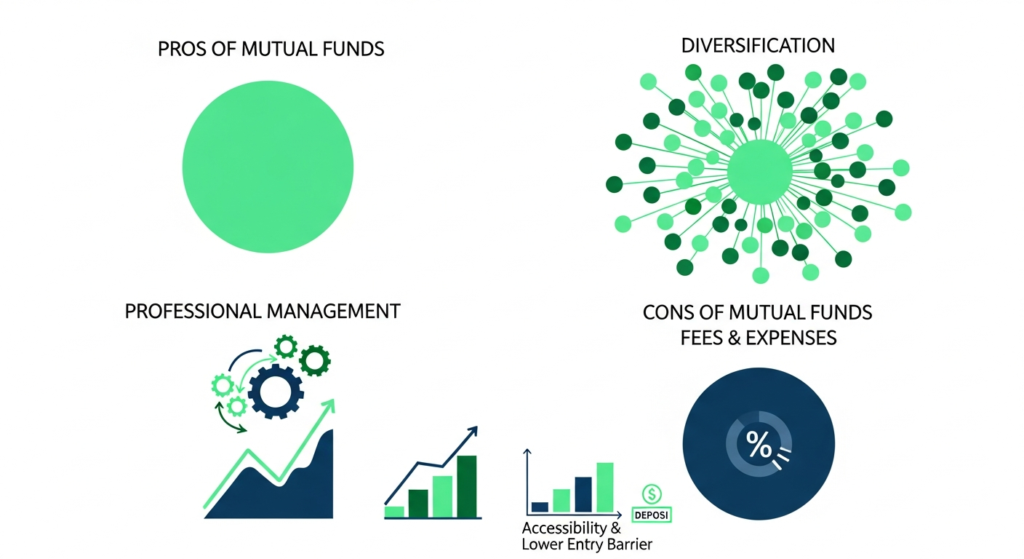
The most significant benefit of a mutual fund is diversification. For a relatively small investment, you can gain exposure to hundreds, or even thousands, of underlying assets. If you were to attempt to build a portfolio of 500 individual stocks, the transaction costs alone would significantly erode your capital. Mutual funds provide this “basket” approach instantly. This diversification helps mitigate “unsystematic risk”—the risk associated with a single company failing. While market risk always remains, the impact of a single bankruptcy in a 500-stock fund is negligible.
#
2. Professional Management and Systematic Strategy
Even with the rise of self-directed trading, there is value in professional oversight. Active mutual funds employ teams of analysts who scrutinize financial statements, macro trends, and geopolitical shifts. In 2026, many of these managers use advanced AI-driven sentiment analysis to fine-tune their holdings. For the retail investor who lacks the time to perform 40 hours of research a week, paying a small fee for this expertise can be a rational trade-off. Even passive index funds offer a form of “systematic” management, ensuring the portfolio is rebalanced to match its benchmark without the investor having to lift a finger.
#
3. Accessibility and Automated Investing
Mutual funds are built for the “set it and forget it” investor. Most fund families allow for automatic monthly contributions, often as low as $50 or $100 after the initial minimum is met. Unlike stocks or ETFs, where you typically must buy whole shares (unless using a fractional-share broker), mutual funds allow you to invest a specific dollar amount. This makes them the perfect tool for dollar-cost averaging, ensuring you buy more shares when prices are low and fewer when prices are high.
The Disadvantages: Potential Pitfalls for the Modern Trader
While the benefits are clear, the downsides of mutual funds often hide in the fine print. For the trader focused on minimizing costs, these disadvantages can represent a significant “drag” on performance.
#
1. Lack of Real-Time Liquidity
One of the most frustrating aspects of mutual funds for active traders is the way they are priced. Unlike stocks or ETFs, which trade throughout the day on an exchange, mutual funds are only priced once a day at the close of the market. This is known as the Net Asset Value (NAV). If you place an order to sell at 10:00 AM because of a sudden market drop, your trade won’t execute until the market closes at 4:00 PM. This delay can lead to “slippage,” where the price you receive is significantly different from the price you saw when you decided to sell.
#
2. The Impact of Fees and “Hidden” Costs
In 2026, while many fees have trended toward zero, some mutual funds still carry significant overhead. The “expense ratio” is the annual fee expressed as a percentage of your investment. A 1% fee might sound small, but over 30 years, it can eat away nearly a third of your potential portfolio value due to lost compounding. Additionally, some funds still charge “12b-1 fees” for marketing and distribution, which provide no value to the investor.
#
3. Tax Inefficiency
Mutual funds are famously less tax-efficient than ETFs. Due to their structure, when a fund manager sells a security within the fund for a profit, those capital gains must be distributed to the shareholders. This means you might owe taxes on capital gains even if you didn’t sell a single share of the mutual fund itself. For investors in high tax brackets holding funds in taxable brokerage accounts, this “tax drag” can be a major disadvantage.
Cost Analysis: Minimizing Fees in a High-Performance Market
For the retail investor in 2026, cost is the only factor you can truly control. High returns are never guaranteed, but low fees are. To maximize your net performance, you must understand the different layers of mutual fund costs.
#
Load vs. No-Load Funds
Historically, many funds charged a “load”—a sales commission paid to the broker who sold you the fund. Front-end loads are charged when you buy; back-end loads (contingent deferred sales charges) are charged when you sell. In the current market, there is almost no reason for a retail investor to pay a load. “No-load” funds are widely available and perform just as well, if not better, because more of your money starts working for you from day one.
#
Expense Ratios and the Race to Zero
The industry has seen a “race to the bottom” regarding expense ratios. Top-tier providers now offer index mutual funds with expense ratios as low as 0.015% or even 0.00%. For a cost-conscious trader, the target should always be an expense ratio below 0.20% for domestic equities and slightly higher for international or specialized bonds. Anything higher than 0.75% for an active fund should be scrutinized heavily to see if the manager’s “alpha” (outperformance) truly justifies the cost.
#
Turnover Costs
A hidden cost often overlooked is the portfolio turnover rate. When a manager frequently buys and sells stocks within the fund, the fund incurs transaction costs (bid-ask spreads and brokerage commissions). These costs are not included in the expense ratio but are reflected in the fund’s overall performance. High-turnover funds are generally less efficient for the retail investor.
Mutual Funds vs. ETFs: Which One Wins in 2026?
The debate between mutual funds and Exchange-Traded Funds (ETFs) has reached a fever pitch in 2026. While they share many similarities, the choice often comes down to your trading style and account type.
**ETFs are generally superior for:**
* **Taxable Accounts:** Their unique “in-kind” redemption process makes them much more tax-efficient.
* **Active Traders:** Because they trade like stocks, you can use limit orders, stop-losses, and buy/sell throughout the day.
* **Lower Initial Investment:** Most ETFs have no minimum investment beyond the price of a single share.
**Mutual Funds are generally superior for:**
* **401(k) and Retirement Plans:** Many employer-sponsored plans only offer mutual funds.
* **Automated Investing:** The ability to invest exact dollar amounts (e.g., exactly $200 every payday) is more seamless with mutual funds.
* **Lowering Behavioral Risk:** The lack of real-time pricing prevents investors from “panic selling” during a mid-day market dip, encouraging a long-term mindset.
For the cost-conscious retail investor, a hybrid approach is often best: using ETFs in taxable brokerage accounts for tax efficiency and low-cost index mutual funds in tax-advantaged accounts like IRAs or 401(k)s.
Strategy: How to Build a Low-Fee Mutual Fund Portfolio
Building a high-performing, low-cost portfolio in 2026 requires a disciplined approach. Follow these steps to ensure your strategy is optimized:
1. **Prioritize Index Funds:** Over long periods, the majority of active managers fail to beat their benchmark indices after fees. By choosing index funds, you ensure market-matching returns at the lowest possible price point.
2. **Screen for “Clean” Share Classes:** When looking at a fund, ensure you are buying the share class with the lowest expense ratio available to you. Many funds have “Institutional” or “Admiral” shares that offer lower fees for those with higher balances or those using specific platforms.
3. **Check for Transaction Fees:** Even if a fund is “no-load,” your brokerage platform might charge a transaction fee to buy or sell it. Focus on funds that are on your broker’s “No Transaction Fee” (NTF) list.
4. **Evaluate the Manager’s Tenure:** If you do choose an active fund, look for a manager with a consistent track record over at least 5-10 years. In 2026, ensure the fund’s strategy hasn’t been overly “commoditized” by AI, unless that is specifically what you are looking for.
5. **Watch the Cash Drag:** Some mutual funds keep a significant portion of their assets in cash to handle potential redemptions. This “cash drag” can hurt performance in a bull market. Check the fund’s prospectus to see their typical cash position.
FAQ: Common Questions for 2026 Investors
**1. What is the minimum investment for a mutual fund in 2026?**
While it varies by fund family, many popular low-cost providers have lowered their minimums to $1,000 or $3,000 for initial purchases. Some “digital-first” funds allow you to start with as little as $1. Once the minimum is met, subsequent investments can usually be any amount.
**2. Are mutual funds safer than individual stocks?**
Generally, yes, due to diversification. While the entire market can go down, a mutual fund protects you from the total loss that could occur if a single company goes bankrupt. However, “safety” is relative; a mutual fund focused on a volatile sector like “2026 Tech Startups” will be much riskier than a Total Bond Market fund.
**3. How do I know if I’m paying too much in fees?**
Check the “Expense Ratio” in the fund’s prospectus. For a standard S&P 500 index fund, you should not be paying more than 0.05% to 0.10%. If you are paying over 1.00%, you are likely in a high-cost active fund or a fund with hidden marketing fees.
**4. Can I lose money in a mutual fund?**
Yes. Mutual funds are not insured by the FDIC (unlike bank savings accounts). The value of the fund fluctuates with the value of the underlying securities. If the stocks or bonds in the fund drop in price, your share value will also drop.
**5. Why would I choose a mutual fund over an ETF?**
The primary reasons are the ease of automated, dollar-based investing and the psychological benefit of not seeing your portfolio value fluctuate every second of the trading day. Mutual funds are often the better choice for disciplined, long-term retirement savers who want to automate their wealth building.
Conclusion
Navigating the pros and cons of mutual funds in 2026 requires a balance between traditional wisdom and modern cost-efficiency. Mutual funds remain a powerful tool for retail investors, offering unparalleled ease of diversification and the ability to automate financial growth. However, the rise of lower-cost alternatives and the persistent “tax drag” of the mutual fund structure mean that investors must be more discerning than ever.
To succeed, focus on minimizing what you pay and maximizing your time in the market. By choosing no-load, low-expense index funds and being mindful of the differences between mutual funds and ETFs, you can build a robust portfolio that stands the test of time. In an era where technology has democratized access to the markets, the ultimate “edge” for a retail investor is not a secret tip or a high-speed algorithm—it is the discipline to keep costs low and stay the course.